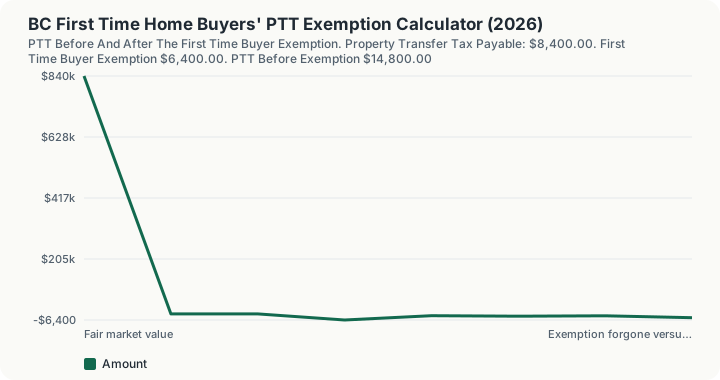
Quick Answer: On an $840,000 purchase by a qualifying first time buyer, British Columbia's Property Transfer Tax comes to $8,400.00. The full rate ladder produces $14,800.00 of tax, and the First Time Home Buyers' exemption knocks off $6,400.00 rather than the full $8,000.00, because $840,000 sits inside the $835,000 to $860,000 phase-out band where the exemption dies at 32 cents per dollar of price.
What does this calculator do?
British Columbia charges Property Transfer Tax (PTT) on the fair market value of property at registration. For a first time buyer the tax is reduced by the First Time Home Buyers' Program, and the shape of that reduction is far more consequential than most buyers realise.
Since 1 April 2024 the program has had three regions. A property worth $500,000 or less is fully exempt. Between $500,000 and $835,000 there is a flat $8,000 exemption. Between $835,000 and $860,000 that $8,000 is withdrawn in a straight line, reaching zero at $860,000. Above $860,000 there is nothing.
That middle-to-upper transition is the whole story of this page. The $8,000 exemption dies over a $25,000 window. Every extra dollar of purchase price in that window costs 32 cents of lost exemption, on top of the ordinary 2% PTT rate that applies there. The effective marginal tax on price between $835,000 and $860,000 is therefore 34%, and this calculator states it as such.
It is a bidding trap. A buyer who wins a competitive situation by pushing from $835,000 to $860,000 pays $25,000 more for the house and also surrenders the last $8,000 of exemption. There is no version of that trade in which the extra $25,000 buys $25,000 of value.
How is this calculated?
The general PTT is a marginal rate ladder applied to fair market value:
PTT_general = 1% × min(V, 200,000) + 2% × max(0, min(V, 2,000,000) − 200,000) + 3% × max(0, V − 2,000,000)
A separate additional surtax of 2% applies to the residential portion of fair market value above $3,000,000. The exemption is then subtracted:
E = full PTT, V ≤ 500,000; 8,000, 500,000 < V ≤ 835,000; 8,000 × (860,000 − V)/25,000, 835,000 < V < 860,000; 0, V ≥ 860,000
The steps the engine performs, in order:
Step 1: Take the fair market value. This is the registration-date value, normally the arm's-length purchase price.
Step 2: Apply the first rate band. 1% on the first $200,000.
Step 3: Apply the second rate band. 2% on value between $200,000 and $2,000,000.
Step 4: Apply the third rate band. 3% on value above $2,000,000.
Step 5: Add the additional surtax. 2% of the residential value above $3,000,000, which is zero for almost every first time buyer.
Step 6: Determine the exemption tier from the fair market value alone.
Step 7: Compute the exemption, capped at the general PTT actually owed.
Step 8: Subtract it from the gross PTT to get the net tax payable.
Worked Example
An $840,000 purchase, buyer qualifying, no surtax territory.
Step 1: Fair market value. $840,000
Step 2: First band, 1% on the first $200,000. $200,000 x 1% = $2,000
Step 3: Second band, 2% on the next $640,000. $840,000 - $200,000 = $640,000 $640,000 x 2% = $12,800
Step 4: Third band, 3% above $2,000,000. $840,000 is below the threshold, so this is $0
Step 5: Gross property transfer tax. $2,000 + $12,800 + $0 = $14,800
Step 6: Locate the exemption tier. $835,000 < $840,000 < $860,000, so the exemption is phasing out
Step 7: Compute the surviving exemption. $860,000 - $840,000 = $20,000 of headroom $20,000 / $25,000 = 0.80 $8,000 x 0.80 = $6,400
Step 8: Net property transfer tax payable. $14,800 - $6,400 = $8,400.00
Step 9: Compare against a purchase at $835,000. $200,000 x 1% = $2,000, plus $635,000 x 2% = $12,700, gross $14,700 $14,700 - $8,000 = $6,700 $8,400 - $6,700 = $1,700 of extra tax for $5,000 more house
Step 10: The exemption forgone. $8,000 - $6,400 = $1,600
The effective PTT rate on the price works out at exactly 1.00%, and the marginal rate on the next dollar of price is 34%: 32 cents of dying exemption plus the 2 cent PTT band.
What does this calculator not account for?
- The additional 20% foreign buyer tax on residential property in specified areas of BC is not modelled. Nor is it relevant to buyers who qualify for the first time buyer program, since that program requires citizenship or permanent residence.
- The Newly Built Home Exemption is a separate relief with its own thresholds and is not calculated here. A buyer of a new build may do better under it than under the first time buyer program.
- Eligibility is assumed, not tested. The calculator takes your answer to the qualification question at face value. It does not check citizenship, the twelve-month BC residence or two-tax-return alternative, prior ownership anywhere in the world, or the occupancy and holding conditions that must be satisfied after registration.
- Partial-interest and mixed-use purchases are not handled. Where only some buyers qualify, or the property is part commercial, the exemption is apportioned in ways this page does not model.
- The additional 2% surtax is applied to the full fair market value above $3,000,000, on the assumption the property is wholly residential. A mixed-use property would carry a smaller surtax base.
- No other Canadian province is modelled here. Ontario and Toronto have their own separate calculators; Alberta and Saskatchewan levy registration fees rather than a percentage transfer tax.
What mistakes do people make with this?
Reading the $8,000 as a rebate you claim afterwards. In BC it is an exemption applied at registration through the property transfer tax return, not a cheque that arrives later. Your notary or lawyer claims it. If it is missed at registration, recovering it is a refund application, not an automatic correction.
Assuming the phase-out is gentle. A $25,000 band is not gentle. It is the steepest stretch of marginal tax most homebuyers will ever cross, and it is invisible in every listing.
Confusing $500,000 with the current threshold. The pre-April-2024 rule was a full exemption to $500,000 phasing out by $525,000. The full exemption ceiling is still $500,000, but above it there is now a flat $8,000 running all the way to $835,000. Advice written before April 2024 will tell you the exemption is gone at $525,000. It is not.
Forgetting that the exemption is capped at the tax owed. Below $500,000 the exemption is the whole general PTT, which at exactly $500,000 happens to equal $8,000. It never produces a refund.
Treating fair market value as the price. They are the same in an ordinary arm's-length sale. In a family transfer, a below-market sale or a transfer of a partial interest, they are not, and the tax follows value.
Frequently Asked Questions
What is the effective tax rate between $835,000 and $860,000?
Should I offer $860,000 or $835,000?
Does the exemption apply per person or per property?
Is a new build treated differently?
What happens if I sell within a year?
Sources
- British Columbia Ministry of Finance, First Time Home Buyers' Program: www2.gov.bc.ca/gov/content/taxes/property-taxes/property-transfer-tax/exemptions/first-time-home-buyers
- British Columbia Ministry of Finance, current exemption amount: www2.gov.bc.ca/gov/content/taxes/property-taxes/property-transfer-tax/exemptions/first-time-home-buyers/current-amount
Sourcing note. The three thresholds used here (the $500,000 full exemption ceiling, the flat $8,000 exemption above it, and the linear phase-out between $835,000 and $860,000, all effective 1 April 2024) come from gov.bc.ca's own pages, which also state the superseded pre-April-2024 rule, confirming these are the post-reform figures. If your purchase price sits close to a threshold, confirm against the pages above before relying on the result. The general rate ladder (1% / 2% / 3%, plus the additional 2% surtax on residential value above $3,000,000) is applied by the same primitive and has been unchanged for several years.