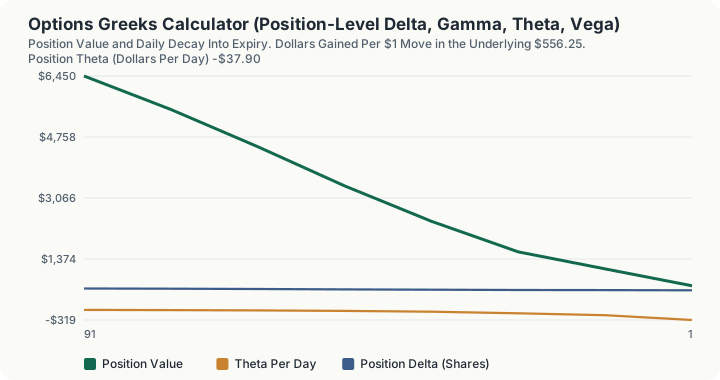
Quick Answer: At the default inputs (10 long at-the-money calls on a $100 underlying, $100 strike, 91 calendar days to expiry, 30% implied volatility, a 4% risk-free rate and no dividend) the position delta is 556.25 share-equivalents. The position cost $6,450 in premium, bleeds $37.90 a day to theta, gains $26.37 of delta for every $1 the underlying rises, and needs a daily move of $1.70 in either direction just for curvature to pay for one day of decay.
What does this calculator do?
Textbook greeks are quoted per share. Nobody trades a share of an option. A position is a signed number of contracts, each covering a block of shares, and every decision the greeks are actually used for is stated in position dollars: how many shares to short to be flat, what the book loses overnight if nothing happens, how far the underlying has to travel before owning the gamma was worth its carry.
This calculator takes the same Black-Scholes greeks a pricing page reports and scales them by contracts times the contract multiplier, keeping the sign. A negative contract count means you sold the option, and every figure flips with it: a short call carries negative delta and positive theta.
It then does two things scaling alone cannot. It runs your scenario through the greeks and through a full Black-Scholes reprice, and reports the gap between them. And it solves for the daily move at which gamma exactly offsets theta. The first tells you how far the greeks can be trusted. The second tells you whether the position is paying for itself.
How is this calculated?
The per-share greeks come from the Black-Scholes-Merton closed form with a continuous dividend yield. Theta is the annual figure divided by 365, so it is a per-calendar-day number. Vega is scaled per one volatility point, and rho per one percentage point of rate.
Δ_pos = Δ_share × contracts × multiplier
Every position greek is that same product. The scale factor is signed, so shorts carry through automatically.
Step 1: Price the option and read the per-share greeks. At $S=100$, $K=100$, $T = 91/365 = 0.2493$ years, σ = 0.30, $r = 0.04$, $q = 0$, the call is worth $6.45 per share, with delta 0.5563, gamma 0.02637, vega 0.1972, theta -$0.0379 per day and rho 0.1226.
Step 2: Build the position scale factor. 10 contracts x 100 shares = 1,000 share-equivalents
Step 3: Scale delta. 0.5563 x 1,000 = 556.25 share-equivalents
Step 4: Scale gamma. 0.02637 x 1,000 = 26.37 shares of delta gained per $1 rise
Step 5: Scale theta. -$0.0379 x 1,000 = -$37.90 per calendar day
Step 6: Scale vega and rho. 0.1972 x 1,000 = $197.21 per volatility point 0.1226 x 1,000 = $122.60 per 1% rate move
Step 7: Solve the delta hedge. The share trade that flattens delta is simply the negative of it: sell 556 shares short.
Step 8: Solve the gamma-theta breakeven move. A one-day profit and loss for a long option, holding volatility and rates fixed, is 1/2Γ(dS)² + Θ. Setting that to zero:
|dS| = √((−2Θ)/Γ)
√((2 × 37.90)/26.37) = √2.8745 = $1.70
The position scale appears in both the numerator and the denominator, so it cancels: the breakeven move is a property of the option, not of how many you own. As a share of the underlying that is 1.70%.
Step 9: Run the scenario through the greeks. The default scenario is a $5 rise, no volatility change, one day of decay. Delta term: 0.5563 x $5 x 1,000 = $2,781.26 Gamma term: 0.5 x 0.02637 x $5^2 x 1,000 = $329.59 Theta term: -$37.90 x 1 day = -$37.90 Vega term: $197.21 x 0 points = $0.00 Sum: $3,072.95
Step 10: Reprice the position exactly and take the residual. Black-Scholes is re-run at $S = 105$, σ unchanged, $T = 90/365$, and the new value is differenced against the old. Full reprice: $3,060.00 Residual: $3,060.00 - $3,072.95 = -$12.95
That residual is the honest measure of how far the greeks can be trusted. It grows roughly with the cube of the move, so it is noise on a quiet day and material on a gap.
Worked Example
You own 10 March 100 calls on a $100 stock, 91 days out, quoted at a 30% implied volatility.
Step 1: What you paid. $6.45 x 1,000 = $6,450
Step 2: What you control. $100 x 1,000 shares = $100,000 of notional
That is 15.5 times leverage on the premium, which is the entire attraction and the entire hazard.
Step 3: Your directional exposure. 556.25 share-equivalents. Owning these ten calls is, for small moves right now, like owning 556 shares of the stock. The position gains $556.25 for the first $1 the stock rises.
Step 4: How fast that exposure changes. If the stock rises $1, delta becomes 556.25 + 26.37 = 582.62. The hedge you set this morning is wrong by 26 shares by the time the stock has moved a point.
Step 5: What a quiet day costs. -$37.90. If nothing happens for a week, that is roughly -$265 of decay, before any change in implied volatility.
Step 6: The move that pays for the decay. $1.70, or 1.70% of the underlying. If this stock does not routinely move 1.7% in a day, owning the gamma is not paying its carry, whatever your view on direction.
Step 7: A five dollar rally. The greeks say $3,072.95. The reprice says $3,060.00. The greeks overstated the gain by $12.95, about four tenths of a percent of the move. Push the shock to a 20% gap and that error stops being a rounding difference.
Carrying the Position Down the Calendar
The schedule reprices the same ten calls at successive dates with the stock pinned at $100, so every difference below is time and nothing else.
Step 8: At 68 days, 23 days later. Position value $5,520, against $6,450 at the open: $930 of premium gone with the stock exactly where it started.
Step 9: What the decay rate has done to itself. Theta at 68 days is -$43.11 a day, against -$37.90 at 91 days. The bleed accelerates as the clock runs.
Step 10: At 27 days. Value $3,400, cumulative decay $3,050, theta now -$65.54 a day. Nearly half the premium is gone with 30% of the original time still on the clock.
Step 11: At one day. Value $630, cumulative decay $5,820, theta -$318.66 a day.
Nine tenths of the premium disappears without the stock moving a cent, and it disappears fastest at the end. Note also that position delta drifts from 556.25 shares down to 505.92 over the same stretch: an at-the-money call held to expiry does not keep the exposure you bought, so a delta hedge set in month one is wrong by month three even on a flat tape.
What does this calculator not account for?
- American early exercise. The pricing is European. The right to exercise early, which matters for in-the-money puts and for calls on a stock about to go ex-dividend, is not valued.
- Discrete dividends. Dividends enter as a smooth continuous yield, so nothing here models an ex-dividend date or the exercise decision around one.
- Volatility skew. The position carries a single implied volatility, so vega is a parallel-shift number. Real chains price different strikes at different volatilities and this calculator cannot see that.
- Financing and borrow. The delta hedge is reported as a share count only. Interest on the hedge, borrow cost on a short, and dividends paid away on that short are all outside the model.
- Pin risk, transaction costs and bid-ask spread. The premium is a model price, not a fill.
- Multi-leg positions. One strike, one expiry, one option type. A spread must be evaluated leg by leg and the position greeks added by hand.
- Any authority for your market inputs. Implied volatility, the risk-free rate and the dividend yield are yours. Nothing here sources them, and the defaults are illustrative round numbers, not a quote.
What mistakes do people make with this?
- Reading theta as a business-day number. The annual theta is divided by 365, not 252. A weekend costs three days of decay on this page, which is the convention that matches how the underlying calendar actually works.
- Confusing per-share and position figures. Delta per share is 0.5563; position delta is 556.25. The outputs label both, and mixing them by a factor of 1,000 is the most expensive arithmetic mistake available here.
- Treating the delta hedge as durable. The hedge is exactly right for an instant. Gamma is the rate at which it becomes wrong, and at 26.37 shares per point it becomes wrong quickly.
- Judging a long option by direction alone. A position can be right about direction and still lose money if the move is smaller than the gamma-theta breakeven. That is the single most common surprise in owning short-dated options.
- Trusting the greeks through a gap. The residual line exists because the Taylor expansion stops at second order and the option does not. On the default $5 move the error is $12.95; it scales roughly with the cube.
- Forgetting the sign on a short. A negative contract count flips every greek. Short gamma with positive theta means the breakeven move changes meaning entirely: it becomes the largest daily move the position can absorb before the short gamma costs more than the theta collected. The page states which case applies.
- Using a stale implied volatility. Vega here is $197.21 per point. A five-point volatility crush is a $986 loss with the stock unmoved, which is the classic post-earnings outcome.
Frequently Asked Questions
Why is position delta expressed in shares rather than as a decimal?
Is theta per calendar day or per trading day?
What does the gamma-theta breakeven move actually tell me?
Why do the greeks and the full reprice disagree?
What happens to all of this if I sell the options instead of buying them?
Where should I get the implied volatility figure?
Sources
- U.S. Securities and Exchange Commission, Investor.gov, the official authority for the investing this calculator relates to. investor.gov
Also consulted: Black, F., and Scholes, M., "The Pricing of Options and Corporate Liabilities," Journal of Political Economy, 1973. The closed-form pricing equation the greeks are differentiated from; Merton, R.C., "Theory of Rational Option Pricing," Bell Journal of Economics and Management Science, 1973. The continuous dividend yield extension used here; Hull, J.C., "Options, Futures, and Other Derivatives." Standard reference for the closed-form greek derivations and for the Taylor-expansion approximation of position profit and loss.