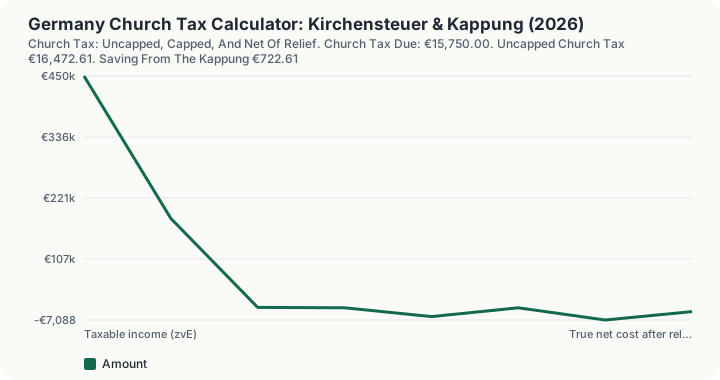
Quick Answer: €450,000 of zu versteuerndes Einkommen assessed singly in Nordrhein-Westfalen, with a 3.5% Kappungssatz, owes €15,750.00 of Kirchensteuer. The nominal 9% of the €183,029.00 income tax would have been €16,472.61, so the Kappung saves €722.61, and in NRW that cap is granted only on application. Because church tax is deductible as a Sonderausgabe, relief at the 45% marginal rate brings the true net cost down to €8,662.50.
What does this calculator do?
German church tax is levied as a percentage of your assessed Einkommensteuer, not of your income: 8% in Bayern and Baden-Württemberg, 9% in the other fourteen Länder. Because income tax is progressive, church tax computed that way is progressive too, and it keeps climbing indefinitely with income.
Most Landeskirchen and (Erz-)Bistümer therefore apply a Kappung: a cap that stops church tax following the income-tax curve upward and recomputes it instead as a flat percentage of the zu versteuerndes Einkommen, a different and much larger base.
Kirchensteuer = min(rate × Einkommensteuer, Kappungssatz × zvE)
Above a crossover income the cap binds, and church tax stops being a share of income tax and becomes a fixed share of taxable income instead. Two things about the Kappung cost people real money and are the reason this page exists separately from a general German income tax calculator.
First, Bayern has no Kappung at all. Its lower 8% rate is generous at ordinary incomes and becomes the worse deal only at extreme ones.
Second, in several Länder the cap is not applied automatically. It must be claimed. Missing that application is the single most common way a German high earner overpays Kirchensteuer.
How is this calculated?
Step 1: Check membership. Kirchensteuer is owed only by registered members of a tax-collecting religious body. If membership is off, everything below is zero.
Step 2: Compute the income tax on the zvE. The §32a EStG tariff, applying the Splitting tariff if the filing status is married. Ehegattensplitting halves the combined zvE, taxes the half and doubles the result, which lowers the income tax and therefore the church tax with it.
Step 3: Select the nominal church tax rate from the Bundesland. 8% for Bayern and Baden-Württemberg, 9% for the other fourteen.
Step 4: Compute the uncapped church tax. Income tax multiplied by that rate.
Step 5: Determine the Kappungssatz. For Bayern the calculator forces it to zero, because Bayern levies no cap. Elsewhere it is the rate you enter, bounded by the published 2.75% to 4% span.
Step 6: Compute the Kappung ceiling. The Kappungssatz applied to the zu versteuerndes Einkommen. Where the Kappungssatz is zero, there is no ceiling and the uncapped figure stands.
Step 7: Take the lower of the two. The cap applies only when the ceiling is genuinely below the uncapped figure. That is the Kirchensteuer due.
Step 8: Report what the cap saved. Uncapped church tax minus church tax due.
Step 9: Flag whether the cap must be claimed. If the cap binds and the Land is one where it is granted only on application, the calculator says so.
Step 10: Estimate the marginal income tax rate. Numerically: the income tax on the zvE, less the income tax on the zvE reduced by €1,000, divided by 1,000.
Step 11: Value the Sonderausgaben deduction. Church tax due multiplied by that marginal rate.
Step 12: Report the true net cost. Church tax due minus that relief.
Worked Example
A single filer in Nordrhein-Westfalen with €450,000 of zu versteuerndes Einkommen, whose church body applies a 3.5% Kappungssatz.
Step 1: Income tax under §32a EStG. €450,000 of zvE produces €183,029.00 of Einkommensteuer
Step 2: Nominal church tax rate. Nordrhein-Westfalen, so 9%
Step 3: Uncapped church tax. €183,029.00 x 9% = €16,472.61
Step 4: The Kappung ceiling. €450,000 x 3.5% = €15,750.00
Step 5: Which is lower? €15,750.00 < €16,472.61, so the cap binds
Step 6: Kirchensteuer due. €15,750.00
Step 7: Saving from the Kappung. €16,472.61 - €15,750.00 = €722.61
Step 8: Effective rate on income tax. €15,750.00 / €183,029.00 = 8.605%, below the nominal 9% precisely because the cap is binding
Step 9: Effective rate on taxable income. €15,750.00 / €450,000 = 3.50%, which is the Kappungssatz exactly. Once the cap binds, this figure stops rising however high the income goes.
Step 10: Marginal income tax rate. The tariff difference over the last €1,000 of zvE gives 45%
Step 11: Sonderausgaben relief. €15,750.00 x 45% = €7,087.50
Step 12: True net cost after relief. €15,750.00 - €7,087.50 = €8,662.50
And the procedural point that matters most: because Nordrhein-Westfalen is one of the Länder where the Kappung is granted on application rather than automatically, this taxpayer only gets the €722.61 if they ask for it. Setting the Kappungssatz to 0 in the calculator reproduces the position of someone who never filed that application: the full €16,472.61 falls due.
What does this calculator not account for?
- The Kappungssatz is an input, not a constant, because it varies by church body. It is not set by federal or even Land law. Each Landeskirche and each (Erz-)Bistum fixes its own in its Kirchensteuerbeschluss, so several Länder carry two different rates at once, one evangelical and one catholic. kirchenfinanzen.de confirms the 2.75% to 4% overall span and that the cap is granted "auf Antrag oder von Amts wegen", but publishes no per-Land table. We could not obtain the individual Kirchensteuerbeschlüsse, so the 3.5% default is a midpoint, not any church's actual rate. Confirm yours with your own Landeskirche or diocese.
- The list of Länder where the cap must be claimed is taken from kirchenfinanzen.de, and covers Baden-Württemberg, Hessen, Nordrhein-Westfalen, Rheinland-Pfalz and Saarland. Check it against your own church body's Beschluss.
- The Mindestbetrags-Kirchensteuer is not modelled. A few Landeskirchen levy a small floor amount, which this calculator does not apply.
- The besonderes Kirchgeld is not modelled. Where a church member is married to a non-member under Zusammenveranlagung, a separate charge can arise that is computed on a different basis entirely.
- The Sonderausgaben relief is an approximation. It multiplies the church tax by the marginal rate on the last €1,000 of zvE. It does not recompute the income tax on a zvE reduced by the church tax actually paid, and it ignores the timing: the deduction lands in the assessment for the year the tax is paid, not the year it accrues. It also ignores the interaction with any Kirchensteuer refund, which is itself taxable in the year received.
- The zvE is taken as given. This calculator does not derive taxable income from gross salary; it starts at the figure on your Steuerbescheid after all Werbungskosten, Sonderausgaben and allowances.
- The solidarity surcharge is not included. It is charged on the same income tax base but under its own rules and is a separate figure.
- Church tax on Kapitalertragsteuer is out of scope. Church tax withheld at source on investment income follows a different mechanism, with the rate applied to a reduced Abgeltungsteuer, and is not modelled here.
- Kirchenaustritt timing is not modelled. Formally leaving ends the liability from the following month, and the calculator has no field for a partial year.
What mistakes do people make with this?
- Never applying for the Kappung. In Baden-Württemberg, Hessen, Nordrhein-Westfalen, Rheinland-Pfalz and Saarland the cap is not applied automatically in the assessment. High earners who do not claim it simply pay the uncapped figure, year after year.
- Assuming Bayern's 8% is always cheaper. It is cheaper at ordinary incomes, but Bayern grants no Kappung at all. The missing cap only overtakes a 3.5% Kappung once income tax exceeds roughly 43.75% of zvE, which requires a very large zvE, but at that point the nominally lower rate becomes the worse outcome.
- Applying the rate to income rather than to income tax. 9% of €450,000 is €40,500, nearly three times the actual charge. Church tax is a surcharge on the Einkommensteuer.
- Reading the Kappungssatz as a percentage of income tax. It is a percentage of the zu versteuerndes Einkommen, a much larger base. That is the entire reason the two figures cross over.
- Forgetting the Sonderausgaben deduction. Church tax is fully deductible, so at a 45% marginal rate its true cost is barely more than half the headline figure. Comparing the headline church tax against the cost of leaving the church overstates the saving considerably.
- Assuming your Landeskirche caps at 3.5%. Published rates span 2.75% to 4%, and evangelical and catholic bodies within the same Land can differ. The default here is a midpoint chosen because no defensible single national value exists.
- Expecting the cap to matter at ordinary incomes. At €60,000 of zvE the 9% of income tax is far below 3.5% of the zvE, so the cap does nothing at all. It is a high-income provision.
Frequently Asked Questions
What is the Kappung and who benefits from it?
Do I have to apply for the Kappung?
Why does Bayern have no cap?
What is the Kappungssatz in my Land?
How much does church tax really cost after the deduction?
How do I stop paying church tax?
Sources
- kirchenfinanzen.de, kirchenfinanzen.de/kirchensteuer/kappung.html, read 2026-08-31: confirms the Kappung mechanism, the overall 2.75% to 4% span of Kappungssätze, that the cap is granted "auf Antrag oder von Amts wegen", and which Länder require an application. It publishes no per-Land table of rates.
- Federal Ministry of Finance (Germany), the official authority for the national tax authority this calculator relates to. bundesfinanzministerium.de
Also consulted: §32a EStG, the Einkommensteuertarif used for the income tax base and the marginal rate; the Länder church tax laws setting 8% in Bayern and Baden-Württemberg and 9% in the other fourteen Länder.