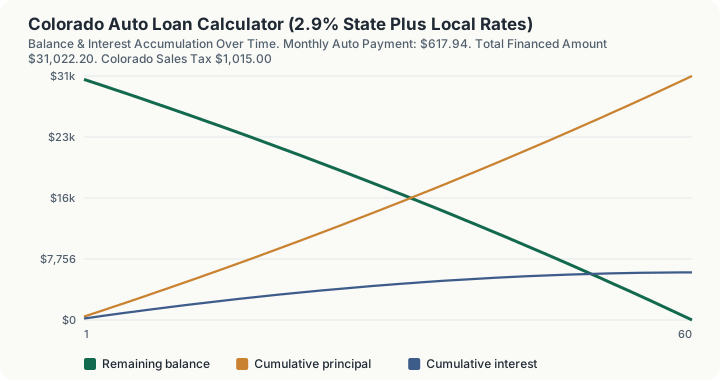
Quick Answer: Colorado's 2.9% state rate is among the lowest in the country and describes only a fraction of what you will pay. A $35,000 vehicle with $5,000 down, a 60-month term, and a 7.25% APR costs $617.94 a month at the state rate alone, including $1,015.00 of tax. Add a 5% city, county and district rate and the tax nearly triples to $2,765.00. Which local taxes apply depends on where you register the car, not where the dealer sits.
Overview
Colorado's headline number misleads in a specific way. The state rate under C.R.S. § 39-26-104 and § 39-26-106 is 2.9%, low enough that it looks like good news, but the local layer is usually larger than the state layer. Denver's own city rate has been reported at 5.15% since January 2019, which by itself is nearly double the state's. City, county, and special district taxes stacked together commonly carry the combined rate well past 8%.
The rule that catches out-of-state shoppers and cross-town shoppers alike is sourcing. Colorado applies the taxes of the jurisdictions where the vehicle will be registered, which means the buyer's residence, not the dealership's address. The RTD, Cultural District and Scientific and Cultural Facilities District taxes apply to purchasers who live inside those district boundaries and do not apply to a purchaser who buys inside the district but lives outside it. A dealer outside the district still has to collect from a district resident and remit it to the purchaser's county motor vehicle department with the title application. Denver takes the same principle further: under Denver Code § 53-26(11), a sale of a vehicle required to be registered outside the city is exempt from Denver tax altogether.
Layered on top of that is the reason this page publishes no rate table. Colorado has home-rule cities that self-collect their own sales tax and define their own tax base. A home-rule city does not have to follow the state's rules about what is taxable, which means a single combined percentage does not fully describe a Colorado purchase even when the percentage is right. No Colorado metro combined rate could be confirmed from a primary rate table in any case, so the local rate here starts at zero and you should get your own from your city's finance department and your county clerk.
Auto Loan APR by Credit Score
The APR columns below are national averages, not Colorado figures. No primary source publishes average auto loan APR by state: Experian's report has no geographic cut, the CFPB publishes state origination volume but no rates, and the New York Fed publishes state delinquency only. The payment column is the part that is specific to Colorado, because it runs this calculator's own Colorado tax and fee rules at each tier's rate.
| Credit Tier | VantageScore 4.0 | Avg New APR | Avg Used APR | Est. Payment in Colorado |
|---|---|---|---|---|
| Super prime | 781-850 | 4.55% | 6.30% | $579.05 |
| Prime | 661-780 | 6.23% | 8.77% | $603.07 |
| Nonprime | 601-660 | 9.67% | 14.03% | $654.10 |
| Subprime | 501-600 | 13.44% | 19.42% | $712.86 |
| Deep subprime | 300-500 | 16.01% | 21.77% | $754.56 |
Payment assumptions: $35,000 vehicle price, $0 trade-in, $5,000 cash down, $0 dealer documentation fee, 60-month term, new-vehicle APR applied to the Colorado delivered price including tax and statutory fees. At the 6.39% overall new-car average the same purchase costs $605.39 a month.
The score bands are VantageScore 4.0, not FICO. The same borrower can land in a different tier under each model, so a FICO score pulled from a card issuer will not always match the band here. Source: Experian, State of the Automotive Finance Market, Q1 2026, slide 45.
What Moves Your Payment
Each row changes one input and leaves the rest at the baseline below. The dollar effects are this calculator's own output for Colorado, not a rule of thumb.
| Factor | What Changes | Effect on Monthly Payment | Effect on Total Interest |
|---|---|---|---|
| Vehicle Price | Each extra $1,000 of price raises both the amount financed and the sales tax base, so the tax rises with it. | +$20.50 | +$200.83 |
| Trade-In Allowance | A $1,000 allowance cuts the amount financed by $1,000 and reduces the sales tax base by the same amount, so it saves tax as well as principal. | -$20.49 | -$200.82 |
| Cash Down Payment | A $1,000 larger down payment cuts the amount financed by $1,000. It never reduces the sales tax, which is assessed on the price, not on what you borrow. | -$19.92 | -$195.16 |
| Dealer Doc Fee | A $100 higher documentation fee adds $100 to the amount financed. It sits outside the sales tax base in Colorado, so it does not raise the tax. | +$1.99 | +$19.52 |
| Longer Term | Stretching the same balance from 60 months to 72 months spreads the principal over twelve more payments at the same rate. | -$85.31 | +$1,272.79 |
Baseline: $35,000 vehicle price, $0 trade-in, $5,000 cash down, $0 documentation fee, 60 months at 7.25% APR, giving a $617.94 payment and $6,054.40 of total interest.
How This Is Calculated
Colorado's 2.9% is the lowest state sales tax rate among the states that levy one, which is why the local rate you enter usually outweighs it. Four steps.
1. Net taxable base. C.R.S. § 39-26-102(7) defines purchase price to exclude the fair market value of property exchanged, where the exchanged property is to be resold in the seller's usual course of business. That is the trade-in credit. The dealer handling fee is held outside the base here, because its taxability could not be confirmed.
2. Sales tax. The 2.9% state rate plus whatever city, county and district rate applies where you register.
3. Title fee. A flat $7.20. Registration is deliberately excluded, for reasons set out below.
4. Amount financed and amortization. The trade-in works twice, reducing the tax base and the balance borrowed. The result amortizes as a fixed-rate installment loan:
where $P$ is the financed amount, $i$ is the monthly rate (APR divided by 12), and $n$ is the term in months.
Registration and the Specific Ownership Tax
Colorado registration is not a single fee. It is a stack of small statutory charges plus the Specific Ownership Tax, and the second of those is the large one.
The Specific Ownership Tax under C.R.S. § 42-3-106 is an annual ad valorem tax on the vehicle's value, collected at registration and distributed to local government in lieu of local personal property tax on the car. For a passenger vehicle the taxable value is 85% of MSRP, adjusted by an age factor, and the rate in the first year is 2.1%, dropping in later years. On a new car it is a meaningful recurring cost, often larger than the fixed fees around it.
The fixed components commonly cited alongside it are the $7.20 title fee, an $8 plate charge, a $23 Road Safety fee, and an $18 Bridge and Tunnel surcharge, plus weight-based and county components. Those figures could not be read from the primary fee schedule, so only the title fee is included in this calculator's total. Budget separately for the rest, and treat the Specific Ownership Tax as an annual cost rather than something you finance.
Worked Example
At 2.9%, Colorado has the lowest state sales tax rate of any state that levies one. It is also the state where the state rate tells you the least, because home rule cities routinely charge more than the state does.
- Vehicle price: $35,000
- Trade-in allowance: $0
- Cash down: $5,000
- Dealer handling fee: $0
- Local rate: 0% (state floor)
- Term: 60 months at 7.25% APR
Step 1 -- The taxable base. The handling fee is left out of the base, and there is no trade-in: $35,000.00
Step 2 -- State sales tax at 2.9%. $35,000.00 x 2.9% = $1,015.00
Step 3 -- The title fee, outside the base. $7.20
Step 4 -- Total delivered price. $35,000 + $1,015.00 + $7.20 = $36,022.20
Step 5 -- Amount financed. $36,022.20 - $0 trade-in - $5,000 cash down = $31,022.20
Step 6 -- The monthly payment. $31,022.20 at 7.25% over 60 months = $617.94
Step 7 -- Month 1. $31,022.20 x (7.25% / 12) = $187.43 interest, $430.51 principal, balance $30,591.69
Step 8 -- Month 2. $30,591.69 x (7.25% / 12) = $184.82 interest, $433.12 principal, balance $30,158.57. Cumulative interest: $372.25
Step 9 -- The running total. Through month 12: $2,073.94 of interest paid, $25,680.86 still owed. Across 60 months, $6,054.40
Now apply an illustrative 5% local rate, which is well within the range a Front Range address can carry. Tax rises to $2,765.00, the delivered price to $37,772.20, and the payment to $652.80. The local layer added $1,750.00, more than the state took.
A $10,000 trade-in on the state-rate baseline drops the base to $25,000, tax to $725.00, and the payment to $412.97. The credit is worth $290.00 at the state rate alone. With the 5% local rate applied, the same trade-in is worth $790.00, assuming the local jurisdictions follow the state's treatment of trade-ins. That assumption is exactly where a home-rule city can diverge, which is why the trade-in credit here is reported as likely rather than confirmed.
What This Does Not Account For
- Local and district rates. Left at zero because no Colorado metro combined rate could be confirmed from a primary rate table. The default output is a floor and will understate most Colorado buyers' tax substantially.
- Home-rule tax bases. Self-collecting home-rule cities define what is taxable for their own tax. Their treatment of trade-ins, handling fees, and rebates is not automatically the state's, and this calculator applies one base to both layers.
- Registration and the Specific Ownership Tax. Explained above. Only the $7.20 title fee is included.
- Handling and doc fee taxability. Colorado is reported to cap the dealer handling fee by rule through the Auto Industry Division, but neither the cap nor the fee's taxability was confirmed from a primary source. The fee is held outside the tax base, so if your city does tax it the figure here is slightly low.
- The Denver out-of-city exemption, and equivalent rules in other home-rule cities, which can remove a city's tax entirely for a buyer who registers elsewhere.
- Aurora's split county position. Aurora spans Arapahoe and Adams counties, so the county component depends on your address within the city rather than on the city itself.
- GAP insurance, extended warranties, and aftermarket add-ons, unless you fold them into the vehicle price yourself.
Common Pitfalls
- Treating 2.9% as the rate. It is the smallest part of most Colorado tax bills. On a $35,000 car, moving from 2.9% to a combined 7.9% costs $1,750.
- Using the dealer's ZIP code. Colorado sources to the buyer's residence. Two people buying identical cars from the same dealer on the same day pay different tax if they live in different districts.
- Using a stale Denver figure. The 8.81% combined Denver rate still published widely appears to be built on a 4.81% city rate that changed to 5.15% in January 2019.
- Assuming a district tax applies because you bought inside the district. RTD, CD and SCFD taxes follow residence. Buying inside the district while living outside it does not trigger them, and buying outside while living inside does not avoid them.
- Assuming a home-rule city mirrors the state. It may not, on trade-ins or on anything else. Confirm with the city's own finance department if the amount matters.
- Judging a loan by the monthly payment alone. Stretching this $31,022.20 balance from 60 to 72 months lowers the payment to $532.63 and raises total finance charges from $6,054.40 to $7,327.13.
Frequently Asked Questions
What is Colorado's sales tax rate on cars?
Does a trade-in reduce sales tax in Colorado?
Is Colorado car tax based on where I buy or where I live?
What is the Colorado Specific Ownership Tax?
Why does this calculator not list Colorado city rates?
Is there a cap on dealer handling fees in Colorado?
Sources
- Colorado Department of Revenue, Sales & Use Tax Topics: Motor Vehicle Sales (sourcing to the buyer's registration address; RTD, CD and SCFD district application; dealer collection and remittance with the title application) tax.colorado.gov
- Consumer Financial Protection Bureau, Truth in Lending Act (Regulation Z, 12 CFR § 1026.22) disclosure requirements for installment credit. ecfr.gov/current/title-12/chapter-X/part-1026
Also consulted: C.R.S. § 39-26-104 and § 39-26-106 (state sales tax, 2.9%); C.R.S. § 39-26-102(7) (purchase price excludes the fair market value of property exchanged for resale); C.R.S. § 42-3-106 (Specific Ownership Tax) and § 42-3-306 (registration fees); Denver Code § 53-26(11) (exemption for vehicles required to be registered outside the city); Colorado DMV form DR 2395 and the state title and registration fee schedule (title fee); Experian, State of the Automotive Finance Market, Q1 2026, slide 45 (average new and used auto loan APR by VantageScore 4.0 credit tier; national, no state level cut published).