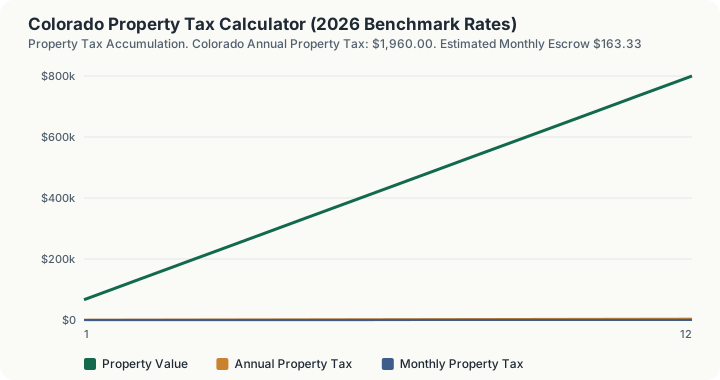
Quick Answer: A $400,000 home in Colorado carries an estimated $1,960.00 in annual property tax at the state's 0.49% effective rate, or about $163.33 a month.
What 0.49% Measures
Colorado's 0.49% is an observed ratio rather than a legislated rate: median real estate taxes paid over median home value, taken from the U.S. Census Bureau's 2024 1-Year American Community Survey, published in SmartAsset's property tax dataset and cross-checked against WalletHub's 2025 ranking for relative order. Colorado sits at #41 of 50.
The reason a low ratio coexists with high Colorado home prices is structural. Residential property is assessed at a small fraction of actual value, historically driven down by the Gallagher Amendment and set directly by the legislature since its 2020 repeal, and county mill levies are then applied to that fraction. The result is a bill that is a small percentage of market value even where the mill levy is high. All of that is compressed into the single 0.49% here.
Because the rate never varies, the output is proportional throughout: $200,000 returns $980.00, $300,000 returns $1,470.00, $500,000 returns $2,450.00, $750,000 returns $3,675.00, and $1,000,000 returns $4,900.00.
How This Is Calculated
- Take the value as entered. No residential assessment rate is applied to it, no mill levy is looked up, and no county is identified. The number you type is the number that is taxed.
- Subtract the exemption, floored at zero. A flat dollar subtraction guarded by
max(0, ...). - Multiply by 0.49%. A single rate for every value, with no band, threshold or cap in the code.
- Divide by twelve. $1,960.00 a year becomes $163.33 a month. No escrow cushion or shortage is modelled.
The residential assessment rate and mill levies described above are Colorado's real mechanism, offered as background. This engine performs neither step.
Worked Example
Baseline: a $400,000 Colorado home, no exemption.
- Value. $400,000.00.
- Exemption. $0.00, leaving $400,000.00 taxable.
- Annual tax. $1,960.00.
- Monthly escrow. $163.33.
Applying the calculator's $25,000 exemption scenario returns $1,837.50 a year and $153.13 a month.
Where the Sweep Steps, and Where It Does Not
It does not step at all in the value dimension. The 12-row table under the result climbs in a straight line from $326.67 of annual tax at a $66,666.67 value, through $1,960.00 at $400,000, to $3,920.00 at $800,000. A flat rate has no bracket edge and inventing one would be dishonest.
The engine's only true discontinuity is the exemption floor. On a $150,000 property:
Exemption $100,000. Taxable $50,000, annual tax $245.00, monthly $20.42.
Exemption $150,000, equal to the value. Annual tax $0.00.
Exemption $200,000, above the value. Annual tax $0.00. Excess exemption is discarded rather than carried anywhere.
Pricing Exemption Dollars and Value Dollars
Each $1,000 of exemption is worth $4.90 a year at any value above it. Colorado's senior and disabled-veteran homestead exemption exempts a portion of value up to $100,000 for qualifying owners, and entering that $100,000 figure moves a $400,000 home from $1,960.00 to $1,470.00, saving $490.00 a year and taking the escrow line from $163.33 to $122.50. Smaller amounts scale the same way: $25,000 returns $1,837.50, $50,000 returns $1,715.00, and the input's $200,000 maximum returns $980.00.
Value costs $4.90 per thousand in the same proportion. $400,000 returns $1,960.00 and $401,000 returns $1,964.90. Ten thousand dollars of value costs $49.00 a year, taking the bill to $2,009.00 and the escrow line to $167.42 a month. A buyer moving from a $500,000 house ($2,450.00) to a $750,000 house ($3,675.00) adds $1,225.00 a year of modelled property tax.
The Reverse Question: Value a Budget Supports
A $2,000 annual property tax budget is crossed between $400,000 of value, which returns $1,960.00, and $410,000, which returns $2,009.00. That is a narrow answer, and a useful one on a Front Range purchase where prices move in $10,000 increments. A $3,000 budget lands between $600,000 ($2,940.00) and $750,000 ($3,675.00), and a million-dollar Colorado home reaches $4,900.00, or $408.33 a month.
Turned into an exemption question: holding a $400,000 home under $1,500 of annual tax takes the full $100,000 senior exemption, which returns $1,470.00. Anything less does not get there, because the relationship is exactly linear.
Applying the Assessment Rate Twice, Priced
Colorado's residential assessment rate is a single-digit percentage of actual value, in the region of 6.7% in recent years, and it appears prominently on every notice of valuation. A $400,000 home therefore shows an assessed value near $26,800, and that number looks like the base a property tax calculator would want.
Actual value entered. $400,000 returns $1,960.00 a year.
Assessed value entered instead. $26,800 returns $131.32 a year.
The gap is $1,828.68, an understatement of roughly fifteen times. The cause is the same in every state on this family of pages: 0.49% is already the ratio of tax paid to market value, so the assessment rate is inside it, and applying the rate a second time discounts the same value twice. The engine performs no assessment-rate conversion of its own, has no way to tell an actual value from an assessed one, and will return the smaller figure without warning. This box wants the market or purchase value of the home.
What This Does Not Account For
- The exemption field is a flat dollar subtraction with no eligibility test. Whatever you type is removed from the base before the 0.49% rate is applied, and the engine treats a general homestead, a senior freeze and a disabled-veteran exemption as the same number. A $25,000 entry returns $1,837.50 on a $400,000 home, $50,000 returns $1,715.00 and $100,000 returns $1,470.00; no step of that sweep asks whether the amount is one you actually qualify for, and no per-programme cap is enforced beyond the field's own maximum.
- The residential assessment rate. Set by the legislature since Gallagher's repeal and changed more than once in recent sessions. It is not an input here and no version of it is applied.
- County and district mill levies. Denver, Boulder, El Paso, Larimer and every school and special district set their own levies. None is looked up; one statewide ratio stands for all.
- Senior and veteran exemption eligibility. The exemption box is an unconditional dollar subtraction with no test for age, tenure, occupancy or disability rating.
- TABOR refunds and levy limits. Colorado's revenue constraints affect real bills and appear nowhere in this calculation.
- Time. No year selection, no appreciation, no reassessment cycle. Each result is a single static valuation.
Common Pitfalls
- Entering the assessed value from a notice of valuation. Priced above at $131.32 against a correct $1,960.00.
- Reading the schedule as a forecast. All twelve rows price a different property at today's rate, not this property in a later year. Row 12 sits at $800,000 of value and returns $3,920.00 with no exemption entered; there is no appreciation, reassessment or levy growth anywhere in the code path.
- Expecting the senior exemption to apply automatically. Nothing is applied unless it is typed into the exemption box.
- Assuming a rate break at higher values. There is none: $4,900.00 on a million-dollar home is the same 0.49% behind $980.00 at $200,000.
- Treating $163.33 as a full escrow line. It is one twelfth of the property tax and nothing else.
Frequently Asked Questions
How high are property taxes in Colorado?
Should I enter actual value or assessed value?
What is the senior homestead exemption worth here?
What does each additional $10,000 of value cost?
Does this reflect my county's mill levy?
Sources
- U.S. Census Bureau: 2024 1-Year American Community Survey, median real estate taxes paid over median home value. census.gov/programs-surveys/acs
- Colorado Department of Revenue, the official state tax authority for Colorado rates, rules and forms. tax.colorado.gov
Also consulted: Colorado Division of Property Taxation: residential assessment rate and senior homestead exemption, cited as background only and not applied by this engine.