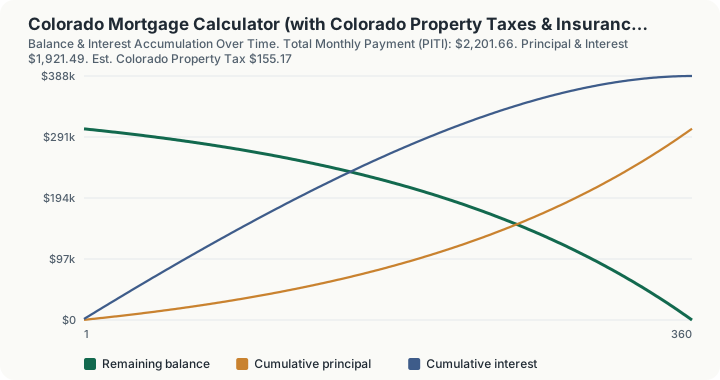
Quick Answer: A $380,000 Colorado home with 20% down ($76,000) and a 6.5% 30-year fixed rate carries a total monthly payment of about $2,201.66, including principal, interest, property tax, and insurance.
The Shape of the Model
This calculator takes a price, a down payment percentage and an APR, and everything else is a constant fixed in its configuration. The amortization runs over exactly 360 periods, with no term selector, no adjustable-rate path and an extra-payment parameter passed as zero. The property tax rate is a hardcoded 0.49% living in this calculator's own config rather than read from a state rate table, and it multiplies the purchase price rather than any assessed value. Homeowners insurance is a flat $125 a month at every price, from a Pueblo starter home to a Boulder purchase.
At the defaults that yields a $304,000.00 loan principal, $1,921.49 of monthly principal and interest, $155.17 of monthly property tax, $125.00 of insurance, a PITI of $2,201.66, and $387,732.82 of interest over the full 360 payments.
Colorado's real system assesses residential property at a small statutory fraction of actual value, set directly by the legislature since the 2020 repeal of the Gallagher Amendment, and applies county, city and district mill levies to that fraction. This engine does neither; 0.49% of the purchase price is the entire tax model.
How This Is Calculated
- Down payment and loan principal. The down payment percentage is applied to the home price and the remainder is financed. At the defaults, 20% of $380,000 is $76,000, leaving $304,000.
- Principal and interest. The principal is amortized over exactly 360 monthly periods at APR / 12:
The 360 is hardcoded in the call and no prepayment is applied.
- Property tax. The home price is multiplied by the configuration's 0.49% constant and divided by 12. No assessment rate is applied and no mill levy is looked up.
- Insurance. A flat $125.00 a month, independent of price, county and coverage.
- Total PITI. Principal and interest plus property tax plus $125.00. No mortgage insurance term is added at any loan-to-value.
Worked Example
The default scenario: a $380,000 Colorado home, 20% down, 6.5% APR.
- Down payment and principal. 20% of $380,000 is a $76,000 cash down payment, leaving $304,000.00 financed.
- Monthly principal and interest. $1,921.49.
- Monthly property tax. $155.17.
- Monthly insurance. $125.00.
- Total PITI. $2,201.66.
- Lifetime interest. $387,732.82 across the 360 payments, more than the loan principal itself.
The Down Payment Ladder and Its Missing Rung
Every line is a separate run at $380,000 and 6.5%.
0% down. Principal $380,000.00, P&I $2,401.86, PITI $2,682.03, lifetime interest $484,667.97.
3.5% down. Principal $366,700.00, P&I $2,317.79, PITI $2,597.96.
5% down. Principal $361,000.00, P&I $2,281.77, PITI $2,561.94, lifetime interest $460,432.24.
10% down. Principal $342,000.00, P&I $2,161.67, PITI $2,441.84.
20% down. Principal $304,000.00, P&I $1,921.49, PITI $2,201.66.
25% down. Principal $285,000.00, P&I $1,801.39, PITI $2,081.56.
The missing rung is mortgage insurance. A conventional loan at 5% down runs at 95% loan-to-value and carries PMI until the balance reaches the statutory cancellation point, and nothing in this engine adds it: the 5% row holds exactly the same three components as the 25% row. Inside the model, dropping from 20% to 5% down costs $360.28 a month and dropping to nothing down costs $480.37 a month. A real borrower's gap is larger than both by the full premium, which makes $2,561.94 the single most optimistic figure on this page.
Pricing an Eighth of a Point
Rate steps in 0.125% increments here, and each step has a fixed price at $380,000 with 20% down.
6.375% APR. P&I $1,896.56, PITI $2,176.73, lifetime interest $378,763.14.
6.5% APR. P&I $1,921.49, PITI $2,201.66, lifetime interest $387,732.82.
6.625% APR. P&I $1,946.55, PITI $2,226.72, lifetime interest $396,756.31.
One eighth of a point costs $25.06 a month and $9,021.08 of interest across the term. A full point from 6.5% to 7.5% takes PITI to $2,405.78 and lifetime interest to $461,220.45. Locking at 5.5% instead returns PITI of $2,006.25 and lifetime interest of $317,388.26, which is $70,346.97 less interest for the same $304,000 loan.
Backing Into a Price From a Payment
Holding 20% down and 6.5%: a $340,000 purchase returns PITI of $1,983.06 and a $380,000 purchase returns $2,201.66, so a $2,000 monthly ceiling is crossed a little above $340,000. $300,000 returns $1,764.46. A buyer with $2,450 of room can reach $420,000, which returns $2,420.25. $500,000 returns $2,857.44 and $750,000 returns $4,223.66.
The Quote That Is Not the Payment
A rate sheet quotes $1,921.49. The payment this calculator models is $2,201.66. The difference is $280.17 a month, or $3,362.04 a year, all of it escrow: the tax component plus the insurance placeholder. That gap is the reason a pre-approval based on P&I alone regularly overshoots what a household can carry.
It grows with price, because the tax term scales with the purchase price while P&I depends only on the financed amount. At $750,000 the P&I is $3,792.41 against a PITI of $4,223.66.
The Insurance Placeholder Does Not Move
Two runs settle it. At $300,000 the modelled tax is $122.50 a month and insurance is $125.00, so the placeholder is the larger escrow item. At $750,000 the tax is $306.25 and insurance is still $125.00. Colorado's wildfire and hail exposure has pushed real premiums well above that in much of the state, so every PITI figure here carries an understatement that grows in absolute terms as price rises.
What This Does Not Account For
- Private mortgage insurance. Not added at any loan-to-value, so the 0%, 3.5%, 5% and 10% down figures above are all understated.
- The flat insurance constant. $125.00 a month at $300,000 and at $750,000 alike, as verified above.
- The fixed 360-month term. There is no 15-year or 20-year option and no adjustable path, and the extra-payment parameter is passed as zero, so no prepayment scenario can be modelled.
- The hardcoded 0.49% tax rate. It is a constant in this calculator's configuration, not a figure read from a state rate table, and it is applied to the purchase price.
- Colorado's residential assessment rate. The statutory fraction of actual value that a real Colorado bill is built on is not applied at any point.
- County and district mill levies. Denver, Boulder, El Paso and Larimer levies differ, as do school and special district levies within them. None is looked up.
- HOA dues, metropolitan district fees, closing costs, points and escrow reserves. None appears in the PITI figure, and metro district fees are common in newer Front Range developments.
Common Pitfalls
- Budgeting the $1,921.49 P&I figure. The modelled housing payment is $2,201.66, $280.17 a month higher.
- Trusting a low-down-payment result. The $2,561.94 at 5% down contains no PMI line.
- Assuming insurance scales with price. It stays at $125.00 between a $300,000 and a $750,000 run.
- Reading 0.49% as a mill levy. It is a configuration constant applied to the purchase price, with no assessment rate involved.
- Comparing this against a 15-year quote. Every figure here is 360 payments; the term cannot be changed.
- Ignoring the opportunity cost of a larger down payment. Moving from 5% to 25% down saves $480.38 a month in this model but ties up $76,000 of additional cash at closing.
Frequently Asked Questions
Does this reflect Colorado's actual property tax mechanism?
Is PMI included in the monthly payment?
Does the insurance estimate vary by home price or county?
What does an eighth of a point cost?
Can I model a 15-year loan or extra principal payments?
What price keeps the payment under $2,000?
Sources
- Consumer Financial Protection Bureau (CFPB): Regulation Z (Truth in Lending Act) and PMI requirements under the Homeowners Protection Act. ecfr.gov/current/title-12/chapter-X/part-1026
- U.S. Census Bureau: American Community Survey median real estate tax data underlying published state effective rates. census.gov/programs-surveys/acs
- Colorado Department of Revenue, the official state tax authority for Colorado rates, rules and forms. tax.colorado.gov
Also consulted: Colorado Division of Property Taxation: residential assessment rate and mill levy administration, cited as background only and not applied by this engine.