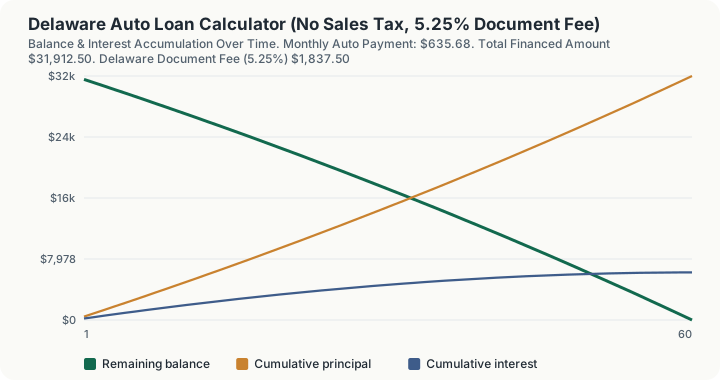
Quick Answer: A $35,000 vehicle in Delaware with $5,000 cash down, a 60-month term, and a 7.25% APR carries a $635.68 monthly payment. Delaware charges no sales tax on vehicles. Instead the state collects a $1,837.50 document fee at 5.25% of the net purchase price, plus $75 in title and registration, financing $31,912.50.
Overview
Delaware is one of five states with no sales tax, and buyers often assume that means a car costs sticker plus paperwork. It does not. Under 21 Del. C. Sec. 2118, the Division of Motor Vehicles collects a document fee when a vehicle is titled, and since 1 October 2025 that fee is 5.25% of the net purchase price.
The distinction matters, and not only as a label. The document fee is a titling charge, not a transaction tax. It attaches when the vehicle is titled in Delaware rather than when it is sold, so it reaches vehicles brought in from out of state as well as ones bought from a Delaware dealer. There is no local add-on anywhere in the state, and there is no dollar cap: the fee on a $70,000 vehicle is twice the fee on a $35,000 one.
The 5.25% figure is new. House Bill 164 raised it from 4.25% effective 1 October 2025, which adds $350 to the cost of a $35,000 car compared with the old rate. Any estimate built on 4.25% is now a year out of date and understates the bill.
One more naming trap. In Delaware, "document fee" means the state's 5.25% levy. A dealer may separately charge its own processing or paperwork fee, which is a different thing entirely. Read any buyer's order carefully to see which one a line item refers to.
Auto Loan APR by Credit Score
The APR columns below are national averages, not Delaware figures. No primary source publishes average auto loan APR by state: Experian's report has no geographic cut, the CFPB publishes state origination volume but no rates, and the New York Fed publishes state delinquency only. The payment column is the part that is specific to Delaware, because it runs this calculator's own Delaware tax and fee rules at each tier's rate.
| Credit Tier | VantageScore 4.0 | Avg New APR | Avg Used APR | Est. Payment in Delaware |
|---|---|---|---|---|
| Super prime | 781-850 | 4.55% | 6.30% | $595.67 |
| Prime | 661-780 | 6.23% | 8.77% | $620.38 |
| Nonprime | 601-660 | 9.67% | 14.03% | $672.88 |
| Subprime | 501-600 | 13.44% | 19.42% | $733.32 |
| Deep subprime | 300-500 | 16.01% | 21.77% | $776.22 |
Payment assumptions: $35,000 vehicle price, $0 trade-in, $5,000 cash down, $0 dealer documentation fee, 60-month term, new-vehicle APR applied to the Delaware delivered price including tax and statutory fees. At the 6.39% overall new-car average the same purchase costs $622.76 a month.
The score bands are VantageScore 4.0, not FICO. The same borrower can land in a different tier under each model, so a FICO score pulled from a card issuer will not always match the band here. Source: Experian, State of the Automotive Finance Market, Q1 2026, slide 45.
What Moves Your Payment
Each row changes one input and leaves the rest at the baseline below. The dollar effects are this calculator's own output for Delaware, not a rule of thumb.
| Factor | What Changes | Effect on Monthly Payment | Effect on Total Interest |
|---|---|---|---|
| Vehicle Price | Each extra $1,000 of price raises both the amount financed and the vehicle document fee base, so the tax rises with it. | +$20.96 | +$205.40 |
| Trade-In Allowance | A $1,000 allowance cuts the amount financed by $1,000 and reduces the vehicle document fee base by the same amount, so it saves tax as well as principal. | -$20.97 | -$205.41 |
| Cash Down Payment | A $1,000 larger down payment cuts the amount financed by $1,000. It never reduces the vehicle document fee, which is assessed on the price, not on what you borrow. | -$19.92 | -$195.16 |
| Dealer Doc Fee | A $100 higher documentation fee adds $100 to the amount financed. It sits outside the vehicle document fee base in Delaware, so it does not raise the tax. | +$1.99 | +$19.51 |
| Longer Term | Stretching the same balance from 60 months to 72 months spreads the principal over twelve more payments at the same rate. | -$87.76 | +$1,309.31 |
Baseline: $35,000 vehicle price, $0 trade-in, $5,000 cash down, $0 documentation fee, 60 months at 7.25% APR, giving a $635.68 payment and $6,228.07 of total interest.
How This Is Calculated
Delaware has no sales tax. What a car buyer pays is a 5.25% Document Fee assessed at titling, raised from 4.25% in October 2025. Four steps.
1. Net purchase price. 21 Del. C. Sec. 2118 defines the base as the purchase price less the allowance for a vehicle taken in trade.
The statute assesses the fee on the greater of that net price or the NADA book value, so a price well below book will not reduce the fee to match. This calculator uses the net purchase price, which is the binding figure in an arm's length dealer transaction.
2. Document fee.
There is no local rate and no dollar ceiling.
3. Title and registration. A fixed $75, being the $35 certificate of title and the $40 flat annual passenger registration. Delaware registers most passenger vehicles at a flat rate rather than by weight, though trucks and commercial vehicles are weight rated. These fees sit outside the document fee base.
4. Amortization. The financed balance amortizes as a fixed-rate installment loan:
where $P$ is the amount financed, $i$ is the monthly rate (APR divided by 12), and $n$ is the term in months. Each period's interest is the outstanding balance times $i$, the remainder reduces principal, and the schedule reconciles to zero at maturity.
Worked Example
Delaware has no sales tax, so the line that looks like one is really the titling Document Fee under 21 Del. C. 2118, which HB 164 raised to 5.25% on 1 October 2025. It behaves like a tax and the trade-in reduces it.
- Vehicle price: $35,000
- Trade-in allowance: $0
- Cash down: $5,000
- Dealer processing fee: $0
- Term: 60 months at 7.25% APR
Step 1 -- The net purchase price. Price less any trade-in allowance, with the processing fee excluded: $35,000 - $0 = $35,000.00
Step 2 -- The Document Fee at 5.25%. $35,000.00 x 5.25% = $1,837.50
Step 3 -- Title and registration, outside the base. $35.00 title + $40.00 registration = $75.00
Step 4 -- Total delivered price. $35,000 + $1,837.50 + $75.00 = $36,912.50
Step 5 -- Amount financed. $36,912.50 - $0 trade-in - $5,000 cash down = $31,912.50
Step 6 -- The monthly payment. $31,912.50 at 7.25% over 60 months = $635.68
Step 7 -- Month 1. $31,912.50 x (7.25% / 12) = $192.80 interest, $442.88 principal, balance $31,469.62
Step 8 -- Month 2. $31,469.62 x (7.25% / 12) = $190.13 interest, $445.55 principal, balance $31,024.07. Cumulative interest: $382.93
Step 9 -- The running total. By month 12 you have paid $2,133.45 in interest and owe $26,417.79. Over 60 months the finance charge is $6,228.07
Under the old 4.25% rate the same purchase carried a $1,487.50 document fee. HB 164 added $350 to it.
Now add a $10,000 trade-in. The net purchase price falls to $25,000, the document fee drops to $1,312.50, and the payment falls to $426.03. The trade-in saved $525 in document fee on top of the $10,000 it removed from the loan, which is 5.25% of the allowance.
That $525 is the practical reason to trade in at the dealership rather than sell privately and bring cash. A private sale has to beat the dealer's trade offer by more than $525 to leave you ahead.
What This Does Not Account For
- The NADA book value floor. The statutory base is the greater of the net purchase price or the NADA value. On a genuine below-market deal, a damaged vehicle, or a family transaction, the DMV can assess the fee on book value instead, and the fee will be higher than this calculator shows. Bring documentation of condition if you are buying below book.
- The dealer's own processing fee. Delaware's cap on that charge, if any, and its typical market amount could not be verified from a primary source, so the input defaults to zero. If your dealer charges one, enter it. The calculator adds it to the delivered price but does not put it inside the 5.25% base, because whether it forms part of the statutory purchase price was not verified either.
- Fee amounts confirmed only from secondary sources. The $35 title fee and $40 registration fee come from summaries of the DMV fee schedule, not a live fee page. Delaware DMV fees generally rose under HB 164, so both are more likely than usual to be out of date. Confirm at dmv.de.gov before you budget to the dollar.
- Weight-rated registration. Trucks and commercial vehicles are registered by weight, not at the flat passenger rate used here.
- Out-of-state credit rules. Delaware may credit a similar tax paid to another state when a vehicle is titled in Delaware after being bought elsewhere. The mechanics vary by the other state's law and are not modeled.
- GAP insurance, extended warranties, and negative equity, unless you fold them into the vehicle price yourself.
Common Pitfalls
- Believing no sales tax means no purchase levy. Delaware collects 5.25% at titling. On a $35,000 car that is $1,837.50, comparable to what neighboring states charge as sales tax. The absence of a sales tax shows up in everything else you buy in Delaware, not in the car.
- Using the old 4.25% rate. HB 164 raised it to 5.25% on 1 October 2025. Older calculators and printed guides still show the lower number and will understate the fee by roughly $350 on a $35,000 vehicle.
- Confusing the state document fee with the dealer's processing fee. They are two separate line items that share a name. The 5.25% goes to the state at titling; the dealer charge goes to the dealer and is negotiable.
- Assuming a low negotiated price sets the base. The fee applies to the greater of the net purchase price or NADA book value, so a price far under book will not carry the fee down with it.
- Expecting a local rate. There is no county or municipal vehicle tax in Delaware. The rate is 5.25% statewide.
- Judging a loan by the monthly payment alone. Stretching the baseline $31,912.50 balance from 60 to 72 months lowers the payment to $547.92 but raises total finance charges from $6,228.07 to $7,537.39.
Frequently Asked Questions
Does Delaware charge sales tax on cars?
When did Delaware's document fee go up to 5.25%?
Does a trade-in reduce Delaware's document fee?
What is the difference between the state document fee and a dealer doc fee?
Is there an annual car tax in Delaware?
What if I buy a car out of state and bring it to Delaware?
Sources
- 21 Del. C. Sec. 2118 and Sec. 2118A (motor vehicle document fee on the net purchase price or NADA value, whichever is greater) sec.gov
- Consumer Financial Protection Bureau, Truth in Lending Act (Regulation Z, 12 CFR Sec. 1026.22) disclosure requirements for installment credit. ecfr.gov/current/title-12/chapter-X/part-1026
- Delaware Division of Revenue, the official state tax authority for Delaware rates, rules and forms. revenue.delaware.gov
Also consulted: State of Delaware news release, "DMV Fees Increase in October 2025" (House Bill 164 raising the document fee from 4.25% to 5.25% effective 2025-10-01); Delaware Division of Motor Vehicles fee schedule (certificate of title and passenger registration fees); Experian, State of the Automotive Finance Market, Q1 2026, slide 45 (average new and used auto loan APR by VantageScore 4.0 credit tier; national, no state level cut published).