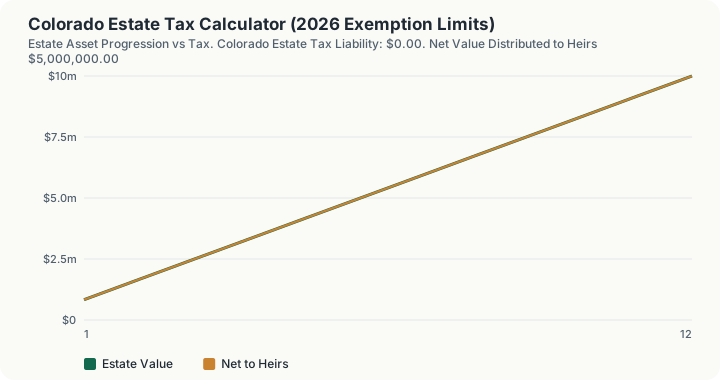
Quick Answer: Colorado has no state-level estate tax, so a $5,000,000 estate owes $0 in Colorado estate tax. Federal exemption rules apply separately.
A Constant, Not a Curve
Colorado's record in the engine's 2026 state estate tax table sets hasEstateTax to false, with an exemption of $0 and no brackets. The primitive evaluates that flag before anything else and returns immediately.
At the default $5,000,000 gross estate the calculator reports $0.00 of Colorado estate tax, an effective rate of 0.00%, an exemption threshold of $0, and $5,000,000.00 distributed to heirs. No estate value the input accepts changes the tax figure. That constant is the accurate Colorado answer rather than an unfinished configuration.
How This Is Calculated
With no Colorado estate tax entry there is no exemption to clear and no rate schedule to walk.
- Value the gross estate. Date-of-death fair market value of real property, business interests, securities, cash, and life insurance proceeds, taken as entered.
- Subtract allowable deductions. The deductions figure comes off the gross and the result is floored at zero. The subtraction is real code; what it feeds is a state test with one possible outcome here.
- Look Colorado up in the state estate tax table. The lookup returns
hasEstateTax: false, and the function exits with a tax of $0, an exemption threshold of $0, and a taxable estate above exemption of $0. - Return $0. No Colorado reduction is applied at any estate size.
Worked Example
- Start with the gross estate. A $5,000,000 gross estate at fair market value, before deductions.
- Check Colorado's table entry. No estate tax and no brackets, so no threshold or schedule is loaded.
- Compute the state estate tax due. $0.00.
- Distribute the net estate. The full $5,000,000.00 passes to beneficiaries.
- What this excludes. The Colorado state-level figure only; the federal return is separate and is not computed here.
Twelve Values, One Answer
Every figure below comes from its own run of the calculator.
At a $1,000,000 estate. Colorado estate tax = $0.00; net to heirs $1,000,000.00.
At a $9,999,000 estate, then at $10,000,000. Colorado estate tax = $0.00 in both; the thousand dollars between costs $0.00.
At a $15,000,000 estate, then at $15,001,000. Colorado estate tax = $0.00 in both.
At a $25,000,000 estate. Colorado estate tax = $0.00; net to heirs $25,000,000.00.
At a $50,000,000 estate. Colorado estate tax = $0.00; net to heirs $50,000,000.00.
Each marginal figure the page can report is zero: the next dollar costs $0.00, the next $1,000,000 costs $0.00, and the effective rate stays at 0.00% across the entire range. The reverse question, how much can pass before Colorado charges, resolves to no dollar amount, because there is no charge to approach.
Saying so with computed endpoints is the useful service here. Estate calculators are usually read for a cliff, and confirming from the engine that this one has none at any value up to $50,000,000 answers the question the visitor actually arrived with.
Deductions: Real Arithmetic, Zero Effect on the Tax
A zero headline invites the theory that deductions consumed the estate. Three runs dispose of it.
Deductions at $0 on a $5,000,000 gross estate: tax $0.00, net distributed $5,000,000.00. Deductions at $1,000,000: tax $0.00, net distributed $4,000,000.00. Deductions at $5,000,000: tax $0.00, net distributed $0.
The deduction moves net distributed by its full amount and moves the tax by $0.00. It is applied before the state test, and that test returns zero regardless of the number handed to it.
Reading the $0 on the Exemption Threshold Line
The Statutory Exemption Threshold output shows $0 on this page, which looks like a state exempting nothing. It signals that no exemption exists to state.
That field is populated with a statutory figure only when the table gives a state an estate tax. Colorado triggers the early return, which assigns $0 as a null value along with hasEstateTax: false and a taxable estate above exemption of $0. The tax figure beside it is the disambiguator: a state that really taxed the first dollar would show a $0 threshold and a substantial tax, whereas here the tax on $50,000,000 is $0.00.
The Number That Is Missing From This Page
No federal estate tax is computed anywhere in this engine. Its 2026 tables carry no federal exemption, and no part of the code path applies a unified credit, portability of a deceased spouse's unused exclusion, an add-back of lifetime taxable gifts, or the generation-skipping transfer tax.
A $50,000,000 Colorado estate showing $0.00 here has a zero state bill and an uncomputed federal one. Reading this headline as a total death tax estimate is the largest available error on the page, and it is available at every estate value because the state figure is always zero.
Colorado is also absent from the engine's separate 2026 state inheritance tax table, which carries records for Pennsylvania, Nebraska, Maryland, Kentucky, and New Jersey only. Estate tax and inheritance tax fall on different payers, so a zero in one proves nothing about the other; for Colorado neither table generates a charge.
Where the Property Sits
The calculator handles one jurisdiction per run. Real property physically located in a state that does levy an estate tax stays taxable by that state under its own schedule, whatever the decedent's domicile, and this page offers no input that could carry it. A Colorado estate holding land in a taxing state reads $0.00 here and owes an uncomputed amount there.
What This Does Not Account For
- Federal estate tax under IRC Chapter 11. Not computed; no federal exemption figure exists in the engine's tables.
- Federal generation-skipping transfer tax under IRC Chapter 13. Not computed.
- Out-of-state situs. One jurisdiction per run, with no apportionment of value between states.
- Valuation discounts. Minority-interest and lack-of-marketability adjustments on closely held entities are not applied.
- Administration cost. Executor commissions and ancillary probate expenses enter only through the deductions figure, which cannot change the Colorado tax.
Common Pitfalls
- Reading the $0 exemption threshold as a first-dollar tax. The tax next to it is $0.00 at $50,000,000.
- Assuming deductions produced the zero. The tax is $0.00 at $0 of deductions and $0.00 at $5,000,000 of deductions.
- Using the headline as a total death tax figure. It contains no federal component.
- Expecting out-of-state real property to be included. The calculator cannot see it.
- Looking for a threshold above the tested range. The sweep runs to $50,000,000 without the answer moving.
Frequently Asked Questions
Does Colorado have a state estate tax?
Does Colorado have an inheritance tax?
Do deductions cut the Colorado estate tax?
Why is the exemption threshold shown as $0?
Is $0.00 the estate's entire death tax liability?
Sources
- Colorado Department of Revenue, the official state tax authority for Colorado rates, rules and forms. tax.colorado.gov
Engine table: engine/tables/2026/state-estate-tax.json, Colorado entry: hasEstateTax: false, exemption 0, empty bracket array.
Engine table: engine/tables/2026/state-inheritance-tax.json, listing Pennsylvania, Nebraska, Maryland, Kentucky, and New Jersey only.