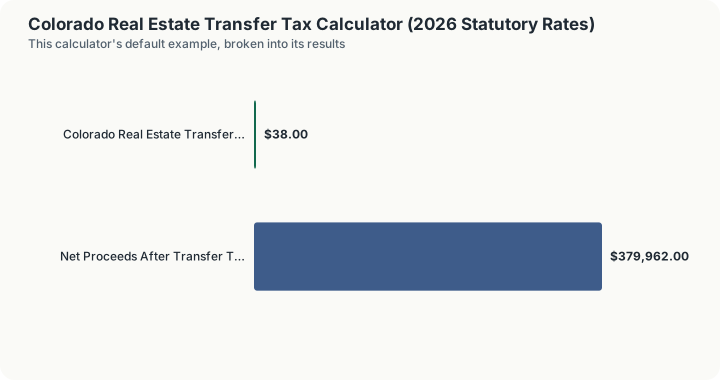
Quick Answer: A $380,000 home sale in Colorado owes just $38.00 in the state documentary fee, an unusually low flat 0.01% rate, though a handful of grandfathered home-rule resort towns like Aspen, Vail, and Telluride charge their own much higher local transfer taxes on top.
The Lowest Documentary Fee in the Country
Colorado charges the lowest nominal real estate transfer tax rate of any state that levies one at all: a documentary fee of just $0.01 per $100 of consideration under C.R.S. 39-13-102, equal to 0.01% of the sale price, and sales under $500 are exempt by statute, an exemption this calculator does not implement. On a typical $380,000 home that works out to only $38, a figure many buyers mistake for a rounding error rather than the actual statutory tax.
The statewide figure is not the complete picture in a handful of Colorado's home-rule mountain resort towns. Aspen, Vail, Breckenridge, Telluride, and Crested Butte have grandfathered local real estate transfer taxes running roughly 1% to 3%, authorized under older home-rule provisions that predate a later statewide ban on new local transfer taxes. Colorado law and local custom generally place responsibility for the documentary fee with whoever records the deed, most often the buyer, though this is commonly addressed by contract at closing.
A Straight Line from $100 to $5,000,000, and the One Place It Should Bend
No schedule table is rendered on this page, so the ladder below was produced by running the sale price through the engine value by value. It is a straight line with no bracket anywhere in it: $0.01 at $100, $0.10 at $1,000, $1.00 at $10,000, $10.00 at $100,000, $25.00 at $250,000, $38.00 at the $380,000 default, $50.00 at $500,000, $100.00 at $1,000,000, $150.00 at $1,500,000, $200.00 at $2,000,000 and $500.00 at $5,000,000. The effective rate prints 0.010% at every one of those points.
Marginal cost of the next unit of price. Each additional $100,000 of consideration costs $10.00. Each additional $10,000 costs $1.00. Going from $380,000 to $390,000 moves the fee from $38.00 to $39.00; going from $1,000,000 to $1,010,000 moves it from $100.00 to $101.00.
The reverse question. A $50.00 documentary fee corresponds to a $500,000 sale, $200.00 to a $2,000,000 sale, and $380.00 to a $3,800,000 sale. The last of those is worth holding next to the default: the fee on a $3,800,000 Cherry Creek house, $380.00, is one thousandth of its price.
Is there a Colorado mansion tax? No. The mansionTax output is $0.00 at $1,000,000, $0.00 at $2,000,000 and $0.00 at $5,000,000. The $5,000,000 figure of $500.00 is the same 0.01% applied to the whole price.
Where the line should bend, and does not. The statute exempts consideration below $500, but the engine does not implement that exemption. Run it and see: at $499 it returns $0.05, at $500 $0.05, and at $501 $0.05 again. The output is continuous straight through the statutory cliff. On a sub-$500 nominal-consideration deed this calculator therefore charges a nickel that the county would not collect. That is a five-cent error and it never touches a residential sale, but it is a real gap between the statute and the code, and it is documented rather than papered over. See What This Does Not Account For below.
Right rate against wrong rate, priced. The classic misreading is treating "$0.01 per $100" as "$1.00 per $100", which is 1% rather than 0.01%. On the default sale that wrong reading produces $3,800.00 against the engine's $38.00: a hundredfold overstatement, and enough to make a buyer reserve cash for a charge two orders of magnitude larger than the one they will actually pay. The sanity check is the effective rate line. If it does not read 0.010%, the rate has been mis-scaled.
The gap that dwarfs all of this. At $1,000,000 the engine returns $100.00. Inside the town limits of Aspen, Vail, Breckenridge, Telluride or Crested Butte, a grandfathered local transfer tax of roughly 1% to 3% applies on top, and it is not in this engine's tables or its output at any price. The statewide figure is a rounding error next to it. This calculator has no municipality input and cannot model that layer; the local rate has to come from the town's own ordinance.
How This Is Calculated
Colorado has the smallest transfer charge of any state that has one: a documentary fee of a penny per $100, or 0.01%.
The engine multiplies the sale price by 0.0001, the statewide rate under C.R.S. 39-13-102. A handful of home rule resort towns, Aspen, Vail, Breckenridge, Telluride and Crested Butte among them, hold grandfathered local transfer taxes of roughly 1% to 3%. Those are not in this figure and are one to three hundred times the state charge, so a resort-town purchase needs the local rate looked up directly.
Worked Example
Colorado's documentary fee is the smallest charge of its kind in the country, and the baseline sale shows why that matters less than the local exceptions do.
Step 1 -- The consideration. Contract sale price = $380,000
Step 2 -- The statutory rate. C.R.S. 39-13-102, $0.01 per $100 of consideration = 0.01%
Step 3 -- Apply the rate. $380,000 x 0.0001 = $38.00
Step 4 -- Net proceeds after the documentary fee. $380,000.00 - $38.00 = $379,962.00
Step 5 -- The effective rate. $38.00 / $380,000 = 0.010%
The calculator's $1,500,000 scenario changes the figure but not the rate.
Step 6 -- The luxury sale. $1,500,000 x 0.0001 = $150.00
Step 7 -- The effective rate at $1.5M. $150.00 / $1,500,000 = 0.010%
A $150 charge on a million-and-a-half-dollar transaction is closer to a filing fee than a tax, and that is essentially what Colorado intends it to be. The number that should actually give a Colorado buyer pause is the one this calculator does not model: a handful of home-rule resort towns, Aspen, Vail, Breckenridge, Telluride and Crested Butte among them, kept grandfathered local real estate transfer taxes of roughly 1% to 3% when the state constitution barred new ones. The same $1,500,000 sale in Step 6 could carry $15,000 to $45,000 in local transfer tax inside those town limits, three hundred times the statewide figure, so the town line matters far more here than the price does.
What This Does Not Account For
- Home-rule resort town transfer taxes. Aspen, Vail, Breckenridge, Telluride, and Crested Butte each levy their own grandfathered local real estate transfer tax, generally in the 1% to 3% range, which is not reflected in this calculator's statewide baseline and can dwarf the state documentary fee.
- The $500 exemption threshold is not implemented. Colorado's documentary fee does not apply to transfers of consideration under $500, but the engine applies the 0.01% rate at every price without checking that floor. Verified: a $499 consideration returns $0.05, not $0.00, and $500 and $501 return $0.05 as well. The calculator charges the fee below the statutory threshold. The amount at stake is five cents and it cannot affect a residential sale, but the rule is a rule the code does not apply, and no output on this page reflects it.
- Recording fees. Colorado county clerk and recorder offices charge separate flat recording fees to file a deed, unrelated to sale price and not included in this calculator's output.
- Title insurance and closing costs. As in any state, the documentary fee is a small part of a Colorado closing statement; title insurance, escrow fees, and attorney costs are separate line items.
Common Pitfalls
- Assuming the entire state has no meaningful transfer tax. While true for the vast majority of Colorado, buyers and sellers in Aspen, Vail, Telluride, Breckenridge, or Crested Butte face a dramatically different picture; always check local town ordinances for property in these specific mountain resort communities.
- Confusing the documentary fee with a percentage-based transfer tax. At 0.01%, Colorado's statewide rate is roughly one-tenth the size of Alabama's or Georgia's already-low 0.1% rates, and buyers sometimes assume a decimal error when they see how small the number is.
- Overlooking that resort town rates stack on top of, not instead of, the state fee. A sale in Aspen owes both the tiny statewide documentary fee and Aspen's own local transfer tax; the two are not alternatives to each other.
- Assuming new Colorado home-rule municipalities can adopt similar transfer taxes today. The resort towns' authority to levy local transfer tax is grandfathered under a specific constitutional carve-out; new municipalities generally cannot enact new local real estate transfer taxes under current Colorado law.
Frequently Asked Questions
What is Colorado's statewide real estate transfer tax rate?
Why is Colorado's rate so much lower than most other states?
Do Aspen, Vail, and other resort towns really have higher transfer taxes?
Who pays the documentary fee in Colorado?
Could other Colorado cities add their own transfer tax in the future?
Sources
- Colorado Department of Revenue, the official state tax authority for Colorado rates, rules and forms. tax.colorado.gov
Also consulted: Colorado Revised Statutes Section 39-13-102, Documentary Fee.