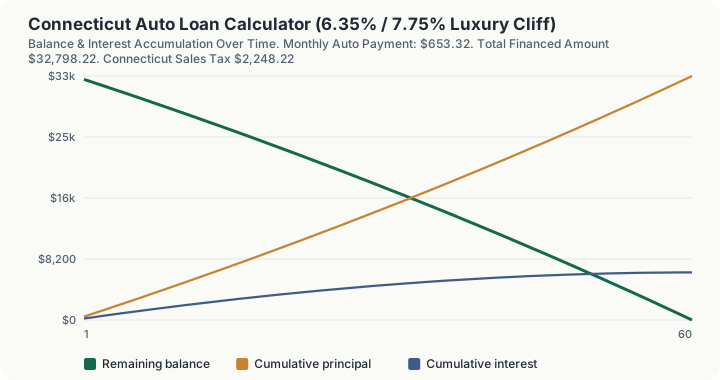
Quick Answer: A $35,000 vehicle in Connecticut with $5,000 cash down, a $405 dealer conveyance fee, a 60-month term, and a 7.25% APR carries a $653.32 monthly payment. That includes $2,248.22 of Connecticut sales tax at 6.35% and $145 in title and registration, financing $32,798.22. If the taxable amount exceeds $50,000, the rate jumps to 7.75% on the entire amount, not just the excess.
Overview
Connecticut taxes motor vehicles at 6.35%, the same as its general sales tax rate. That part is ordinary. What is not ordinary is what happens at $50,000.
Under Conn. Gen. Stat. Sec. 12-408(1), a motor vehicle with a taxable sales price above $50,000 is taxed at 7.75%, and that higher rate applies to the whole taxable amount. It is a cliff, not a bracket. There is no marginal band where the first $50,000 stays at 6.35% and only the excess is taxed at 7.75%. Cross the line by one dollar and the rate on every dollar changes.
The size of that step is easy to underestimate. Take a $49,500 car with a $405 conveyance fee: the taxable amount is $49,905, and the tax is $3,168.97. Move to a $49,700 car, $200 more expensive, and the taxable amount becomes $50,105. The tax is now $3,883.14. Two hundred dollars of extra car costs $714.17 in extra tax.
Two details make that cliff easier to manage than it looks. The dealer conveyance fee counts toward the threshold, so a fee you never negotiated can be what pushes you over. And the trade-in allowance is subtracted before the threshold is tested, so a trade-in can pull a car back under the line and cut the rate on the entire purchase.
This calculator applies the cliff correctly, shows which rate actually got used, and separates the tax from the loan so you can see both.
Auto Loan APR by Credit Score
The APR columns below are national averages, not Connecticut figures. No primary source publishes average auto loan APR by state: Experian's report has no geographic cut, the CFPB publishes state origination volume but no rates, and the New York Fed publishes state delinquency only. The payment column is the part that is specific to Connecticut, because it runs this calculator's own Connecticut tax and fee rules at each tier's rate.
| Credit Tier | VantageScore 4.0 | Avg New APR | Avg Used APR | Est. Payment in Connecticut |
|---|---|---|---|---|
| Super prime | 781-850 | 4.55% | 6.30% | $612.20 |
| Prime | 661-780 | 6.23% | 8.77% | $637.60 |
| Nonprime | 601-660 | 9.67% | 14.03% | $691.55 |
| Subprime | 501-600 | 13.44% | 19.42% | $753.67 |
| Deep subprime | 300-500 | 16.01% | 21.77% | $797.76 |
Payment assumptions: $35,000 vehicle price, $0 trade-in, $5,000 cash down, $405 dealer documentation fee, 60-month term, new-vehicle APR applied to the Connecticut delivered price including tax and statutory fees. At the 6.39% overall new-car average the same purchase costs $640.05 a month.
The score bands are VantageScore 4.0, not FICO. The same borrower can land in a different tier under each model, so a FICO score pulled from a card issuer will not always match the band here. Source: Experian, State of the Automotive Finance Market, Q1 2026, slide 45.
What Moves Your Payment
Each row changes one input and leaves the rest at the baseline below. The dollar effects are this calculator's own output for Connecticut, not a rule of thumb.
| Factor | What Changes | Effect on Monthly Payment | Effect on Total Interest |
|---|---|---|---|
| Vehicle Price | Each extra $1,000 of price raises the amount financed and the sales tax base. Crossing a $50,000 taxable price moves the ENTIRE amount to 7.75%, not just the excess. | +$21.18 | +$207.55 |
| Trade-In Allowance | A $1,000 allowance cuts the amount financed by $1,000 and reduces the sales tax base by the same amount, so it saves tax as well as principal. | -$21.18 | -$207.56 |
| Cash Down Payment | A $1,000 larger down payment cuts the amount financed by $1,000. It never reduces the sales tax, which is assessed on the price, not on what you borrow. | -$19.92 | -$195.17 |
| Dealer Doc Fee | A $100 higher documentation fee adds $100 to the amount financed and is inside the sales tax base, so it is taxed on top of itself. | +$2.12 | +$20.75 |
| Longer Term | Stretching the same balance from 60 months to 72 months spreads the principal over twelve more payments at the same rate. | -$90.20 | +$1,345.65 |
Baseline: $35,000 vehicle price, $0 trade-in, $5,000 cash down, $405 documentation fee, 60 months at 7.25% APR, giving a $653.32 payment and $6,401.00 of total interest.
How This Is Calculated
Connecticut runs a cliff rather than a bracket: a taxable price one dollar over $50,000 moves the entire amount from 6.35% to 7.75%. Five steps.
1. Net taxable amount. Connecticut allows a full trade-in credit when the vehicle is bought from a licensed dealer. The conveyance fee is part of the taxable sales price.
2. Threshold test. The taxable amount from step one, after the trade-in, is compared against $50,000.
3. Sales tax. The selected rate applies to the full taxable amount.
There is no local component. Connecticut has no county or municipal sales tax, so 6.35% and 7.75% are the only two rates in play anywhere in the state.
4. Title and registration. A fixed $145, being the $25 certificate of title and the $120 private passenger registration. Connecticut registers passenger vehicles on a three-year cycle, so the $120 is a multi-year charge collected at purchase rather than an annual one. These fees sit outside the tax base.
5. Amortization. The financed balance amortizes as a fixed-rate installment loan:
where $P$ is the amount financed, $i$ is the monthly rate (APR divided by 12), and $n$ is the term in months.
Worked Example
Connecticut is a cliff state. Cross $50,000 of taxable amount and 7.75% applies to the whole thing, not just the excess, so the baseline below is deliberately set under the line and the second case is set over it.
- Vehicle price: $35,000
- Trade-in allowance: $0
- Cash down: $5,000
- Dealer conveyance fee: $405
- Term: 60 months at 7.25% APR
Step 1 -- The taxable amount. The conveyance fee is inside the base and there is no trade-in: $35,000 + $405 = $35,405.00
Step 2 -- Test the threshold. $35,405.00 is below $50,000, so the rate applied is 6.35%
Step 3 -- The sales tax. $35,405.00 x 6.35% = $2,248.22
Step 4 -- Title and registration, outside the base. $25.00 title + $120.00 registration = $145.00
Step 5 -- Total delivered price. $35,000 + $405.00 + $2,248.22 + $145.00 = $37,798.22
Step 6 -- Amount financed. $37,798.22 - $0 trade-in - $5,000 cash down = $32,798.22
Step 7 -- The monthly payment. $32,798.22 at 7.25% over 60 months = $653.32
Step 8 -- Month 1. $32,798.22 x (7.25% / 12) = $198.16 interest, $455.16 principal, balance $32,343.06
Step 9 -- Month 2. $32,343.06 x (7.25% / 12) = $195.41 interest, $457.91 principal, balance $31,885.15. Cumulative interest: $393.57
Step 10 -- The accumulation. Interest through month 12 is $2,192.70, balance $27,151.08. Over the full 60 months, $6,401.00
Now the cliff. Take a $55,000 vehicle with the same $405 fee. The taxable amount is $55,405, above the threshold, so 7.75% applies to all of it: $4,293.89 in tax and a $1,092.46 monthly payment.
Add a $10,000 trade-in to that same $55,000 purchase. The taxable amount falls to $45,405, back under $50,000, and the rate reverts to 6.35%. Tax drops to $2,883.22, a saving of $1,410.67. That is far more than the $635 a $10,000 trade-in saves on the $35,000 car, because the trade-in did two jobs at once: it removed $10,000 from the base and it moved the whole purchase off the 7.75% rate.
If you are shopping anywhere near $50,000, run the trade-in scenario before you decide to sell your old car privately.
What This Does Not Account For
- The annual municipal motor vehicle property tax. This is a recurring cost, separate from the purchase tax, and it is not financed into the loan. Towns assess vehicles at 70% of value and apply a mill rate that Conn. Gen. Stat. Sec. 12-71e caps at 32.46 mills, meaning $32.46 per $1,000 of assessed value. The cap binds only where a town's motor vehicle rate would otherwise exceed its real property rate, and several towns set vehicle rates below the cap. Budget for it annually.
- Private-party purchases. There is no trade-in credit in a casual sale, and the tax is computed on the greater of the bill-of-sale price or the NADA average trade-in value, not on whatever the two of you agreed. The calculator models a licensed dealer transaction.
- Extended warranties and service contracts. These are always taxed at 6.35%, even on a vehicle whose purchase price triggers the 7.75% rate. The calculator does not model them, so do not fold a warranty price into the vehicle price field or you will overstate the tax on it.
- Statutory registration add-ons. Beyond the base registration there are Clean Air Act, greenhouse gas, and plate fees. The $120 registration figure and the $25 title fee come from secondary summaries of the Connecticut DMV fee schedule rather than a live fee page, so treat both as close estimates and confirm at the DMV.
- GAP insurance, aftermarket add-ons, and negative equity, unless you fold them into the vehicle price yourself.
Common Pitfalls
- Treating the 7.75% rate as a bracket. It is not. There is no marginal calculation and no first-$50,000 exemption. A taxable amount of $50,001 is taxed at 7.75% on all $50,001.
- Testing the threshold against the sticker price. The test uses the taxable amount after the trade-in and including the conveyance fee. Both directions matter: a trade-in can pull you under, and the conveyance fee can push you over.
- Letting an uncapped conveyance fee decide your tax rate. Connecticut law does not cap the fee. Conn. Gen. Stat. Sec. 14-62 requires only that it be disclosed. On a car in the high $49,000s, a $405 fee is what determines whether you pay 6.35% or 7.75%, so it is worth negotiating specifically at that price point.
- Forgetting the annual town property tax when comparing Connecticut to a neighboring state. The purchase tax is only part of the picture. A vehicle assessed at $25,000 in a town at the 32.46-mill cap owes roughly $811 a year on top of the loan.
- Assuming a local rate applies. Connecticut has no local sales tax. If a quote shows a county or city add-on line, it is wrong.
- Judging a loan by the monthly payment alone. Stretching the baseline $32,798.22 balance from 60 to 72 months lowers the payment to $563.12 but raises total finance charges from $6,401.00 to $7,746.62.
Frequently Asked Questions
What is the sales tax on a car in Connecticut?
Does the 7.75% rate apply only to the amount over $50,000?
Does a trade-in reduce sales tax in Connecticut?
Is the dealer conveyance fee capped in Connecticut?
Do I still pay a yearly car tax in Connecticut?
How is tax calculated if I buy from a private seller?
Sources
- Conn. Gen. Stat. Sec. 12-408(1) (6.35% rate and the 7.75% rate on motor vehicles with a taxable price above $50,000, applied to the full amount) sec.gov
- Consumer Financial Protection Bureau, Truth in Lending Act (Regulation Z, 12 CFR Sec. 1026.22) disclosure requirements for installment credit. ecfr.gov/current/title-12/chapter-X/part-1026
- Connecticut Department of Revenue Services, the official state tax authority for Connecticut rates, rules and forms. portal.ct.gov/drs
Also consulted: Connecticut DMV, Sales Tax on Registrations guidance (trade-in credit on licensed dealer sales, private-sale valuation on the greater of bill of sale or NADA value); Conn. Gen. Stat. Sec. 12-430 (trade-in and casual sale provisions); Conn. Gen. Stat. Sec. 12-71e (32.46-mill cap on the municipal motor vehicle property tax); Conn. Gen. Stat. Sec. 14-62 (dealer conveyance fee disclosure requirement); Connecticut Office of Legislative Research, Report 2023-R-0092 (no statutory cap on the conveyance fee, reported average amounts); Connecticut DMV fee schedule (title and private passenger registration fees); Experian, State of the Automotive Finance Market, Q1 2026, slide 45 (average new and used auto loan APR by VantageScore 4.0 credit tier; national, no state level cut published).