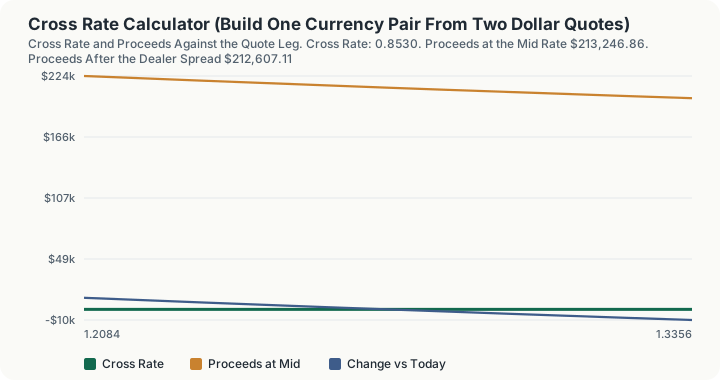
Quick Answer: With EUR/USD at 1.0850 and GBP/USD at 1.2720, the EUR/GBP cross is 0.8530, because 1.0850 divided by 1.2720 is 0.85299. Converting 250,000 euros at that rate gives £213,246.86 at mid, or £212,607.11 after a 0.6% dealer spread, which quietly costs £639.74. A direct quote of 0.8450 would hand over only £211,250, so the cross is worth computing before you accept one.
What does this calculator do?
Most currencies are quoted against the dollar and against almost nothing else. When you need a price for two currencies that are not the dollar, you build it from their two dollar quotes. That constructed price is a cross rate:
EUR/GBP = (EUR/USD)/(GBP/USD)
The dollar cancels. What remains is the price of one euro in pounds, and it is a real tradeable price rather than an approximation, because a dealer quoting a EUR/GBP price away from the cross could be arbitraged by two dollar trades.
The arithmetic is a single division. Everything difficult about cross rates is bookkeeping:
- which currency is the base, the one being priced, and
- which is the quote, the one it is priced in, and
- whether both dollar legs are quoted the same way round.
Get any of those backwards and the answer is not slightly wrong, it is the reciprocal, which for this pair is a 37% error in the wrong direction.
The second thing this page shows is the cost of trading the cross. Crosses are quoted wider than either dollar leg, because the dealer is managing two positions rather than one, and the wider spread never appears as a fee.
How is this calculated?
- Divide the base leg by the quote leg. Both legs are entered as dollars per one unit of the currency, so the dollar cancels and the result is quote-currency units per one base-currency unit.
Cross = (Base/USD)/(Quote/USD)
- Compute the reciprocal pair by swapping the two legs in the same division. It is the same function called with the arguments reversed, rather than one rate divided into the other, so the two figures are consistent by construction and their product is one.
- Multiply the amount by the cross to get the mid-market proceeds. This is the benchmark. Nobody trades at mid.
- Apply half the quoted dealer spread to the rate. The convention is a two-sided spread quoted around mid, so a buyer receives the mid rate reduced by half of it.
Rate_effective = Cross × (1 − spread/200)
- Multiply the amount by that effective rate, and take the spread cost as the difference from the mid proceeds. The proceeds and the cost reconcile to the mid figure to within a cent, each being rounded independently.
- Value any directly quoted cross the same way and compare. The direct proceeds are the amount times the quoted rate. The comparison against mid is reported as a money difference, and the routing verdict compares the direct quote against the spread-adjusted cross, which is the honest comparison because that is the rate you would actually get on the cross route.
The table repeats step 1 with the quote leg walked five percent either side of where it sits, holding the base leg fixed, because a cross moves on either leg and people usually watch only one.
Worked Example
A European exporter has 250,000 euros to convert into sterling. EUR/USD is 1.0850 and GBP/USD is 1.2720.
Step 1: Build the cross. $1.0850 / 1.2720 =$ 0.85299, quoted as 0.8530
One euro buys 85.3 pence.
Step 2: Check the reciprocal. $1.2720 / 1.0850 =$ 1.1724
One pound buys 1.1724 euros, and $0.85299 \times 1.17235 = 1$ exactly. If your two figures do not multiply to one, you have mixed up a quote convention somewhere.
Step 3: Proceeds at mid. $250{,}000 \times 0.85299 =$ £213,246.86
Step 4: The dealer's 0.6% spread. $0.85299 \times (1 - 0.003) = 0.85043$, quoted as 0.8504
$250{,}000 \times 0.85043 =$ £212,607.11
Step 5: What the spread cost. $213{,}246.86 - 212{,}607.11 =$ £639.74
No fee was charged and no line item appeared. The entire cost is in the rate, which is precisely why the mid rate has to be computed separately to see it.
Step 6: Test the direct quote. A bank offers 0.8450 for the pair directly.
$250{,}000 \times 0.8450 =$ £211,250.00
Step 7: Compare. Against mid that is £1,996.86 worse. Against the spread-adjusted cross of £212,607.11 it is still £1,357.11 worse, so the direct quote is carrying an effective spread of roughly 1.6%, not 0.6%.
That is the practical use of a cross rate. You cannot judge a quote for a pair you rarely trade without a benchmark, and the two dollar legs are the benchmark.
Step 8: Watch one leg move. Sterling weakens and GBP/USD falls to 1.2000, while EUR/USD is unchanged.
$1.0850 / 1.2000 =$ 0.9042, and the proceeds rise to £226,041.67
The euro leg never moved, and the exporter is £12,795 better off. A cross has two sources of risk, and hedging only the leg you think of as "your" currency leaves the other one open.
Step 9: Retail pricing. At a 2% spread the effective rate is $0.85299 \times 0.99 = 0.84446$, giving £211,114.39 and a cost of £2,132.47. On a quarter of a million euros, the difference between a 0.6% and a 2% spread is nearly £1,500.
What does this calculator not account for?
- The real bid/ask on each leg. The two dollar legs are entered as single mid rates. In practice each has its own spread, and a cross built from two bid/ask quotes is wider than one built from two mids.
- Transaction fees. Any flat charge, wire fee or correspondent bank deduction sits on top of the spread modelled here.
- Settlement timing. These are spot rates. A forward price differs by the interest rate differential, which is a separate calculation.
- Market impact and size. Large orders move the price. A rate that holds for 250,000 euros may not hold for 25 million.
- Quote conventions that are not dollars-per-unit. USD/JPY and USD/CHF are conventionally quoted the other way round, as units per dollar. Those must be inverted before being entered here.
- Whether a direct market exists. For major pairs such as EUR/GBP a deep direct market exists and the cross is a check on it. For thinly traded pairs the cross is the only price.
- Weekend and holiday gaps. Legs stop moving at different times across sessions.
What mistakes do people make with this?
- Inverting one leg and not the other. The commonest error by a wide margin. If one rate is quoted as dollars per unit and the other as units per dollar, dividing them produces a number with no meaning at all.
- Multiplying instead of dividing. Whether the two legs multiply or divide depends on which side of each quote the dollar sits. If the dollar is the quote currency in both, as here, you divide. The check is the units: the dollars must cancel.
- Trusting a four-decimal cross for a large trade. Rounding 0.85299 to 0.8530 is a 0.001% error, which is £2 on this trade and £200 on a £25 million one.
- Comparing a direct quote against the mid cross. Mid is not available to you. Compare against the cross adjusted for the spread you would actually pay on the two-leg route, which is what the routing verdict here does.
- Assuming the cross is always cheaper. Two trades mean two spreads. For liquid crosses the direct market is often better, and the point of computing the cross is to find out rather than to assume.
- Hedging only one leg. A euro receivable to be converted into sterling is exposed to both EUR/USD and GBP/USD. Step 8 above cost nothing on the euro leg and moved the result by 6%.
- Reading the reciprocal as a different rate. 0.8530 and 1.1724 are the same price stated twice. Quoting one where the other is expected is a factor of 1.37 error.
Frequently Asked Questions
Why go through the dollar at all?
Which leg goes on top?
Should the cross and the direct market rate be identical?
Why is the spread wider on a cross?
Does the amount affect the rate?
What if my rate is quoted as units per dollar?
Sources
- U.S. Securities and Exchange Commission, Investor.gov, the official authority for the investing this calculator relates to. investor.gov
There is no statutory or regulatory source for these formulas, and none is invented here. A cross rate as one currency's dollar price divided by another's is an arithmetic identity, and the two-sided dealer spread convention is a market practice rather than a legal construct. Where rules do exist they govern conduct and disclosure rather than the arithmetic: several jurisdictions require the mid-market rate and the margin taken from it to be disclosed on retail transfers, which is a rule about showing the number in step 5, not about how to compute it.
The implementations are calculateCrossRate and fxConvert in engine/primitives/fx.ts, proven against hand-derived vectors in engine/vectors/fx.test.ts and in this calculator's own vectors.test.ts. Related pages: the currency conversion calculator for a single pair with a spread, the currency forward rate calculator for pricing the same pair at a future date, and the remittance cost calculator for the retail version where the spread does most of the damage.