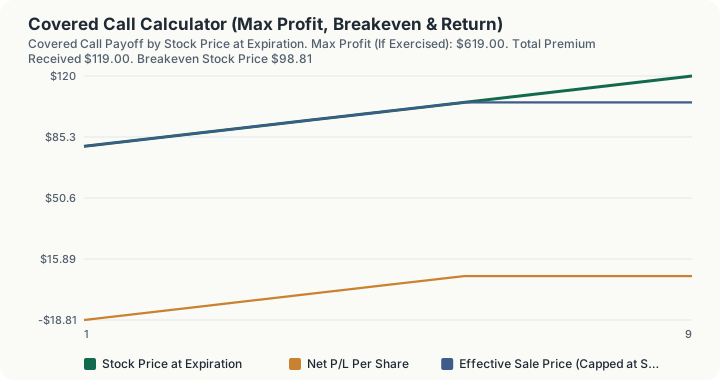
Quick Answer: Selling a $105 call against 100 shares bought at $100 (30 days to expiry, 25% implied volatility) collects a theoretical $1.19 per share ($119.00 total) in premium. That caps max profit at $619.00 if the stock finishes above $105, lowers your breakeven to $98.81, and pays a 1.19% return even if the stock price does not move at all.
Overview
A covered call is one of the most widely used option strategies precisely because it isn't really a bet on direction, it's a way to generate income from shares you already own or are buying today, in exchange for capping how much upside you can capture. You own the stock and simultaneously sell a call option against it. If the stock stays below the strike price, the option expires worthless and you keep the full premium on top of the stock. If the stock rises above the strike, your shares get "called away" (sold) at the strike price, and your total profit is capped at the strike price minus what you paid, plus the premium you collected. This calculator computes the theoretical premium for the call you're selling using the Black-Scholes model, then derives the strategy's max profit, breakeven price, downside protection, and the two standard covered-call return figures every options trader tracks: return if exercised and return if unchanged.
How This Is Calculated
Option premium. The call premium is priced with the Black-Scholes model, the same primitive this platform's standalone options pricing calculator uses, given the stock price, strike, days to expiry, implied volatility, risk-free rate, and dividend yield.
Breakeven price, the stock price below which the position loses money:
Max profit, realized if the stock finishes at or above the strike and shares are called away:
Loss if the stock falls to $0. A covered call's downside is not capped, the stock can still go to zero, but the premium collected does reduce that loss compared to owning the stock alone. This worst case is numerically identical to the breakeven price, since it's exactly the amount you'd be out per share if the shares became worthless:
Return if exercised, the percentage return earned if the shares get called away at the strike:
Return if unchanged, the percentage return earned purely from premium if the stock price does not move by expiration and the call simply expires worthless:
Worked Example
An investor holds 100 shares bought at $100 and sells one 30-day call at the $105 strike against them. Implied volatility is 25%, the risk-free rate 5%, and the stock pays no dividend.
Step 1 -- Price the option. Black-Scholes on a 30-day, $105-strike call at 25% volatility = $1.19 per share
Step 2 -- Premium collected. $1.19 x 100 shares = $119.00 received today
Step 3 -- The breakeven price. $100 cost basis - $1.19 premium = $98.81
Step 4 -- Downside protection. $1.19 / $100 = 1.19%
Step 5 -- Maximum profit per share. ($105 strike - $100 basis) + $1.19 premium = $6.19
Step 6 -- Maximum profit on the position. $6.19 x 100 = $619.00
Step 7 -- Return if exercised. $6.19 / $100 = 6.19% over 30 days
Step 8 -- Return if the stock is unchanged. $1.19 / $100 = 1.19% over 30 days
Step 9 -- Maximum loss, if the stock went to zero. $98.81 x 100 = $9,881.00
The Payoff at Expiration, Priced Out
Walking the outcome across the range is what makes the asymmetry visible.
Step 10 -- Stock finishes at $90. ($90 + $1.19) - $100 = -$8.81 a share, or -$881.00
Step 11 -- Stock finishes at $100, unchanged. ($100 + $1.19) - $100 = $1.19 a share, or $119.00
Step 12 -- Stock finishes at $105, exactly at the strike. ($105 + $1.19) - $100 = $6.19 a share, or $619.00
Step 13 -- Stock finishes at $120. Shares are called away at $105, so ($105 + $1.19) - $100 = $6.19 a share, or $619.00 again
Steps 12 and 13 are identical and steps 9 and 10 are not. That is the whole trade: the upside stops dead at $619.00 no matter how far the stock runs, while the downside continues all the way to $9,881.00. The $1.19 premium in step 4 buys 1.19% of cushion against a move that has no floor, in exchange for capping a move that has no ceiling. A covered call is a bet that the stock finishes between $98.81 and $105, and it is priced fairly for exactly that reason.
Downside Protection vs. Upside Capture
Every covered call is a tradeoff along the same axis: a higher strike price relative to the stock (further out-of-the-money) collects less premium but caps your upside further away, leaving more room to profit if the stock rallies hard. A lower strike (closer to at-the-money) collects more premium and offers more downside cushion, but caps your gains sooner and increases the odds the shares get called away. The "Downside Protection" figure this calculator shows, the premium as a percentage of cost basis, is the exact size of that cushion: it's how far the stock can drop before this specific covered call starts losing money versus simply holding the shares unhedged.
What This Does Not Account For
- Assignment risk before expiration. American-style equity options can be exercised early, particularly just before an ex-dividend date if the call is in-the-money; this calculator assumes European-style exercise only at expiration, matching the Black-Scholes model's own assumption.
- Transaction costs and bid-ask spreads. Real option premiums include a spread between bid and ask; this calculator shows the Black-Scholes theoretical fair value, not an executable market quote.
- Tax treatment of qualified covered calls. Selling calls against stock can affect your holding period and whether dividends and gains qualify for favorable tax treatment (IRS "qualified covered call" rules); this calculator does not model tax consequences.
- Rolling the position. Many covered call traders roll expiring calls into new ones rather than letting shares get called away; this calculator models a single expiration cycle only.
- Dividend timing within the option's life. While a continuous dividend yield input feeds into the Black-Scholes pricing, a discrete, date-specific dividend payment can affect actual option pricing and early-exercise risk differently than the continuous-yield assumption used here.
Common Pitfalls
- Thinking "max loss" means the loss is capped. A covered call still owns the underlying stock; if it goes to zero, you lose your full cost basis minus the premium collected, exactly like owning unhedged shares minus a small cushion. The premium does not create a floor beneath the stock's own downside risk.
- Selling calls too close to the money without wanting to sell the stock. If you don't want your shares called away, selling a strike very close to the current price meaningfully raises the odds of assignment; further out-of-the-money strikes reduce that probability at the cost of less premium.
- Forgetting that "return if unchanged" assumes zero price movement. Any move above zero but below the strike still lets you keep the premium plus any stock appreciation; "if unchanged" is a conservative floor case, not the typical outcome.
- Ignoring that dividends can trigger early assignment. Deep in-the-money calls on dividend-paying stocks are commonly exercised early by the holder just before the ex-dividend date to capture the dividend, which this calculator's expiration-only payoff table does not explicitly flag.
Frequently Asked Questions
What happens if the stock price is exactly at the strike at expiration?
Why would I cap my upside by selling a covered call?
Is a covered call the same as being "short" the stock?
How does implied volatility affect the premium I collect?
Can I run this strategy on stocks I don't already own?
Sources
- Internal Revenue Service, Publication 550, qualified covered call tax treatment. irs.gov/publications/p550
Also consulted: Cboe Global Markets, "Covered Call Strategies," options education materials; Options Clearing Corporation (OCC), exercise and assignment procedures; Financial Industry Regulatory Authority (FINRA), options trading risk disclosures.