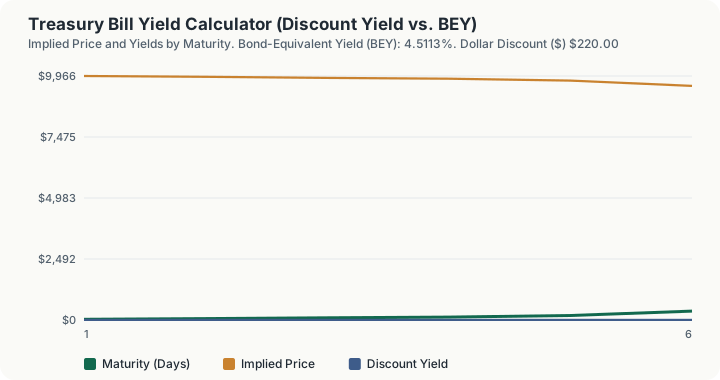
Quick Answer: A 26-week Treasury bill with a $10,000 face value bought at $9,780 has a bank discount yield of 4.3516%, but its bond-equivalent yield (BEY) is 4.5113%, nearly 16 basis points higher, purely because the two yield measures divide the same $220 discount by different denominators.
Overview
Every Treasury bill is quoted two ways, and the two numbers are never equal. The rate you see flash across an auction result or a broker's screen, the bank discount yield, is a market convention inherited from paper commercial bills, not a true measure of return. It divides your gain by the bill's face value, the amount you get back at maturity, rather than by what you actually paid. The bond-equivalent yield (BEY), sometimes called the coupon-equivalent yield, corrects this by dividing by the purchase price instead and annualizing on a 365-day basis, the same convention used for coupon-bearing notes and bonds. This calculator computes both from a T-bill's face value, purchase price, and days to maturity, so you can see the gap directly and compare a T-bill's real return against any other fixed-income instrument on equal footing.
How This Is Calculated
Treasury bills are sold at a discount and pay no coupon; the entire return is the difference between what you pay and the $100-increment face value returned at maturity. The U.S. Treasury defines both yield conventions in 31 CFR Part 356, Appendix B ("Formulas for Calculations Relating to Treasury Bills"), the same rules TreasuryDirect and Treasury auction results use.
Bank discount yield, quoted on an ACT/360 basis:
where $F$ is face value, $P$ is purchase price, and $M$ is days to maturity. Dividing by face value rather than the smaller purchase price, and annualizing on a 360-day year rather than 365, both push this number below the bill's true annualized return. It exists mainly as a historical market convention, not because it's the most accurate yield measure.
Bond-equivalent yield, for bills with 182 days or less to maturity:
where $P_{100}$ is the price rescaled to per-$100-of-face and $y$ is 365 (or 366 if the following 12 months span a leap-year February 29). This is mathematically the same as dividing the dollar discount by purchase price and annualizing on ACT/365, the standard way any other fixed-income return gets quoted.
For bills of more than 182 days to maturity, a straight-line ACT/365 annualization would ignore the fact that a comparable coupon bond compounds semiannually, so Appendix B instead specifies a quadratic equation solved for the annualized rate $i$:
solved via the standard quadratic formula, where $r$ is days to maturity. This calculator applies the correct formula automatically based on whether the bill's term is at or under 182 days or longer, since using the simple linear formula on a 52-week bill would understate its true bond-equivalent yield.
Worked Example
A 26-week bill at the calculator's defaults
$10,000 face, bought at $9,780, 182 days to maturity.
Step 1 -- The dollar discount. $10,000 - $9,780 = $220.00
Step 2 -- The holding period return, not annualized. $220 / $9,780 = 2.2495%
Step 3 -- Bank discount yield, the auction convention. ($220 / $10,000) x (360 / 182) = 4.3516%
Step 4 -- Rescale the price to $100 of face for the BEY formula. $9,780 / 100 = $97.80 per $100 of face, so the discount per $100 is $2.20
Step 5 -- Bond-equivalent yield, at exactly the 182-day boundary. ($2.20 / $97.80) x (365 / 182) = 4.5113%
Step 6 -- The gap. 4.5113% - 4.3516% = 0.1597 percentage points, or just under 16 basis points
Steps 3 and 5 divide the same $220 by different things. Step 3 uses the $10,000 you get back and a 360-day year; step 5 uses the $9,780 you actually paid and a 365-day year. Both adjustments push in the same direction, so the discount yield is always the lower of the two on a bill priced below par -- never the reverse.
Holding the discount yield fixed across the standard tenors
The computed table re-prices this same 4.3516% discount yield at each maturity Treasury issues. Note that the yield columns are rates, not dollars.
Step 7 -- 28-day bill. Implied price $9,966.15, discount yield 4.3521%, BEY 4.4276%, a gap of 0.0754 points
Step 8 -- 91-day bill. Implied price $9,890.00, BEY 4.4612%, gap 0.1095 points
Step 9 -- 182-day bill. Implied price $9,780.00, BEY 4.5113%, gap 0.1597 points
Step 10 -- 364-day bill. Implied price $9,560.00, BEY 4.5632%, gap 0.2116 points
The gap almost triples from step 7 to step 10 on an identical quoted discount yield. That is the practical warning: comparing a 4-week bill's quoted rate against a 52-week bill's quoted rate is not comparing like with like, because the convention's understatement grows with the term.
Two real bills at their own prices
Step 11 -- A 13-week bill, $9,895 for $10,000 face over 91 days. Discount $105.00, discount yield 4.1538%, BEY 4.2562%, gap 0.1024 points
Step 12 -- A 52-week bill, $9,570 for $10,000 face over 364 days. Discount $430.00, discount yield 4.2527%, BEY 4.4560%, gap 0.2033 points
Step 12 crosses the 182-day line, so the engine stops using the linear ACT/365 formula and solves the quadratic that 31 CFR Part 356 Appendix B specifies, putting the bill on the same semiannual-compounding footing as a coupon Treasury. Judged on quoted discount yields the 52-week bill looks barely a tenth of a point better than the 13-week; judged on BEY the advantage is 0.1998 points, roughly double. Same two bills, and the ranking gap changes by a factor of two depending on which convention you read.
Discount Yield vs. Bond-Equivalent Yield: Why They Differ
The two measures diverge for two independent reasons that compound each other. First, the denominator: discount yield divides by face value ($10,000), which is always larger than what you actually invested ($9,780); BEY correctly divides by purchase price, the true cost basis. Second, the day-count convention: discount yield annualizes assuming a 360-day year (a bank-market holdover), while BEY uses the actual 365-day calendar year that every other yield figure you'll see quoted uses. Both factors push discount yield below BEY, never the reverse, for any bill priced under par.
What This Does Not Account For
- Reinvestment assumptions. BEY is a point-in-time annualized figure; it does not assume or model reinvesting the proceeds at the same rate for a full year, unlike an APY compounding calculation.
- Auction competitive vs. noncompetitive bidding mechanics. This calculator takes a purchase price as a given input; it does not model how that price gets set at a Treasury auction.
- State and local tax treatment. T-bill interest is exempt from state and local income tax but fully taxable at the federal level; this calculator shows pre-tax yields only.
- Secondary market bid-ask spreads or settlement timing. Prices quoted on secondary markets can differ from auction results, and this calculator does not model transaction costs.
- Bills with irregular (non-standard) maturities. The days-to-maturity input accepts any value, but real Treasury auctions only issue 4, 8, 13, 17, 26, and 52-week bills.
Common Pitfalls
- Comparing a T-bill's discount yield directly against a CD's or bond's APY. Discount yield is always the lower of the two T-bill figures and uses a different day-count basis; compare BEY to other instruments' yields instead, which is exactly why BEY exists.
- Assuming the yield gap is constant. The gap between discount yield and BEY widens as either the yield level rises or the maturity lengthens; it is not a fixed spread you can just mentally add.
- Using the wrong formula branch for bills over six months. A straight-line ACT/365 conversion of discount yield understates BEY for 52-week bills because it ignores the semiannual-compounding convention Appendix B's quadratic formula corrects for.
- Forgetting the $100-per-unit convention. T-bills are quoted and settled in $100 face-value increments; scaling errors are a common source of yield-calculation mistakes when working from raw price quotes.
Frequently Asked Questions
Why does the Treasury even publish a discount yield if it understates the true return?
Is bond-equivalent yield the same thing as APY?
Why does the formula change at exactly 182 days?
Can I use this calculator for Treasury notes or bonds instead?
Does a higher purchase price always mean a lower yield?
Sources
- U.S. Department of the Treasury, 31 CFR Part 356, Appendix B, "Formulas for Calculations Relating to Treasury Bills." ecfr.gov/current/title-31/subtitle-B/chapter-II/subchapter-A/part-356
- TreasuryDirect.gov, "Treasury Bills," auction results and yield conventions. home.treasury.gov/resource-center/data-chart-center/interest-rates/TextView
- U.S. Securities and Exchange Commission, Investor.gov, Treasury securities overview. investor.gov
- TreasuryDirect, U.S. Department of the Treasury, the official authority for the bonds this calculator relates to. treasurydirect.gov
Also consulted: Securities Industry and Financial Markets Association (SIFMA), U.S. money market conventions.