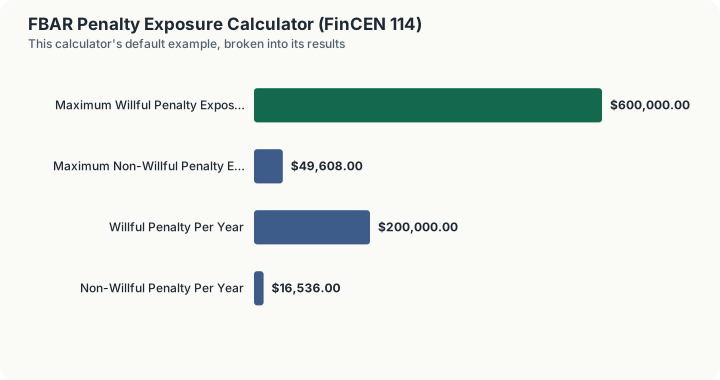
Quick Answer: Failing to file an FBAR can expose you to a non-willful penalty of up to $16,536 per unfiled year, or, if the failure is found willful, the greater of $165,353 or 50% of the account balance per year, for up to six years. On this calculator's baseline of three unfiled years and a $400,000 average balance, that is $49,608 of non-willful exposure against $600,000 of maximum willful exposure.
Overview
U.S. persons, meaning citizens, green card holders, and residents, along with many domestic entities, must file FinCEN Form 114, commonly called the FBAR (Report of Foreign Bank and Financial Accounts), whenever the aggregate value of their foreign financial accounts exceeds $10,000 at any point during the calendar year. This requirement exists separately from, and in addition to, the annual income tax return, and it applies regardless of whether the foreign accounts generated any taxable income at all. A dormant foreign savings account inherited from a relative, a foreign brokerage account, or signature authority over a foreign business account can all trigger the filing requirement even if the account owner never touched the money.
The FBAR is not a tax form and does not itself calculate tax owed. It is an information report, filed electronically with the Financial Crimes Enforcement Network (FinCEN), a bureau of the Treasury Department, not the IRS. That distinction matters because the consequences of not filing are civil penalties, not additional tax, and those penalties can become severe very quickly, especially if the failure is later characterized as willful.
The statute draws two very different penalty tracks. A non-willful violation, generally understood as an inadvertent or negligent failure to file, carries a penalty of up to a fixed dollar amount per violation, adjusted annually for inflation. Following the Supreme Court's 2023 decision in Bittner v. United States, a non-willful penalty applies once per unfiled annual report, not once per individual foreign account within that report, which meaningfully limits exposure for someone with several small accounts compared to how the government had argued the rule should work before that decision.
Willfulness, by contrast, meaning a knowing or reckless failure to file, puts a taxpayer in a different order of magnitude entirely. The penalty for a willful violation is the GREATER of a large fixed dollar amount (also inflation-adjusted) or 50% of the balance of the unreported account at the time of the violation, and this can be assessed for each year within the statute of limitations, generally six years. For an account with a substantial balance, the 50%-of-balance test frequently produces a penalty larger than the fixed dollar figure, and repeated across multiple years, the total exposure can exceed the entire value of the account.
This is a genuinely high-stakes area of tax and regulatory compliance, and the willful-versus-non-willful determination is a factual one made based on the specific circumstances, not a box the taxpayer simply checks. Reasonable people, including experienced tax attorneys, can and do disagree about how a particular set of facts will be characterized. Anyone with unfiled FBARs, or uncertainty about whether their foreign accounts should have been reported, should speak with a tax attorney or CPA experienced in international tax compliance before deciding how to proceed, and should specifically discuss whether one of the IRS's formal voluntary disclosure or delinquent filing procedures might apply to their situation, since coming forward proactively through an appropriate program can substantially reduce or eliminate penalty exposure compared to being found out later.
How This Is Calculated
This calculator computes the maximum statutory penalty exposure under each theory, side by side, so a taxpayer and their advisor can see the scale of the difference between the two outcomes. It does not predict what penalty will actually be assessed in a real case; FinCEN and the IRS retain substantial discretion, and actual assessed penalties, especially non-willful ones, are frequently well below the statutory maximum in practice, particularly for a first-time, clearly inadvertent failure.
Non-willful exposure:
`
Non-Willful Total = $16,536 (2026 maximum per violation) × Number of Unfiled Years
`
Willful exposure, computed per year using the greater of the fixed floor or the percentage test, then summed:
`
Willful Penalty Per Year = max($165,353, 50% × Average Account Balance That Year)
Willful Total = Willful Penalty Per Year × Number of Unfiled Years
`
The calculator asks for both the highest single-year balance (useful context, since the IRS instructions reference the highest balance during the most recently completed year) and an average balance across the unfiled years, since account balances often fluctuate meaningfully from year to year and the 50% test technically applies to the balance "at the time of the violation" for each specific year, not a single number repeated across the whole period. The number of unfiled years is capped at six, the general statute of limitations period for FBAR penalty assessment.
Worked Example
Take a taxpayer who did not file FBARs for three years, with foreign accounts that reached $500,000 in the most recent year and averaged $400,000 across the three. The two theories are computed separately below, because they are separate legal conclusions and the arithmetic only follows once that conclusion is reached.
The non-willful path
Step 1 -- The per-violation maximum for penalties assessed in 2026. $16,536
Step 2 -- The unit the penalty attaches to. After Bittner v. United States (2023), a non-willful penalty attaches to each annual report not filed, not to each account inside it. Three unfiled years means 3 violations, whether the taxpayer held one foreign account or nine.
Step 3 -- One year of exposure. 1 x $16,536 = $16,536
Step 4 -- Two years. 2 x $16,536 = $33,072
Step 5 -- Three years, the case at hand. 3 x $16,536 = $49,608
The non-willful figure is linear in years and completely indifferent to the size of the accounts. A $60,000 account and a $6,000,000 account produce the identical number here.
The willful path
Step 6 -- The fixed floor per violation, per year. $165,353
Step 7 -- The percentage test on the average balance. $400,000 x 50% = $200,000
Step 8 -- Take the greater of the two. max($165,353, $200,000) = $200,000 per year
Step 9 -- Three years of exposure. 3 x $200,000 = $600,000
Step 10 -- The same facts across the full six-year assessment window. 6 x $200,000 = $1,200,000, against $99,216 on the non-willful theory
Where the two tests cross
Step 11 -- The balance at which the percentage test overtakes the floor. $165,353 / 50% = $330,706 of average balance
Step 12 -- Below that line, with an average balance of $45,000. 50% x $45,000 = $22,500, which is below the floor, so the floor governs at $165,353 per year Three years: $496,059
Step 13 -- The ratio between the two theories. At the $400,000 average: $600,000 / $49,608 = 12.09 times At the $45,000 average: $496,059 / $49,608 = 10.00 times
Step 12 is the part most people do not expect. Because the willful penalty has a fixed floor, a comparatively modest account can still carry six-figure annual exposure under that theory, and the ratio between the two paths stays close to ten even for small balances. The size of the account moves the willful number; it is the willfulness finding, not the balance, that decides which column applies.
Everything above is the statutory ceiling, and that is a deliberately narrow thing to compute. FinCEN and the IRS apply internal mitigation guidelines, assessed penalties in ordinary non-willful cases are commonly far below the maximum, a reasonable cause showing can eliminate the non-willful penalty entirely, and disclosure procedures exist for taxpayers who come forward before being contacted. Willfulness itself is a legal conclusion drawn from the whole record, not something a calculator can determine and not something to decide about yourself from a number on a page. If any of these figures are in range for your situation, the useful next step is a conversation with a tax attorney or CPA who can look at the actual facts.
What This Does Not Account For
- Administrative mitigation. FinCEN and the IRS have internal mitigation guidelines that frequently result in penalties well below the statutory maximum, especially for non-willful, first-time, or low-balance situations; this calculator shows the statutory ceiling, not a prediction of the actual assessed amount.
- Voluntary disclosure and delinquent filing programs. The IRS has offered various programs over the years (such as streamlined filing compliance procedures for non-willful taxpayers) that can substantially reduce or, in some circumstances, eliminate penalty exposure for taxpayers who come forward proactively before being contacted by the government. Whether a specific program is currently available and whether a taxpayer qualifies requires current professional advice.
- The separate, smaller "reasonable cause" exception, which can eliminate the non-willful penalty entirely if the taxpayer can demonstrate the failure was due to reasonable cause.
- Criminal penalties. In the most serious willful cases, FBAR violations can also carry criminal exposure under 31 U.S.C. § 5322, entirely separate from the civil penalties calculated here.
- Related tax deficiencies, interest, and accuracy-related penalties on any unreported income the foreign accounts may have generated, which are assessed and calculated separately from the FBAR penalty itself.
- The specific facts that determine willfulness, which is a legal conclusion based on the totality of the circumstances, not a checkbox this or any calculator can determine.
Common Pitfalls
- Assuming a small or dormant account is not reportable. The $10,000 aggregate threshold applies across ALL foreign accounts combined, and a single low-balance account can still trigger the requirement if combined balances exceed $10,000 at any point in the year, even for a single day.
- Confusing FBAR with FATCA Form 8938. These are two separate reporting regimes with different thresholds, different filing locations (FinCEN versus the IRS), and different penalty structures; many taxpayers with foreign accounts must file both.
- Waiting to address a known filing gap. Penalty exposure, particularly willful exposure, tends to compound with each additional year that passes without filing, and voluntary disclosure programs are generally only available before the government has already opened an examination or investigation.
- Self-diagnosing willfulness. Willfulness is a legal determination based on specific facts and evidence, not simply a matter of how guilty or careless the taxpayer feels; an experienced attorney's assessment of the actual facts is far more reliable than a taxpayer's own guess.
- Treating the fixed penalty figures as static. Both the non-willful and willful maximums are adjusted for inflation on a regular basis; the figures used in this calculator are specific to penalties assessed in 2026 and should be reverified against current FinCEN guidance for any other year.
Frequently Asked Questions
What exactly counts as a "foreign financial account" for FBAR purposes?
Is the FBAR penalty a tax, and can it be deducted?
If I file late but before the IRS contacts me, do I still face these penalties?
Does the 50% willful penalty apply to the full account balance, or just the unreported portion?
Can willful FBAR penalties really exceed the value of the account itself?
Sources
- Internal Revenue Service, the official authority for the tax rules this calculator relates to. irs.gov
Also consulted: 31 U.S.C. § 5321(a)(5), civil penalties for FBAR violations, including the willful and non-willful penalty structures; 31 U.S.C. § 5321(b), six-year statute of limitations for FBAR penalty assessment; 31 C.F.R. § 1010.820 and § 1010.821, the FBAR filing requirement and penalty inflation-adjustment mechanics; Bittner v. United States, 598 U.S. 85 (2023), holding that the non-willful FBAR penalty applies on a per-report, not per-account, basis; Financial Crimes Enforcement Network (FinCEN) and Department of the Treasury, annual civil monetary penalty inflation adjustments under the Federal Civil Penalties Inflation Adjustment Act Improvements Act of 2015. 2026 figures: $16,536 non-willful maximum per violation; $165,353 willful maximum per violation (or 50% of account balance, if greater); 31 U.S.C. § 5322, criminal penalties for willful FBAR violations (separate from the civil penalties calculated here).