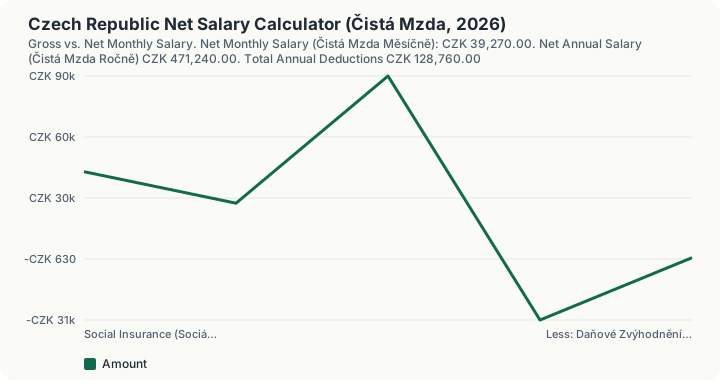
Quick Answer: An employee in the Czech Republic earning a CZK 600,000.00 gross annual salary, with no children, takes home an estimated CZK 471,240.00 net per year (CZK 39,270.00 net per month) in 2026, after CZK 69,600.00 in social and health insurance and CZK 59,160.00 in income tax.
Overview
Working out take-home pay in the Czech Republic (Česká republika) means reconciling a "hrubá mzda" (gross salary) figure against two separate deductions that come straight out of every paycheck: sociální a zdravotní pojištění (mandatory social and health insurance) and daň z příjmů fyzických osob (personal income tax). Since the 2021 abolition of the old "super-hrubá mzda" (super-gross wage) system, the math is more transparent than it used to be -- tax is calculated directly on gross salary, not on a grossed-up figure that used to include the employer's own insurance contributions.
This calculator reconstructs the full 2026 chain for an employee: it applies the current 7.1% employee social-insurance rate and 4.5% employee health-insurance rate (with the social-insurance component capped once income crosses the annual maximum assessment base), runs the result through the Czech Republic's two-band progressive income tax (15% and 23%), and then applies both the flat sleva na poplatníka (basic personal tax credit) and the daňové zvýhodnění na dítě (child tax credit) -- which, uniquely among Czech tax credits, can turn into a refundable "daňový bonus" if it exceeds the tax otherwise owed. The result is a transparent breakdown of exactly where each koruna (CZK) of gross salary goes, useful for evaluating a Czech job offer, understanding a payslip (výplatní páska), or planning around a raise that might cross into the higher tax band.
The Czech Republic's currency is the koruna (CZK), and every figure in this calculator is denominated in CZK.
How This Is Calculated
- Social insurance (sociální pojištění). 7.1% of gross salary, up to the 2026 annual maximum assessment base of CZK 2,350,416.00 (48 times the official 2026 average monthly wage of CZK 48,967.00). Above that ceiling, no further social insurance is owed on the excess.
- Health insurance (zdravotní pojištění). 4.5% of gross salary, with no cap -- the health-insurance maximum assessment base ceiling was abolished in 2013 and has not been reinstated since, so high earners keep paying 4.5% on every additional koruna.
- Tax base. Since the super-hrubá mzda was scrapped in 2021, the income-tax base is simply gross salary itself -- there is no employer-insurance gross-up step.
- Income tax (daň z příjmů), two bands. 15% on the tax base up to CZK 1,762,812.00/year (36 times the 2026 average monthly wage), and 23% on any amount above that threshold.
- Sleva na poplatníka (basic personal tax credit). A flat CZK 30,840.00/year, applied against the computed tax. This credit floors the result at zero -- it cannot itself turn into a refund.
- Daňové zvýhodnění na dítě (child tax credit). CZK 15,204.00/year for a 1st child, CZK 22,320.00 for a 2nd, and CZK 27,840.00 for a 3rd and each additional child -- doubled for a child holding a ZTP/P severe-disability card. Unlike the personal credit, this one can drive the result below zero, producing a refundable "daňový bonus" paid out to the taxpayer (the former CZK 60,300 annual cap on the bonus has been abolished; no cap applies for 2026).
- Net salary. Gross salary minus social insurance, minus health insurance, minus the final tax due (or plus the daňový bonus, if any).
Worked Example
Using the calculator's default inputs:
- Gross Annual Salary: CZK 600,000.00
- Children: 0
Step by step:
- Social insurance: 7.1% × CZK 600,000.00 = CZK 42,600.00 (well under the CZK 2,350,416.00 cap).
- Health insurance: 4.5% × CZK 600,000.00 = CZK 27,000.00.
- Tax base: CZK 600,000.00 (no super-hrubá mzda gross-up since 2021).
- Income tax before credits: CZK 600,000.00 is below the CZK 1,762,812.00 threshold, so the full amount is taxed at 15%: 0.15 × 600,000 = CZK 90,000.00.
- Sleva na poplatníka: CZK 90,000.00 − CZK 30,840.00 = CZK 59,160.00.
- Child tax credit: None claimed, so the figure is unchanged at CZK 59,160.00 tax due, with CZK 0.00 daňový bonus.
- Net salary: CZK 600,000.00 − CZK 42,600.00 − CZK 27,000.00 − CZK 59,160.00 = CZK 471,240.00/year, or CZK 39,270.00/month.
For comparison, the same salary for a filer claiming two children (neither holding a ZTP/P card) reduces the final tax due by the CZK 37,524.00 combined 1st + 2nd child credit -- from CZK 59,160.00 down to CZK 21,636.00 -- raising net pay accordingly.
What This Does Not Account For
- Employer-side contributions. Only the employee's own deductions are shown. The employer separately pays 24.8% for social insurance and 9% for health insurance on top of gross salary -- a substantial cost that never appears on the employee's own payslip but is part of total employment cost.
- Slevy beyond sleva na poplatníka and the child credit. Real Czech tax returns can include additional credits (e.g., for a spouse with low income, for a disability, or for a student), mortgage interest deductions, or gift/donation deductions -- none of which are modeled here.
- Monthly withholding versus annual assessment nuances. This calculator models the full-year outcome the way an annual daňové přiznání (tax return) or year-end payroll reconciliation would compute it. Month-to-month withholding can differ slightly, particularly around when the higher 23% band or a change in dependents first applies mid-year.
- Non-salary income. Investment income, rental income, and capital gains are taxed under separate rules (and sometimes different rates or exemptions) not modeled here.
- The minimum health-insurance base for very low earners. Employees whose gross wage falls below the statutory minimum wage in a given month may owe a "doplatek" (top-up) on health insurance to reach the legal minimum assessment base -- a low-income edge case not modeled in this calculator, which assumes a normal full-time salary.
- Sickness, unemployment, or other benefit interactions. This model computes deductions from gross pay; it does not project sick pay, maternity/parental benefits, or unemployment benefit eligibility, which depend on separately tracked contribution histories.
Common Pitfalls
- Forgetting the super-hrubá mzda was abolished in 2021. Some older rules of thumb and outdated spreadsheets still gross up salary by the employer's insurance share before taxing it -- that model has not applied since 2021; tax is now calculated directly on gross salary.
- Assuming health insurance is capped like social insurance. Only the social-insurance component has a maximum assessment base (48× average wage); health insurance keeps taking 4.5% no matter how high the salary climbs.
- Not realizing the child credit can produce a refund. Because the daňové zvýhodnění na dítě can turn into a daňový bonus (unlike sleva na poplatníka, which only zeroes out tax), lower-income parents with several children may be entitled to money back even if their computed tax before credits was modest.
- Comparing job offers by gross salary alone. Because the 23% band only starts well above the average wage (36× the 2026 average monthly wage), most Czech salaries stay entirely within the 15% band -- a "big number" gross offer doesn't always mean a proportionally bigger net gain if it crosses into the higher band.
- Overlooking the ZTP/P doubling rule. It's easy to enter the number of children correctly but forget to flag which of them hold a ZTP/P card, understating the credit by half for that child.
Frequently Asked Questions
Is the "super-hrubá mzda" (super-gross wage) still used to calculate Czech income tax?
Why does my health insurance keep going up even though my social insurance stopped increasing?
What is a daňový bonus and who gets one?
How much of my salary goes to social and health insurance combined?
At what income does the 23% tax band start applying?
Sources
- Finanční správa ČR (financnisprava.gov.cz) -- "Obecné informace" (Zaměstnanci a zaměstnavatelé | Daň z příjmů), current 2026 figures for income tax rates, the sleva na poplatníka, daňové zvýhodnění na dítě, and the 2026 average monthly wage (CZK 48,967.00). financnisprava.cz
Also consulted: mzdy.cz -- consolidated 2026 payroll-rate tables for employee/employer social and health insurance rates, cross-corroborated with kurzy.cz and MPSV's "Sociální pojištění v roce 2026" page; Česká správa sociálního zabezpečení (cssz.gov.cz) -- maximum assessment base for social insurance (48x average monthly wage), for 2026.