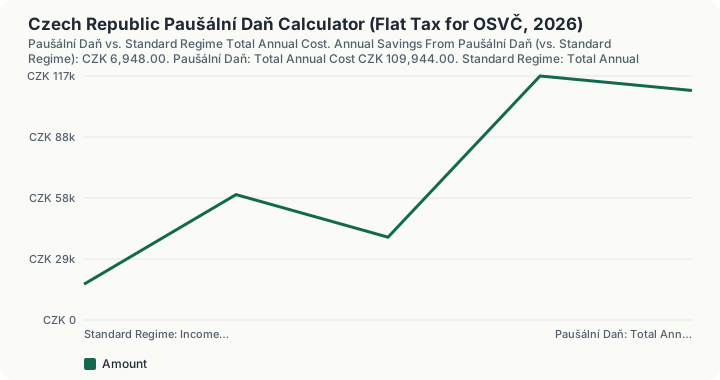
Quick Answer: A self-employed person (OSVČ) in the Czech Republic in Band 1 (Pásmo 1) with CZK 800,000.00 in annual revenue and a 60% flat-rate expense deduction pays an estimated CZK 109,944.00/year under paušální daň versus CZK 116,892.00/year under the standard regime -- making paušální daň about CZK 6,948.00 cheaper for 2026.
Overview
Paušální daň ("flat tax") is an optional regime for OSVČ (osoba samostatně výdělečně činná, i.e. self-employed sole traders) that replaces three separate obligations -- income tax, sociální pojištění (social/pension insurance), and zdravotní pojištění (health insurance) -- with a single fixed monthly payment. Instead of filing an annual tax return, tracking real or flat-rate expenses, and reconciling social and health insurance separately, a paušální-daň taxpayer simply pays one number every month and (in most cases) is done.
Since 2023, paušální daň has three bands (pásma), each with its own fixed monthly total and prior-year revenue ceiling. For 2026, Band 1's monthly total changed mid-year: an amendment retroactively reduced its pension-insurance component for the whole year, applied from July 2026 with a credit for taxpayers who had already overpaid. Bands 2 and 3 are unaffected and stay flat all year.
This calculator computes your correct full-year 2026 paušální daň total for the band you select (correctly netting Band 1's January-June credit against the reduced July-December rate, since the reduction was applied retroactively to the whole year), and compares it against the standard regime -- real progressive income tax on profit after a chosen flat-rate expense deduction, plus standard-regime social and health insurance on that same profit. Comparing the two totals is the whole point: paušální daň suits some OSVČ and shortchanges others, depending mostly on how much of revenue is genuinely profit.
The Czech Republic's currency is the koruna (CZK), and every figure in this calculator is denominated in CZK.
How This Is Calculated
- Paušální daň total (selected band). Each band has a fixed CZK monthly total for 2026: - Band 1 (Pásmo 1): CZK 9,984.00/month January-June 2026 in cash, then CZK 9,162.00/month July-December 2026 (a mid-year reduction in the pension-insurance component). The reduction was enacted retroactively to 1 January 2026, so the January-June overpayment (CZK 4,932.00 total) is credited back -- the true full-year 2026 liability is 12 x the reduced rate: CZK 109,944.00. - Band 2 (Pásmo 2): CZK 16,745.00/month, flat all year. Full-year total: CZK 200,940.00. - Band 3 (Pásmo 3): CZK 27,139.00/month, flat all year. Full-year total: CZK 325,668.00.
Eligibility depends on your prior-year self-employment revenue: Band 1 requires revenue up to CZK 1,000,000 (any composition), or up to CZK 1,500,000/2,000,000 if at least 75% of revenue qualifies for the 60%/80% flat-rate expense deduction respectively; Band 2 requires up to CZK 1,500,000 (any composition) or CZK 2,000,000 under the same 75%-qualifying condition; Band 3 covers any composition up to CZK 2,000,000.
- Standard-regime profit. Annual revenue minus a chosen flat-rate expense percentage (80% for agriculture/craft trades, 60% for most other trade licenses, 40% for liberal professions and most other self-employment, or 30% for asset rental and certain other income types).
- Standard-regime income tax. The same progressive 15%/23% formula used for employees, applied to profit, minus the flat CZK 30,840.00/year sleva na poplatníka (this comparison does not add child credits, to keep the comparison focused purely on the OSVČ/business decision).
- Standard-regime social insurance. 29.2% of an assessment base equal to 55% of profit, floored at the published 2026 minimum monthly contribution (CZK 5,005.00/month from July 2026) and capped once the base reaches 48× the average monthly wage.
- Standard-regime health insurance. 13.5% of an assessment base equal to 50% of profit, floored at the published 2026 minimum monthly contribution (CZK 3,306.00/month), with no upper cap.
- Comparison. Standard-regime total (tax + social + health) minus the paušální daň total. A positive number means paušální daň saves you money; a negative number means the standard regime is cheaper.
Worked Example
Using the calculator's default inputs:
- Annual Revenue: CZK 800,000.00
- Band: 1 (Pásmo 1)
- Expense Ratio (standard-regime comparison only): 60%
Step by step:
- Paušální daň (Band 1, full year 2026): the January-June rate cut was retroactive to 1 January 2026, so the true annual liability is 12 x the reduced rate: CZK 9,162.00 × 12 = CZK 109,944.00 (the CZK 4,932.00 difference from the CZK 9,984.00/month cash rate paid January-June is credited back).
- Standard-regime profit: CZK 800,000.00 × (1 − 0.60) = CZK 320,000.00.
- Standard-regime income tax: 15% × CZK 320,000.00 = CZK 48,000.00; minus sleva na poplatníka (CZK 30,840.00) = CZK 17,160.00.
- Standard-regime social insurance: 55% × CZK 320,000.00 = CZK 176,000.00 assessment base; 29.2% × that = CZK 51,392.00 -- below the CZK 60,060.00/year minimum (CZK 5,005.00 × 12), so the minimum applies: CZK 60,060.00.
- Standard-regime health insurance: 50% × CZK 320,000.00 = CZK 160,000.00 assessment base; 13.5% × that = CZK 21,600.00 -- below the CZK 39,672.00/year minimum (CZK 3,306.00 × 12), so the minimum applies: CZK 39,672.00.
- Standard-regime total: CZK 17,160.00 + CZK 60,060.00 + CZK 39,672.00 = CZK 116,892.00.
- Comparison: CZK 116,892.00 − CZK 114,876.00 = CZK 2,016.00 -- paušální daň saves CZK 2,016.00/year at this revenue and expense level.
For a very different case, an OSVČ in Band 3 with CZK 1,900,000.00 revenue but genuinely high real costs (80% expense ratio, leaving only CZK 380,000.00 profit) would owe just CZK 126,860.00 under the standard regime versus CZK 325,668.00 under paušální daň -- a case where paušální daň would cost nearly CZK 199,000.00/year more than necessary.
What This Does Not Account For
- The prior-year revenue rule. Real eligibility for each band is fixed based on your previous calendar year's actual revenue and composition, not the revenue you enter for the current year's estimate. This calculator assumes you already qualify for the band you select.
- Mid-year regime switches, opt-outs, and exits. Leaving paušální daň mid-year, exceeding the VAT registration threshold, or taking on employees can force an exit from the regime with month-specific consequences not modeled here.
- Real (not flat-rate) expenses under the standard regime. If your actual documented expenses differ from the flat-rate percentages offered here, the standard-regime side will be less precise -- pick the percentage closest to your real ratio, or use a bespoke bookkeeping estimate instead.
- Children and other tax credits under the standard regime. The standard-regime side applies only the basic sleva na poplatníka, to isolate the pure business-structure decision; a parent claiming child credits would see the standard regime look comparatively more attractive than shown here.
- Health insurance for OSVČ who are also employed (souběh) or state-insured (student, pensioner, parent on leave). Different minimum-contribution rules can apply and are not modeled.
- VAT and other business taxes. Paušální daň covers only income tax and social/health insurance; VAT (DPH), road tax, and other obligations are unaffected by which regime you choose.
Common Pitfalls
- Assuming paušální daň is always the cheaper option. It is a great deal for OSVČ whose real expenses run close to (or below) the flat-rate percentage assumed for their trade; it can be a poor deal for anyone with genuinely low profit margins relative to revenue, as the Band 3 example above shows.
- Picking a band based on the current year's expected revenue instead of last year's actual revenue. Band eligibility is set by your prior calendar year's figures, filed by a January deadline -- not a forecast of the year ahead.
- Forgetting the Band 1 mid-year change for 2026. Anyone budgeting off last year's Band 1 monthly figure (CZK 8,716.00 in 2025) should use the correct 2026 amounts (CZK 9,984.00 for January-June, then CZK 9,162.00 from July) rather than either the old 2025 figure or a single flat 2026 number.
- Ignoring the 75% composition rule for the higher revenue ceilings. Bands 1 and 2 offer higher revenue ceilings only if at least 75% of revenue would otherwise qualify for the 60%/80% flat-rate expense deduction -- mixed-income OSVČ can be surprised to find they only qualify for a lower ceiling than they expected.
- Not re-checking eligibility every year. A strong year of revenue growth can push an OSVČ out of their current band (or out of paušální daň eligibility entirely) for the following year, even if this year's payments continue unchanged.
Frequently Asked Questions
Why did the Band 1 monthly payment change partway through 2026?
Can I switch between paušální daň and the standard regime whenever I want?
Does choosing paušální daň mean I never have to file anything?
Which expense ratio should I use in the standard-regime comparison?
Is paušální daň available to everyone who is self-employed?
Sources
- Finanční správa ČR (financnisprava.gov.cz) -- "Informace k institutu paušální daně pro rok 2025 a 2026" and the GFŘ press release "Poplatníkům v prvním pásmu paušálního režimu se od července 2026 sníží záloha," current 2026 figures. financnisprava.cz
Also consulted: Cross-corroborating component-level breakdown of all three 2026 bands (dokladbot.cz), matching every figure from the primary source; Finanční správa ČR "Obecné informace" -- 2026 progressive income tax rates and sleva na poplatníka, used for the standard-regime comparison; Česká správa sociálního zabezpečení (cssz.gov.cz) -- "Zálohy na pojistné na důchodové pojištění" (29.2% rate, 55% assessment-base share) and "Změna výše minimálních záloh OSVČ v roce 2026" (2026 minimum contribution amounts); VZP ČR -- "OSVČ - minimální výše záloh," 2026 minimum health-insurance contribution for self-employed persons.