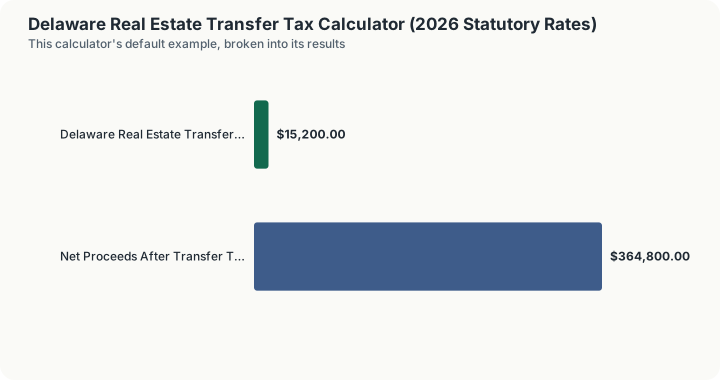
Quick Answer: A $380,000 home sale in Delaware owes $15,200.00 in combined state and local realty transfer tax, a flat 4% rate that stands as the highest fixed combined transfer tax rate of any state in the country.
Overview
Delaware's realty transfer tax carries the highest fixed combined rate of any state in the country: a 2.5% state tax under Title 30, Chapter 54, plus a local rate of up to 1.5% that New Castle County, Kent County, and most Delaware municipalities have all enacted at the full permitted level. Added together, that produces a typical combined rate of 4% of the sale price, which on a $380,000 home works out to $15,200, a figure that surprises buyers moving from states where 1% or 2% combined is considered high.
Delaware law does not fix which party pays, and local custom commonly splits the combined 4% evenly between buyer and seller, though the purchase contract governs the actual allocation and practices can vary by transaction. Because both the state and local components are already at their statutory ceilings in nearly every Delaware jurisdiction, there is little of the county-by-county variation found in a state like Maryland, where local rates range from 0% to 1.5%.
How This Is Calculated
Delaware carries the highest fixed combined transfer tax rate in the country, 4%, and it gets there by splitting the charge between the state and the local jurisdiction.
The engine applies the 2.5% state rate under Title 30, Chapter 54 plus a 1.5% local rate. The state rate is 2.5% precisely where the local jurisdiction has enacted its full 1.5%, which New Castle, Kent and most Delaware municipalities have. There is no bracket structure, so 4% applies to a starter home and a waterfront estate alike.
Worked Example
Delaware's combined rate is the highest fixed transfer tax in the country, and the engine builds it from two separate multiplications rather than one.
Step 1 -- The consideration. Contract sale price = $380,000
Step 2 -- The state realty transfer tax. Del. Code Title 30 Ch. 54, 2.5% of the full price: $380,000 x 0.025 = $9,500.00
Step 3 -- The local realty transfer tax. The full 1.5% enacted in New Castle, Kent and most municipalities: $380,000 x 0.015 = $5,700.00
Step 4 -- Total transfer tax due. $9,500.00 + $5,700.00 = $15,200.00
Step 5 -- Net proceeds after tax. $380,000.00 - $15,200.00 = $364,800.00
Step 6 -- The effective rate. $15,200.00 / $380,000 = 4.000%
The calculator's $1,500,000 scenario, where the same two multiplications simply get larger.
Step 7 -- State portion on the luxury sale. $1,500,000 x 0.025 = $37,500.00
Step 8 -- Local portion on the luxury sale. $1,500,000 x 0.015 = $22,500.00
Step 9 -- Total on the luxury sale. $37,500.00 + $22,500.00 = $60,000.00
Step 6 is the number to hold on to. Four percent of a sale price is a larger transfer tax than any bracket in Connecticut, Washington or Vermont reaches, and Delaware charges it on the first dollar as well as the last, with no low-value tier and no threshold. The comparison is stark: the same $1,500,000 sale in Step 9 costs $60,000 in Delaware against $1,500 in Georgia and $1,650 in California. Delaware convention splits the tax evenly between buyer and seller, which the engine does not model, so each side would ordinarily carry half of Step 4. First-time Delaware buyers can claim a partial exemption on the state portion, which is likewise not modelled here.
What This Does Not Account For
- First-time homebuyer reductions. Delaware offers a reduced transfer tax rate for qualifying first-time homebuyers on their primary residence, which can lower the effective rate below the 4% standard combined figure this calculator uses. This calculator models the standard non-exempt rate.
- Sussex County and municipalities with a lower local rate. While New Castle, Kent, and most municipalities charge the full 1.5% local rate, a small number of jurisdictions may charge less, which would lower the combined rate below 4% for those specific properties.
- Split payment by contract. Delaware customarily divides the transfer tax between buyer and seller (commonly 50/50 by local practice), though this calculator reports the total tax due rather than each party's individual share.
- Recording fees and title insurance. Delaware county recorders of deeds charge separate flat recording fees, and title insurance premiums are entirely separate from the realty transfer tax calculated here.
Common Pitfalls
- Underestimating Delaware's rate relative to neighboring states. Buyers relocating from Pennsylvania (2% combined typically) or Maryland (around 1% combined) sometimes budget using a rate from a neighboring state, dramatically underestimating what a Delaware closing will actually cost.
- Forgetting to check first-time homebuyer eligibility. Delaware's reduced rate for qualifying first-time buyers can meaningfully lower the effective tax; buyers who might qualify should confirm eligibility before assuming the full 4% rate applies to their purchase.
- Assuming the state and local rates are optional or capped. Because nearly every Delaware locality has adopted the full 1.5% local rate, the "typical" 4% combined figure is effectively the default assumption for the vast majority of the state, not a worst-case scenario.
- Splitting the tax incorrectly at closing. Local custom in Delaware commonly splits the transfer tax 50/50 between buyer and seller, but this is a matter of contract, not statute, and should always be confirmed in the purchase agreement rather than assumed.
Frequently Asked Questions
What is Delaware's real estate transfer tax rate?
Who pays the realty transfer tax in Delaware?
Does Delaware offer any reduction for first-time homebuyers?
Why is Delaware's combined rate so much higher than most states?
Is Delaware's transfer tax marginal like Connecticut's?
Sources
- Delaware Division of Revenue: Realty Transfer Tax guidance, Delaware Code Title 30, Chapter 54. revenue.delaware.gov