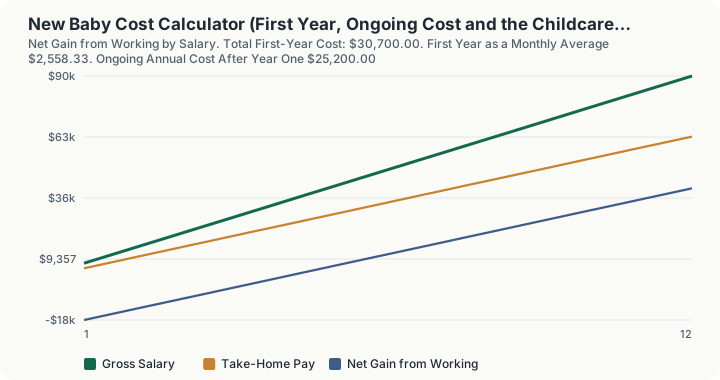
Quick Answer: A first baby costs $30,700.00 in year one, an average of $2,558.33 a month. Of that, $5,500 is one-off and does not repeat, leaving an ongoing annual run rate of $25,200 once a full twelve months of childcare begins. Separately, a second earner returning to work on a $45,000 salary nets $8,857.50 a year after tax, childcare and the costs of working, which is 19.68% of the salary and $12,590.62 above the breakeven salary of $32,409.38.
What does this calculator do?
Two different questions live on this page and it is worth keeping them apart.
The first is what the first year costs. That is an addition problem: a birth cost after insurance, the one-off purchases, the recurring monthly costs, the childcare paid during whatever part of the year it starts, the pay given up during unpaid leave, and the increase in insurance premiums from adding a dependant. It is worth doing carefully because the first year is unusual: it contains one-off items that will never recur and, usually, only a partial year of childcare, so reading the first-year total as a run rate is wrong in both directions at once.
The second question is the one people get wrong, and it is the childcare cliff. A second earner returning to work does not gain their salary. They gain their salary, less the tax on it, less childcare, less the costs that only exist because they work. Because childcare is paid out of after-tax income, there is a salary below which working is a net loss, and it is much higher than most people expect. At the defaults, that breakeven salary is $32,409.38, against childcare of $19,200 a year.
Nothing statutory is encoded here. No parental leave entitlement, no dependent care credit design, no childcare subsidy scheme and no tax bracket. Every rate, cost and subsidy is a number you supply, which is what lets the page work regardless of jurisdiction and which is also why the defaults are placeholders rather than research.
How is this calculated?
First Year = Birth + Setup + 12M_b + m_c × M_c + w × P_w + I
Net Gain from Working = S(1 − tₘ − tₚ) − 12C − 12W + σ
Breakeven Salary = (12C + 12W − σ)/(1 − tₘ − tₚ)
Step 1: Annualise the recurring baby costs. $300 a month x 12 = $3,600
Step 2: Compute the childcare paid inside the first year. $1,600 a month x 6 months = $9,600
Step 3: Compute the pay given up during unpaid leave. 8 weeks x $1,200 a week = $9,600
Step 4: Add the one-off and annual items. $3,000 birth cost after insurance + $2,500 of setup purchases + $3,600 recurring + $9,600 childcare + $9,600 forgone leave income + $2,400 extra insurance = $30,700.00
Step 5: Spread it over twelve months. $30,700.00 / 12 = $2,558.33 a month
Step 6: Compute the ongoing run rate, which is a different number. Recurring costs of $3,600 plus a full twelve months of childcare at $1,600, being $19,200, plus $2,400 of insurance = $25,200 a year
Step 7: Isolate the one-off premium in year one. $30,700.00 - $25,200.00 = $5,500.00 That is the birth cost plus the setup purchases, and it does not repeat. Note that the first year is also lighter on childcare than a normal year, by six months' worth.
Step 8: Compute the returning earner's take-home pay. Combined rate: 22% income tax plus 7.65% payroll tax = 29.65% $45,000 x 29.65% = $13,342.50 of tax $45,000 - $13,342.50 = $31,657.50
Step 9: Subtract the costs that exist only because they work. Childcare: $1,600 x 12 = $19,200 Costs of working: $400 x 12 = $4,800 Subsidy received: $1,200 $31,657.50 - $19,200 - $4,800 + $1,200 = $8,857.50 a year
Step 10: Express that as a rate and find the breakeven. $8,857.50 / $45,000 = 19.68% of the salary $8,857.50 / 12 = $738.13 a month Breakeven: ($19,200 + $4,800 - $1,200) / (1 - 0.2965) = $22,800 / 0.7035 = $32,409.38 $45,000 - $32,409.38 = $12,590.62 of headroom above the cliff
Worked Example
The breakeven figure is the one that changes decisions, so it deserves a walk of its own.
Step 1: Total the costs that must be covered. $19,200 of childcare plus $4,800 of commuting, work clothing and convenience costs, less the $1,200 subsidy: $22,800
Step 2: Recognise that they are paid from after-tax income. Every dollar of those costs requires more than a dollar of salary, because tax is taken first.
Step 3: Compute how much of each salary dollar survives tax. 1 - 0.2965 = $0.7035 kept per dollar of salary
Step 4: Gross the cost up. $22,800 / 0.7035 = $32,409.38 Below that salary, this earner loses money by working.
Step 5: Test a $30,000 salary against it. $30,000 x 0.7035 = $21,105 of take-home $21,105 - $19,200 - $4,800 + $1,200 = a loss of $1,695 a year The job pays $30,000 and costs the household money.
Step 6: Put the $45,000 job in the same terms. It nets $8,857.50, or $738.13 a month, which is 19.68% of the salary. Four-fifths of the gross is consumed before it reaches the household.
That is the honest arithmetic of the decision, and it is worth noting what it does not say. It does not price career continuity, pension accrual, the value of not restarting a career later, or the risk of a single-income household. Those are real and this calculator does not attempt them.
What does this calculator not account for?
- Any parental leave entitlement, statutory or employer-provided. The weeks of unpaid leave and the weekly pay forgone are both numbers you enter.
- Any childcare subsidy or tax credit design. The subsidy is a single annual figure you supply; no scheme is modelled, and in particular the US dependent care credit's rules, limits and phase-outs are not applied.
- Tax brackets and progressivity. One flat combined marginal rate is applied to the returning earner's whole salary. In reality the first dollars are taxed lower, which makes the true breakeven somewhat lower than the figure shown.
- The child tax credit, filing status changes, or any other tax effect of adding a dependant beyond the insurance premium you enter.
- Employer benefits such as a dependent care flexible spending account, which changes the arithmetic materially where it is available.
- The second and subsequent child, where childcare costs often rise less than proportionally and setup costs largely disappear.
- Childcare cost changes as the child ages. Infant care is typically the most expensive year, and the rate here is held constant.
- Career and pension effects of leaving work, which are real, long-dated, and not in this arithmetic. The sabbatical calculator on this site prices that shape of loss.
- Anything after year one except through the ongoing run rate, which itself assumes prices do not move.
What mistakes do people make with this?
- Reading the first-year total as a run rate. It contains $5,500 of one-off cost that never recurs, and only six months of childcare rather than twelve. Both errors are large and they point in opposite directions.
- Comparing childcare to gross salary. Childcare is paid from after-tax income. At a 29.65% combined rate, $19,200 of childcare consumes $27,292 of salary.
- Forgetting the costs of working. Commuting, work clothing and the convenience spending that comes with two working parents add $4,800 a year here, and they move the breakeven by nearly $6,800 of salary.
- Ignoring the forgone pay during leave. At $9,600 it is nearly a third of the first-year total and it is the item most often left out of a baby budget entirely.
- Treating a negative net gain as a reason to stop working. The arithmetic here is one year at a time. It says nothing about earnings five years later, which is where the cost of a career break usually shows up.
- Assuming the birth cost is the insured amount. The field asks for out-of-pocket cost after insurance, which for a US household means the deductible and coinsurance rather than the billed amount.
- Using a marginal rate that includes payroll tax twice. The two rates are entered separately here and added, so entering 29.65% in the income tax field alongside 7.65% of payroll tax overstates the tax by a third.
Frequently Asked Questions
How much does a baby cost in the first year?
What is the childcare cliff?
Why does a $45,000 job only add $8,857.50?
Does the calculator include the child tax credit or the dependent care credit?
Should the lower earner stop working if the net gain is small?
Why is the first-year total higher than the ongoing annual cost even though childcare is only six months?
Sources
- U.S. Bureau of Labor Statistics, Consumer Expenditure Surveys. bls.gov/cex
Also consulted: No figure on this page comes from any authority. There is no official schedule of what a baby costs, of childcare rates, or of the cost of working, and every one of them is supplied by the user; The tax rates are also yours to enter. The engine applies a flat combined marginal rate and a flat payroll rate to the returning earner's salary, and looks nothing up; For US childcare costs, the closest thing to comparable public data is the Department of Labor Women's Bureau National Database of Childcare Prices, which reports county-level median prices by care type and by the age of the child. It is survey data rather than a rate schedule, it is not current, and this engine does not use it. A written quote from the provider you would actually use is better evidence than any national figure; For the birth cost after insurance, your own plan's summary of benefits and coverage is the only reliable source.