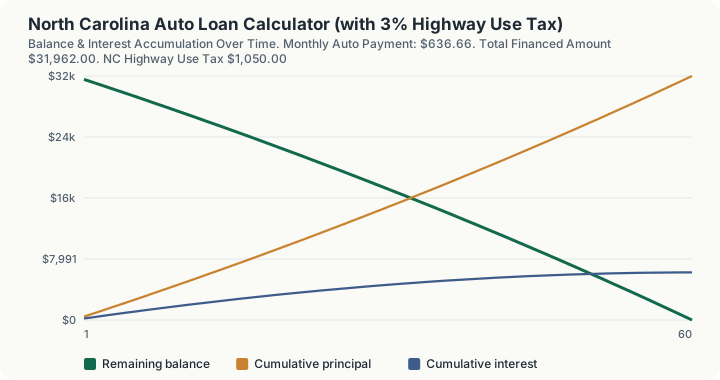
Quick Answer: A $35,000 vehicle in North Carolina with $5,000 cash down, a $799 dealer documentation fee, a 60-month term, and a 7.25% APR carries a $636.66 monthly payment. That figure includes $1,050.00 of Highway Use Tax at the flat 3% statewide rate and $113.00 in title and plate fees, financing $31,962.00 in total.
Overview
North Carolina does not charge sales tax on a car. It charges a Highway Use Tax, levied under N.C.G.S. § 105-187.3 in Article 5A of Chapter 105, at 3% of the vehicle's sales price. The state's 4.75% general sales tax and the 2.0% to 2.75% county rates that ride on top of it do not touch a motor vehicle purchase at all. That is why a North Carolina car costs less in tax than the same car in most neighboring states, and why any estimate built on the general sales tax rate will be roughly double the true figure.
There is one rate and it applies everywhere in the state. No county add-on, no city add-on, no transit district. A buyer in Charlotte, Asheville, and Elizabeth City all pay 3%.
The tax is uncapped for ordinary passenger vehicles. A $2,000 ceiling exists in the statute, but it applies to Class A and Class B commercial motor vehicles and to recreational vehicles. A private car pays the full 3% whatever it costs, so a $70,000 vehicle owes $2,100 and a $100,000 vehicle owes $3,000. Quoted caps circulating on car-buying sites usually omit the class restriction, which is the most common error in North Carolina estimates.
What North Carolina takes back on the other end is the annual county vehicle property tax, billed with your registration renewal through the Tag and Tax Together program. That is a recurring cost outside this calculator and it is often larger over a few years than the Highway Use Tax was at purchase.
Auto Loan APR by Credit Score
The APR columns below are national averages, not North Carolina figures. No primary source publishes average auto loan APR by state: Experian's report has no geographic cut, the CFPB publishes state origination volume but no rates, and the New York Fed publishes state delinquency only. The payment column is the part that is specific to North Carolina, because it runs this calculator's own North Carolina tax and fee rules at each tier's rate.
| Credit Tier | VantageScore 4.0 | Avg New APR | Avg Used APR | Est. Payment in North Carolina |
|---|---|---|---|---|
| Super prime | 781-850 | 4.55% | 6.30% | $596.60 |
| Prime | 661-780 | 6.23% | 8.77% | $621.34 |
| Nonprime | 601-660 | 9.67% | 14.03% | $673.92 |
| Subprime | 501-600 | 13.44% | 19.42% | $734.45 |
| Deep subprime | 300-500 | 16.01% | 21.77% | $777.42 |
Payment assumptions: $35,000 vehicle price, $0 trade-in, $5,000 cash down, $799 dealer documentation fee, 60-month term, new-vehicle APR applied to the North Carolina delivered price including tax and statutory fees. At the 6.39% overall new-car average the same purchase costs $623.73 a month.
The score bands are VantageScore 4.0, not FICO. The same borrower can land in a different tier under each model, so a FICO score pulled from a card issuer will not always match the band here. Source: Experian, State of the Automotive Finance Market, Q1 2026, slide 45.
What Moves Your Payment
Each row changes one input and leaves the rest at the baseline below. The dollar effects are this calculator's own output for North Carolina, not a rule of thumb.
| Factor | What Changes | Effect on Monthly Payment | Effect on Total Interest |
|---|---|---|---|
| Vehicle Price | Each extra $1,000 of price raises both the amount financed and the Highway Use Tax base, so the tax rises with it. | +$20.52 | +$201.01 |
| Trade-In Allowance | A $1,000 allowance cuts the amount financed by $1,000 and reduces the Highway Use Tax base by the same amount, so it saves tax as well as principal. | -$20.51 | -$201.02 |
| Cash Down Payment | A $1,000 larger down payment cuts the amount financed by $1,000. It never reduces the Highway Use Tax, which is assessed on the price, not on what you borrow. | -$19.92 | -$195.16 |
| Dealer Doc Fee | A $100 higher documentation fee adds $100 to the amount financed. It sits outside the Highway Use Tax base in North Carolina, so it does not raise the tax. | +$1.99 | +$19.51 |
| Longer Term | Stretching the same balance from 60 months to 72 months spreads the principal over twelve more payments at the same rate. | -$87.89 | +$1,311.32 |
Baseline: $35,000 vehicle price, $0 trade-in, $5,000 cash down, $799 documentation fee, 60 months at 7.25% APR, giving a $636.66 payment and $6,237.81 of total interest.
How This Is Calculated
North Carolina charges a 3% Highway Use Tax rather than sales tax, and a dealer service charge sits outside its base. Five steps.
1. Net taxable base. N.C.G.S. § 105-187.3(b) defines the retail value as the sales price of the motor vehicle "less the amount of any allowance given by the retailer for a motor vehicle taken in trade." The base is the vehicle sales price including attached accessories. A dealer service or documentation charge is not part of the vehicle's sales price, so it sits outside the base.
The allowance is capped at the price of the vehicle you are buying, so a large trade can drive the base to zero but not below it.
2. Highway Use Tax. A single statewide rate with nothing stacked on it.
3. Title and plate. A fixed $113.00, being the $66.75 certificate of title and the $46.25 base annual private passenger plate fee. Both took effect 1 July 2024 under the quadrennial CPI adjustment in N.C.G.S. § 20-4.02, replacing the older $56 and $38.75 figures.
4. Amount financed. The trade-in works twice. It lowered the tax base in step one, and it also reduces the balance you borrow.
5. Amortization. The financed amount amortizes as a fixed-rate installment loan:
where $P$ is the financed amount, $i$ is the monthly rate (APR ÷ 12), and $n$ is the term in months. Each period's interest is the outstanding balance times $i$, the remainder reduces principal, and the schedule reconciles to zero at maturity.
Worked Example
North Carolina charges a 3% Highway Use Tax instead of sales tax, and it leaves the dealer doc fee entirely outside the base. With doc fees here among the highest in the country, that exclusion is worth more than it sounds.
- Vehicle price: $35,000
- Trade-in allowance: $0
- Cash down: $5,000
- Dealer doc fee: $799
- Term: 60 months at 7.25% APR
Step 1 -- The taxable base. Sales price less any trade-in allowance, with the doc fee excluded: $35,000 - $0 = $35,000.00
Step 2 -- Highway Use Tax at 3%. $35,000.00 x 3% = $1,050.00
Step 3 -- Title and plate, outside the base. $66.75 title + $46.25 plate = $113.00
Step 4 -- Total delivered price. $35,000 + $799.00 doc fee + $1,050.00 + $113.00 = $36,962.00
Step 5 -- Amount financed. $36,962.00 - $0 trade-in - $5,000 cash down = $31,962.00
Step 6 -- The monthly payment. $31,962.00 at 7.25% over 60 months = $636.66
Step 7 -- Month 1. $31,962.00 x (7.25% / 12) = $193.10 interest, $443.56 principal, balance $31,518.44
Step 8 -- Month 2. $31,518.44 x (7.25% / 12) = $190.42 interest, $446.24 principal, balance $31,072.20. Cumulative interest: $383.52
Step 9 -- The running total. By month 12, $2,136.77 of interest paid and $26,458.85 owed. Over the full term, $6,237.81
Add a $10,000 trade-in and nothing else changes. The base drops to $25,000, the tax falls to $750.00, and the payment drops to $431.49. The trade-in saved $300 in tax on its own.
Now push the price to $70,000 and hold everything else. The tax is $2,100.00, above the $2,000 figure often quoted as North Carolina's cap, because that cap does not reach passenger cars. The payment rises to $1,354.76.
The $799 doc fee deserves separate attention. It is untaxed, which sounds like relief, but it is still financed at 7.25% for five years. Negotiating it to zero drops the payment to $620.75, worth $15.91 a month. North Carolina has no statutory cap on the fee and is one of the most expensive doc fee markets in the country, with charges commonly between $700 and $999.
What This Does Not Account For
- The annual county vehicle property tax. North Carolina bills the county, municipal, and fire district ad valorem tax on your vehicle at the same time as your registration renewal, under the Tag and Tax Together program. NCDMV collects it and remits to the county. The rate is your local property tax rate applied to NCDMV's assessed value of the vehicle, roughly 0.6% to 1.5% of value depending on the county. On a $35,000 car that is often $200 to $500 a year, every year, and it is not financed into the loan.
- Regional transportation fees. Some counties and municipalities add a fee to the annual registration renewal on top of the $46.25 base plate fee.
- The new-resident cap. A vehicle titled by someone moving into North Carolina that was already titled out of state is subject to a lower maximum tax. The commonly cited figure is $250, but it comes from secondary sources rather than a clean reading of § 105-187.3(a1), so this calculator does not model it. Confirm it with NCDMV if it applies to you.
- Statutory exemptions under § 105-187.6, which cover transfers between spouses, inheritances, gifts to certain relatives, and similar cases where no tax or a reduced tax is due.
- Doc fee taxability is treated as excluded, not confirmed. The HUT base is the vehicle's sales price, and a dealer service charge is not part of it. That reading has not been confirmed against an NCDOR or NCDMV ruling. If a future ruling pulled the fee into the base, a $799 fee would add $23.97 of tax.
- GAP insurance, extended warranties, and aftermarket add-ons, unless you fold them into the vehicle price yourself.
Common Pitfalls
- Using North Carolina's 4.75% sales tax rate. It does not apply to motor vehicles. Article 5A of Chapter 105 sets up the Highway Use Tax as a separate levy, and using the sales tax rate overstates the tax on a $35,000 car by $612.50 before any county rate is added.
- Adding a county rate. There is none on a vehicle purchase. If a calculator asks you for your county tax rate for a North Carolina car, it is modeling the wrong tax.
- Assuming the $2,000 cap applies to you. It applies to Class A and Class B commercial motor vehicles and to recreational vehicles. Passenger cars are uncapped, and above a $66,666.67 purchase price the difference starts to matter.
- Forgetting the annual property tax when comparing states. A state with a higher purchase tax and no annual vehicle tax can be cheaper over five years than North Carolina. The 3% figure alone does not settle that comparison.
- Treating the doc fee as unavoidable because it is untaxed. It is neither taxed nor capped, and at $799 financed over 60 months it costs more than most buyers assume.
- Rolling negative equity forward. If you owe more than the trade is worth, the shortfall is added to the new loan. It raises the principal and the total interest, and it does not increase the tax deduction, which follows the allowance rather than your equity.
- Judging a loan by the payment alone. Stretching this $31,962.00 balance from 60 to 72 months drops the payment to $548.77 and raises total finance charges to $7,548.96, an extra $1,311.32 in interest.
Frequently Asked Questions
What is the sales tax on a car in North Carolina?
Does my county add anything to the 3%?
Is the Highway Use Tax capped at $2,000?
Does a trade-in reduce the Highway Use Tax?
Are dealer doc fees taxed in North Carolina, and is there a cap?
What is Tag and Tax Together?
Sources
- N.C.G.S. § 20-4.02 (quadrennial CPI adjustment to DMV fees) bls.gov/cpi
- Consumer Financial Protection Bureau, Truth in Lending Act (Regulation Z, 12 CFR § 1026.22) disclosure requirements for installment credit. ecfr.gov/current/title-12/chapter-X/part-1026
- North Carolina Department of Revenue, the official state tax authority for North Carolina rates, rules and forms. ncdor.gov
Also consulted: N.C.G.S. § 105-187.3 (Highway Use Tax rate, base, and vehicle class caps, Art. 5A of Ch. 105); N.C.G.S. § 105-187.3(b) (trade-in allowance deducted from retail value); N.C.G.S. § 105-187.6 (exemptions from the Highway Use Tax); NCDOT / NCDMV, Title and Registration Taxes (Highway Use Tax collection at titling); NCDOT press release, 2 April 2024 (fee increases effective 1 July 2024: $66.75 title, $46.25 private passenger plate); NCDMV, Tag and Tax Together (annual county vehicle property tax billed with registration renewal); Experian, State of the Automotive Finance Market, Q1 2026, slide 45 (average new and used auto loan APR by VantageScore 4.0 credit tier; national, no state level cut published).