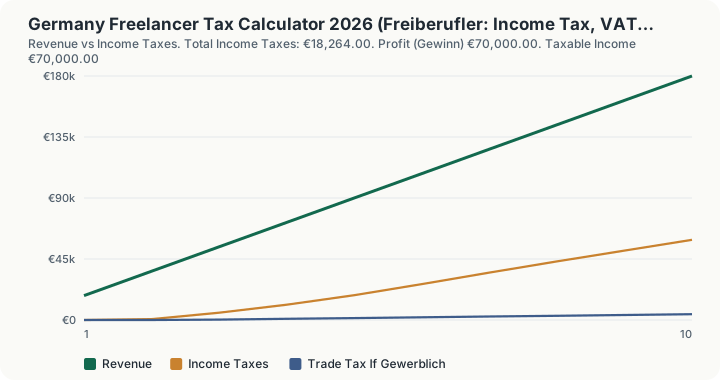
Quick Answer: A single, non-church-member Freiberufler in Nordrhein-Westfalen with EUR 70,000 of profit (EUR 90,000 revenue less EUR 20,000 expenses) owes EUR 18,264.00 in total income taxes for 2026, all of it Einkommensteuer, with EUR 0.00 Solidaritätszuschlag and EUR 0.00 Kirchensteuer. That is 26.09% of profit. Gewerbesteuer is EUR 0.00, because a freiberufliche Tätigkeit is outside the trade tax entirely.
What does this calculator do?
The most valuable thing about being a Freiberufler in Germany is not a rate or an allowance. It is a definitional exclusion. §2 Abs. 1 Satz 2 GewStG defines the trade tax base by reference to the income tax concept of a Gewerbebetrieb, and §15 Abs. 2 Satz 1 EStG says an activity is only a Gewerbebetrieb where it is "weder als Ausübung von Land- und Forstwirtschaft noch als Ausübung eines freien Berufs noch als eine andere selbständige Arbeit anzusehen". A freelance activity under §18 Abs. 1 Nr. 1 EStG is therefore not reached by the trade tax at all.
That is worth considerably more than the EUR 24,500 Freibetrag a sole trader gets, because it does not run out. It also means the §35 EStG credit, which lets a sole trader offset trade tax against income tax, is irrelevant to a Freiberufler: there is no Gewerbesteuer-Messbetrag to credit. The trade tax figure this calculator shows alongside is explicitly hypothetical, and it exists to size the distinction rather than to describe a liability.
The distinction is not always secure. §18 lists the Katalogberufe (doctors, dentists, vets, lawyers, notaries, patent attorneys, surveyors, engineers, architects, commercial chemists, auditors, tax advisers and comparable roles) and the classification of anything not on that list is frequently contested. A mixed partnership can be infected under §15 Abs. 3 Nr. 1 EStG, converting the whole activity to gewerblich. That is precisely the scenario the comparison figure models.
Income tax itself is no different from an employee's. The §32a EStG tariff applies to freelance profit exactly as it applies to salary, with the same Grundfreibetrag and the same five zones.
How is this calculated?
profit = revenue − business expenses; taxable income = profit − further deductions
For 2026, in the fourth §32a zone (taxable income above EUR 69,878 and up to EUR 277,825):
Einkommensteuer = ⌊0.42 × zvE − 11,135.63⌋
Step 1: Compute the profit. EUR 90,000 - EUR 20,000 = EUR 70,000.00
Freiberufler normally use the §4 Abs. 3 EStG cash-basis surplus calculation, so this is receipts less payments rather than an accrual result.
Step 2: Compute taxable income. EUR 70,000.00 - EUR 0.00 of further personal deductions = EUR 70,000.00
Step 3: Identify the §32a zone. EUR 70,000 exceeds the EUR 69,878 upper bound of zone three, so the fourth zone applies, with its flat 42% marginal rate.
Step 4: Apply the zone four formula. EUR 70,000.00 x 0.42 = EUR 29,400.00 EUR 29,400.00 - EUR 11,135.63 = EUR 18,264.37
Step 5: Apply the statutory rounding. §32a Abs. 1 Satz 6 EStG rounds the computed tax down to the nearest whole euro. EUR 18,264.00
Step 6: Test the Solidaritätszuschlag. The Freigrenze for a single filer in 2026 is EUR 20,350 of income tax. EUR 18,264.00 is below it, so the Soli is EUR 0.00.
Above the Freigrenze the Soli is the lesser of 5.5% of the income tax and 11.9% of the excess over the Freigrenze, which is what creates the Milderungszone.
Step 7: Compute the Kirchensteuer. Not a church member, so EUR 0.00. Were this taxpayer a member, Nordrhein-Westfalen charges 9% of the income tax; Bayern and Baden-Württemberg charge 8%.
Step 8: Total income taxes. EUR 18,264.00 + EUR 0.00 + EUR 0.00 = EUR 18,264.00
Step 9: Profit after income taxes. EUR 70,000.00 - EUR 18,264.00 = EUR 51,736.00
Step 10: Effective rate on profit. EUR 18,264.00 / EUR 70,000.00 = 26.09%
Well below the 42% marginal rate, because the Grundfreibetrag and the two progressive zones below sit underneath it.
Step 11: Test Kleinunternehmer status under §19 UStG. Two thresholds, both of which must hold: prior-year turnover at or under EUR 25,000, and current-year turnover at or under EUR 100,000. Prior-year turnover here is EUR 90,000, which exceeds EUR 25,000. Fails. VAT must be charged.
Step 12: Compute output VAT on fees. EUR 90,000.00 x 19% = EUR 17,100.00
Step 13: Compute recoverable input VAT. Expenses carrying input VAT: EUR 20,000 x 60% = EUR 12,000.00 Vorsteuer is extracted with the VAT fraction, not by deducting 19%: EUR 12,000.00 x 19 / 119 = EUR 1,915.97
Step 14: Net VAT payable to the Finanzamt. EUR 17,100.00 - EUR 1,915.97 = EUR 15,184.03
This is collected on behalf of the state. It is not your income and it is not a tax on you.
Step 15: Size the trade tax that does not apply. Had the activity been reclassified as gewerblich, on the same EUR 70,000 profit at the 490% comparison Hebesatz: Rounded Gewerbeertrag EUR 70,000, less the EUR 24,500 Freibetrag = EUR 45,500.00 Messbetrag: EUR 45,500.00 x 3.5% = EUR 1,592.50 Trade tax: EUR 1,592.50 x 4.90 = EUR 7,803.25 §35 credit: min(4 x EUR 1,592.50, EUR 7,803.25) = EUR 6,370.00 Net trade tax burden: EUR 7,803.25 - EUR 6,370.00 = EUR 1,433.25
The Freiberufler bears none of this.
Worked Example
A freelance software engineer in Cologne invoices EUR 90,000 net of VAT and spends EUR 20,000 on equipment, software, coworking space and professional insurance. About 60% of those costs carry German input VAT; the insurance and part of the rent do not. Single, no church membership, no additional Sonderausgaben claimed.
Step 1: Profit. EUR 90,000 - EUR 20,000 = EUR 70,000.00
Step 2: Einkommensteuer. EUR 70,000 x 0.42 - EUR 11,135.63 = EUR 18,264.37, rounded down to EUR 18,264.00
Step 3: Soli. EUR 18,264.00 income tax is under the EUR 20,350 Freigrenze, so EUR 0.00. Note how close this is: about EUR 5,000 more profit would push the income tax over the Freigrenze and the Soli would begin, and it begins steeply at 11.9% of the excess.
Step 4: Kirchensteuer. EUR 0.00. Had he been a church member in NRW: EUR 18,264.00 x 9% = EUR 1,643.76, taking the total to EUR 19,907.76.
Step 5: Total income taxes. EUR 18,264.00, an effective 26.09% on profit.
Step 6: Gewerbesteuer. EUR 0.00. Not reduced, not exempted: outside the scope of §2 GewStG.
Step 7: The counterfactual. If the Finanzamt reclassified the activity as gewerblich, at Cologne's comparison Hebesatz of 490% the trade tax would be EUR 7,803.25, of which the §35 credit would absorb EUR 6,370.00, leaving a real cost of EUR 1,433.25 a year.
Step 8: At a 900% Hebesatz the same reclassification would cost EUR 14,332.50 of trade tax with the credit still frozen at EUR 6,370.00, leaving EUR 7,962.50 standing. The credit does not scale with the Hebesatz; it is fixed at four times the Messbetrag.
Step 9: VAT, which is separate from all of the above. Output VAT of EUR 17,100.00 on fees, less EUR 1,915.97 of recoverable Vorsteuer, gives EUR 15,184.03 payable to the Finanzamt across the year's Voranmeldungen.
Step 10: Take-home. EUR 70,000 profit less EUR 18,264.00 of income taxes = EUR 51,736.00, before any health insurance or pension contributions, which are not modelled here.
What does this calculator not account for?
- No social insurance. This is the largest omission for most freelancers. German freelancers generally pay their own Krankenversicherung and Pflegeversicherung in full, and members of the Künstlersozialkasse, the Versorgungswerke or the compulsory Rentenversicherung categories have further obligations. None of this is computed. You can enter such premiums in "further personal deductions" to reduce taxable income, but the premiums themselves are not calculated for you.
- No Vorauszahlungen. Real freelancers pay quarterly income tax prepayments set by the Finanzamt, with a balancing payment or refund at assessment.
- VAT exemptions under §4 UStG are not modelled. Certain §18 activities, medical services in particular, are VAT-exempt entirely rather than taxable at 19% or 7%. Setting the rate to zero is not the same thing, because an exempt supplier also cannot recover input VAT.
- The share of expenses carrying input VAT is your estimate. Nothing here checks it.
- Kleinunternehmer status is tested on turnover only. The §19 Abs. 1 UStG upper limit is a hard ceiling within the year: exceeding EUR 100,000 ends the exemption from that transaction onward, not merely from the following year. This calculator reports status but does not model a mid-year transition.
- The trade tax comparison is hypothetical throughout and assumes the profit would equal the Gewerbeertrag, with no §8 add-backs or §9 reductions.
- The §35 credit in the comparison is capped only twice, at four times the Messbetrag and at the trade tax payable. The further cap at the actual income tax attributable to the trade income is not applied.
- No Sonderausgaben, außergewöhnliche Belastungen, Kinderfreibeträge or Riester deductions are computed. Only the flat "further personal deductions" figure you supply reduces taxable income.
- Only six Bundesländer are offered, and the state selection affects nothing except the church tax rate.
What mistakes do people make with this?
- Believing the Freiberufler advantage is an allowance. It is not. A sole trader with EUR 20,000 of trade profit also pays no Gewerbesteuer, because of the EUR 24,500 Freibetrag. The Freiberufler difference is that the exclusion never runs out, at any level of profit.
- Assuming your activity is freiberuflich because you work alone. The test is the nature of the activity under §18 Abs. 1 Nr. 1 EStG, not your legal form or your headcount. Trading goods, reselling software licences, or work that the Finanzamt characterises as commercial rather than professional will be gewerblich however solitary it is.
- Gewerblichkeitsinfektion in a partnership. Under §15 Abs. 3 Nr. 1 EStG, a partnership of freelancers that earns even a modest slice of commercial income can have its entire income reclassified as gewerblich. This is why the comparison figure on this page is worth reading rather than dismissing.
- Deducting 19% from gross expenses to find input VAT. EUR 119 gross at 19% contains EUR 19 of VAT, not EUR 22.61. The correct operation is the VAT fraction of 19/119, which is what this engine applies. Getting it wrong overstates recoverable Vorsteuer by about 19%.
- Treating net VAT payable as a tax on you. It is money collected on the state's behalf. It has no effect on profit or on income tax, and it should never be counted as revenue.
- Missing the Soli Freigrenze cliff. With EUR 18,264.00 of income tax the surcharge is zero, but income tax above EUR 20,350 brings it in at 11.9% of the excess, which is a steeper effective marginal rate than 5.5% until the glide zone ends.
- Misreading the Kleinunternehmer thresholds. Both must hold: prior year at or under EUR 25,000 and current year at or under EUR 100,000. Meeting only one is not enough.
Frequently Asked Questions
Why do freelancers pay no trade tax in Germany?
How do I know whether my work is freiberuflich or gewerblich?
What is the Kleinunternehmerregelung and do I qualify?
Why is my Solidaritätszuschlag zero?
How much would I pay if my activity were reclassified as gewerblich?
Is the input VAT really only EUR 1,915.97 on EUR 12,000 of expenses?
Sources
- Federal Ministry of Finance (Germany), the official authority for the national tax authority this calculator relates to. bundesfinanzministerium.de
Also consulted: §18 Abs. 1 Nr. 1 EStG. The definition of freiberufliche Tätigkeit and the Katalogberufe list: "Ärzte, Zahnärzte, Tierärzte, Rechtsanwälte, Notare, Patentanwälte, Vermessungsingenieure, Ingenieure, Architekten, Handelschemiker, Wirtschaftsprüfer, Steuerberater" and comparable roles; §15 Abs. 2 Satz 1 EStG. An activity is a Gewerbebetrieb only where it is "weder als Ausübung von Land- und Forstwirtschaft noch als Ausübung eines freien Berufs noch als eine andere selbständige Arbeit anzusehen"; §2 Abs. 1 Satz 2 GewStG. "Unter Gewerbebetrieb ist ein gewerbliches Unternehmen im Sinne des Einkommensteuergesetzes zu verstehen." Together with §15 Abs. 2 EStG this is why a Freiberufler is outside the scope of the trade tax; §32a EStG, current consolidated text explicitly headed "ab dem Veranlagungszeitraum 2026". Five zones with the exact published coefficients; Grundfreibetrag EUR 12,348; zone boundaries at EUR 17,799, EUR 69,878 and EUR 277,825; the fourth zone formula 0.42 x zvE - 11,135.63; and the statutory rounding of the computed tax down to the nearest whole euro under §32a Abs. 1 Satz 6; §32a Abs. 5 EStG. Ehegattensplitting for joint assessment: halve the combined taxable income, apply the tariff, double the result; SolzG 1995, with the 2026 Freigrenzen of EUR 20,350 for single and EUR 40,700 for joint assessment, the 5.5% rate and the 11.9% Milderungszone rate; §12 UStG. The 19% Regelsteuersatz and the 7% ermäßigter Steuersatz; §19 Abs. 1 UStG (read 2026-08-30). The two Kleinunternehmer thresholds: prior calendar year total turnover that "25 000 Euro nicht überschritten hat", and current calendar year turnover that "100 000 Euro nicht überschreitet"; §11 GewStG and §35 EStG, for the hypothetical trade tax comparison: the EUR 24,500 Freibetrag, the 3.5% Steuermesszahl, the four-times-Messbetrag credit and its cap at the trade tax actually payable.
All read at gesetze-im-internet.de on 2026-08-30 unless noted. Church tax rates are set by state law: 8% in Bayern and Baden-Württemberg, 9% in the other states offered here. The comparison Hebesatz has no national value and is a user input. Each Gemeinde sets its own; the 490% default is illustrative and is not a German average.