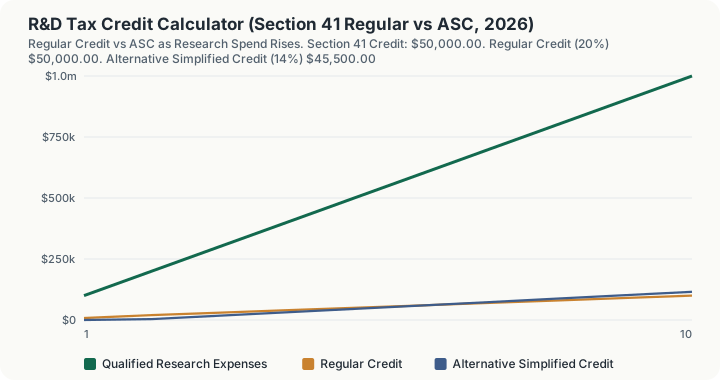
Quick Answer: $500,000 of qualified research expenses, against $2,000,000 of average gross receipts and a 3% fixed-base percentage, earns a section 41 credit of $50,000. The regular 20% credit wins, beating the Alternative Simplified Credit's $45,500. The 50% floor in section 41(c)(2) sets the base amount at $250,000 rather than $60,000, so only half the year's QREs are creditable.
What does this calculator do?
The federal research credit under IRC section 41 is an incremental credit. It does not reward research spending; it rewards research spending above a base amount. Two entirely separate methods exist for computing that base, and a taxpayer may claim whichever gives the larger credit. This calculator computes both and reports the winner.
The regular credit is 20% of QREs over a base amount equal to your fixed-base percentage multiplied by your average annual gross receipts for the four preceding years. The fixed-base percentage derives from your own 1984-1988 ratio of research spend to receipts and is capped at 16%. The crucial mechanic is section 41(c)(2): the base amount can never be less than 50% of the credit year's QREs. For most claimants that floor, not the formula, is what binds, meaning the regular credit effectively tops out at 10% of QREs.
The Alternative Simplified Credit is 14% of QREs over 50% of the average QREs for the three preceding years. If there were no QREs in any of those three years, it collapses to a flat 6% of current QREs with no base subtraction at all.
For a qualified small business the credit does not have to wait for taxable income. Section 41(h) lets up to $500,000 of it be elected against employer payroll tax instead.
How is this calculated?
Regular = 20% × (QRE − max(f × G, 0.5 × QRE))
ASC = 14% × (QRE − 0.5 × mean of QRE₃)
Step 1: Cap the fixed-base percentage at the statutory 16%. 3% is below the cap, so it stands: 3%
Step 2: Compute the section 41(c)(1) base amount. $2,000,000 x 3% = $60,000
Step 3: Compute the section 41(c)(2) floor. $500,000 x 50% = $250,000
Step 4: Take the greater of the two as the base amount. (\60{,}000,\ \$250{,}000) = $ $250,000: the floor binds
Step 5: Apply the 20% regular rate to the excess. ($500,000 − $250,000) x 20% = $50,000
Step 6: Average the three prior years' QREs. ($400,000 + $350,000 + $300,000) ÷ 3 = $350,000
Step 7: Halve that for the ASC base. $350,000 x 50% = $175,000
Step 8: Apply the 14% ASC rate to the excess. ($500,000 − $175,000) x 14% = $45,500
Step 9: Take the larger of the two methods. (\50{,}000,\ \$45{,}500) = $ $50,000, the regular credit The difference between methods is $4,500.
Step 10: Test qualified small business status. Gross receipts this year are $2,500,000, under the $5,000,000 ceiling, and the business had no gross receipts before the five-year window: Eligible for the payroll tax election
Step 11: Apply the $500,000 election cap. (\50{,}000,\ \$500{,}000) = $ $50,000 electable Nothing is left over as an income tax credit.
Step 12: Size the employer Social Security tax available to absorb it. The OASDI base is capped at the wage base per employee: (\1{,}200{,}000,\ \$184{,}500 \times 12) = \$1{,}200{,}000$ $1,200,000 x 6.2% = $74,400
Step 13: Apply the credit against that tax first, per section 3111(f). (\50{,}000,\ \$74{,}400) = $ $50,000 absorbed against Social Security tax
Step 14: Apply any excess against employer Medicare tax. Nothing remains, so $0 against the $17,400 of Medicare tax, and $0 carried forward to later quarters.
The credit is 10.00% of qualified spend.
Worked Example
A twelve-person instrumentation company spends $500,000 on qualified research in 2026: engineer wages for qualified services, supplies consumed in prototyping, and 65% of what it paid an outside laboratory. Its average receipts over 2022-2025 were $2,000,000; 2026 receipts are $2,500,000. Payroll subject to FICA is $1,200,000. It first had revenue three years ago.
Step 1: Base amount under the formula. $2,000,000 x 3% = $60,000
Step 2: Base amount floor. $500,000 x 50% = $250,000 The floor is more than four times the formula figure, so the formula never comes into play.
Step 3: Regular credit. ($500,000 − $250,000) x 20% = $50,000
Step 4: ASC base. Prior three years average $350,000, halved: $175,000
Step 5: ASC credit. ($500,000 − $175,000) x 14% = $45,500
Step 6: Claim the better method. $50,000 under the regular credit, $4,500 more than the ASC
Step 7: Elect it against payroll tax. Receipts of $2,500,000 are under the $5,000,000 ceiling and there were no receipts before the five-year window, so the whole $50,000 is electable, capped at $500,000 by statute.
Step 8: Absorb it. Employer Social Security tax of $1,200,000 x 6.2% = $74,400, which covers the whole $50,000 in the year, with nothing carried to later quarters and nothing left as an income tax credit.
Now change the fixed-base percentage. Suppose the company were an established manufacturer with a 12% fixed-base percentage and $8,000,000 of average receipts. The base amount becomes $8,000,000 x 12% = $960,000, above the $500,000 of current QREs, so the regular credit falls to zero and the ASC's $45,500 becomes the only credit available. That reversal is exactly why both methods must be computed every year rather than chosen once.
What does this calculator not account for?
- The fixed-base percentage is an input, not a computation. It derives from your own 1984-1988 QRE-to-receipts history, which no table can supply. The section 41(c)(3)(B) start-up phase-in is not modelled: a start-up must enter the 3% start-up figure itself.
- Whether your expenses are actually qualified research expenses is not tested. The four-part test of section 41(d), the exclusions in section 41(d)(4), and the 65% haircut on contract research are all assumed to have been applied before you enter a number.
- The section 280C(c) reduced-credit election is not modelled. Claiming the full credit requires adding it back to income unless the reduced credit is elected, which changes the after-tax value materially.
- Section 38 general business credit ordering, limitation and carryforward are out of scope. The portion of a credit not elected against payroll tax is subject to the section 38 limitation, which this page does not apply.
- Controlled group aggregation under section 41(f) is not applied. Related entities must be treated as one taxpayer, which can destroy qualified small business status.
- The employer Social Security figure is an upper bound when pay is uneven. With only aggregate wages and a headcount, the OASDI base is capped at headcount multiplied by the wage base. That is exact when pay is even across employees and an overstatement when a few employees earn far above the base.
- State research credits are not included. Many states offer their own, computed on different bases.
What mistakes do people make with this?
- Expecting 20% of research spend. Because of the 50% floor in section 41(c)(2), the regular credit is effectively capped at 10% of QREs for anyone whose formula base is below the floor, which is most claimants.
- Choosing a method permanently. Which method wins depends on the relationship between this year's spend and both the receipts history and the QRE history. It can flip year to year, and it flipped in the example above with a single input change.
- Assuming a start-up automatically gets the ASC's 6% rate. The flat 6% applies only where there were no QREs in any of the three preceding years. A single dollar of QREs in one of them puts you back on the 14%-over-half-the-average calculation.
- Missing the five-year receipts test for the payroll election. Gross receipts under $5,000,000 is only half the test. Having had gross receipts in any year before the five-year period ending with the credit year disqualifies you permanently, no matter how small the business is now.
- Electing more credit than payroll can absorb in the year. The elected portion is limited each quarter to the employer tax actually imposed. The excess is not lost, but it does carry forward rather than paying out.
- Forgetting section 280C. The credit and the deduction cannot both be taken in full.
Frequently Asked Questions
Why is my credit only 10% of research spend when the statute says 20%?
Should I use the regular credit or the Alternative Simplified Credit?
What is a qualified small business for the payroll tax election?
How much credit can I take against payroll tax?
Does a first year of research get any credit at all?
Can I claim the credit for prior years?
Sources
- 26 U.S.C. 41(a)(1): 20% of qualified research expenses over the base amount. law.cornell.edu/uscode/text/26/41
- 26 U.S.C. 3111(a), 3111(b) and 3111(f): employer Social Security and Medicare taxes, and the ordering of the elected credit against them. law.cornell.edu/uscode/text/26/3111
Also consulted: 26 U.S.C. 41(c)(1): base amount equals the fixed-base percentage times average annual gross receipts for the four preceding years; 26 U.S.C. 41(c)(2): the base amount may not be less than 50% of the credit year's qualified research expenses; 26 U.S.C. 41(c)(3)(A): the fixed-base percentage is capped at 16%; 26 U.S.C. 41(c)(4) and 41(c)(5): the Alternative Simplified Credit at 14% over 50% of the three-year average, and 6% of QREs where there were none in any of the three preceding years; 26 U.S.C. 41(h)(3)(A), qualified small business definition: under $5,000,000 of gross receipts and no gross receipts before the five-taxable-year period ending with the credit year; 26 U.S.C. 41(h)(4)(B): the $250,000 election cap, increased by a further $250,000 for taxable years beginning after 31 December 2022; 2026 Social Security wage base of $184,500 and the employer OASDI and Medicare rates, from the versioned 2026 FICA table in this repository.
All statutory text verified 2026-08-30.