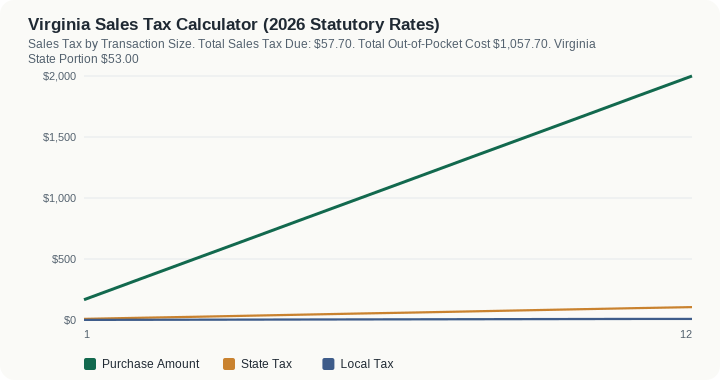
Quick Answer: Virginia sales tax on $1,000 is $57.70 in this calculator: $53.00 at the 5.3% base rate (4.3% state plus a 1% local share levied everywhere) and $4.70 at a 0.47% regional average. The total is $1,057.70.
Virginia Sales Tax Depends On The Region
Virginia's general rate is set by region rather than by city or county:
- 5.3% in most of the state.
- 6% in Central Virginia, Hampton Roads and Northern Virginia.
- 6.3% in eight listed localities.
- 7% in James City County, Williamsburg and York County.
The 5.3% base is 4.3% state tax plus a 1% local tax applied statewide, which is why the engine's "state" column already includes a local piece. The regional add-ons average 0.47% across the population (33rd largest local layer), so the Virginia sales tax calculator reports 5.77% combined, 41st of the 50, the lowest among its taxing neighbours.
Virginia's biggest cities all sit in 6% regions. Virginia Beach and Chesapeake are in Hampton Roads, Richmond is in Central Virginia, and the Northern Virginia suburbs pay 6% as well. The engine runs 23 cents short per $100 there.
Groceries At 1%, Medicine Exempt
Food for home consumption and essential personal hygiene items are taxed at a reduced 1% statewide, regardless of region. A $250 grocery run in Virginia Beach costs $2.50 in tax; the engine, at its general 5.77%, says $14.43.
Prescription drugs and medicines are exempt, along with eyeglasses, hearing aids and their supplies. Nonprescription drugs are exempt under a separate provision, but dietary supplements, vitamins and mineral concentrates sold as supplements are not. Anything exempt from sales tax is also exempt from use tax.
The August Holiday Covers More Than School Clothes
Virginia's 2026 holiday ran August 7 to 9 and covered:
- School supplies up to $20 per item.
- Clothing and footwear up to $100.
- Portable generators up to $1,000.
- Gas-powered chainsaws up to $350, and chainsaw accessories and other hurricane preparedness items up to $60.
- ENERGY STAR or WaterSense products up to $2,500 for home use.
That last category is the valuable one. A $2,400 ENERGY STAR refrigerator bought in Richmond that weekend avoided $144.00 at 6%.
Consumer's Use Tax For Virginians
Online orders, out-of-state catalog purchases and goods bought on a trip without Virginia tax owe consumer's use tax at the rate where the item is used. Individuals report it on their income tax return, or, if they do not have to file one, on the annual Form CU-7. A $1,200 TV bought in Delaware, which has no sales tax, and taken home to Arlington owes $72.00 at 6%.
Cars pay a separate 4.15% motor vehicle sales and use tax at the DMV; the Virginia auto loan calculator covers it.
How is this calculated?
The engine applies 5.3% to the price as the state column and 0.47% as the regional column, rounds each to the cent and adds them.
Unlike most states, the toggle-off result here is a real Virginia rate. Switch off the regional average and the engine returns 5.3%, exactly what most of the state charges outside the three large regions and the 6.3% and 7% localities. Leave it on for a blended estimate. Neither the 1% food rate nor the medicine exemption is applied.
Worked Example
$1,000 of taxable goods bought in Virginia:
- The 5.3% base. $53.00, of which one point is the statewide local share.
- Regional average, 0.47%. $4.70.
- Total. $57.70, for $1,057.70 paid.
In Virginia Beach, Chesapeake or Richmond the same purchase costs $60.00. In Williamsburg, $70.00. In a 5.3% county, $53.00. As groceries anywhere in the state, $10.00.
Virginia Tax At Larger And Smaller Amounts
- $100: $5.77, of which $0.47 regional.
- $5,000: $288.50, split $265.00 and $23.50.
- $25,000: $1,442.50, split $1,325.00 and $117.50. The real answers run $1,325.00 at 5.3%, $1,500.00 at 6%, $1,575.00 at 6.3% and $1,750.00 at 7%.
The default schedule climbs from $166.67 ($9.61) to $2,000 ($115.40).
To recover a price from a receipt, divide by 1.053, 1.06, 1.063 or 1.07 depending on the region. A $1,060.00 Richmond receipt holds $60.00 of tax. At the engine's average, $1,000 all-in buys $945.45 of goods and $54.55 of tax; $500 buys $472.73 and $27.27. Multiplying a $1,057.70 total by 5.77% claims $61.03.
Every taxing neighbour averages more in the engine's table: Kentucky and Maryland 6%, West Virginia 6.6%, North Carolina 7.10% and Tennessee 9.61%. A Bristol, Virginia shopper pays $57.70 or less per $1,000 at the average; across State Street in Tennessee, the engine's figure is $96.10.
A Northern Virginia Household's Year
Take a Fairfax County family spending $8,000 a year on groceries and $10,000 on general taxable goods. At the region's 6%, the general goods cost $600.00 in tax and the groceries, at 1%, $80.00: $680.00 in all. Typed into the calculator as one $18,000 figure, the year shows $1,038.60, overstating the bill by $358.60, almost all of it from treating food at the general rate. Entering the $10,000 alone returns $577.00, which lands within $23.00 of the real general-goods figure.
What does this calculator not account for?
- Your region's rate, 5.3%, 6%, 6.3% or 7%.
- The 1% rate on food and personal hygiene items.
- The exemption for prescription and nonprescription medicines, eyeglasses and hearing aids.
- The August holiday, including ENERGY STAR products up to $2,500.
- Consumer's use tax on Form 760 or CU-7.
- The 4.15% motor vehicle tax.
What mistakes do people make with this?
- Using 5.3% in Hampton Roads or Northern Virginia. Both regions are at 6%.
- Charging the general rate on groceries. Food for home consumption is 1%.
- Assuming vitamins count as medicine. Dietary supplements are taxed.
- Overlooking the holiday's appliance category. ENERGY STAR items up to $2,500 qualified.
- Skipping use tax on Delaware purchases. It is due at your home region's rate.