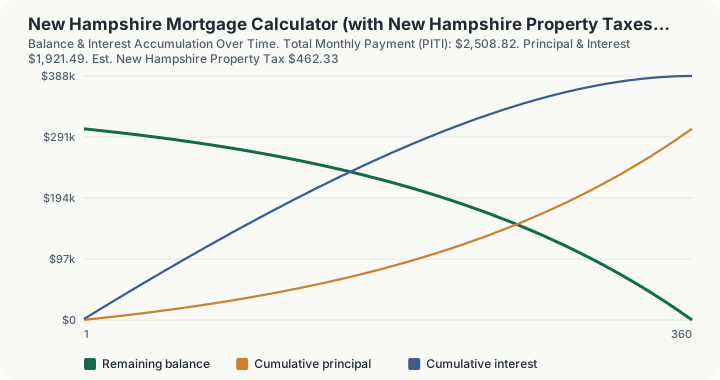
Quick Answer: A $380,000 home in New Hampshire with 20% down at 6.5% costs about $2,509 a month, and nearly a fifth of that is property tax, since New Hampshire has no state income or sales tax to fall back on.
Overview
New Hampshire runs its state and local government almost entirely on property tax revenue. With no broad-based state income tax and no state sales tax, towns and school districts lean on real estate to fund everything from teacher salaries to road maintenance, and it shows in the numbers: New Hampshire consistently ranks among the five highest-property-tax states in the country by effective rate, averaging about 1.46% of home value statewide, well above the roughly 0.89% national average.
A significant piece of that bill is the Statewide Education Property Tax (SWEPT), a portion of every New Hampshire property tax bill that is collected locally but earmarked for public education funding, alongside separate municipal, county, and local school district rates layered on top. The combined total varies meaningfully by town: a home in a town with a small commercial tax base and a large school budget can carry a noticeably higher rate than a similarly priced home in a town with more commercial development sharing the tax load.
This calculator models a standard 30-year fixed mortgage combined with a statewide blended property tax estimate of 1.46% and a placeholder insurance cost, producing a full monthly PITI (Principal, Interest, Taxes, and Insurance) figure along with a complete amortization table.
How This Is Calculated
- Down payment and loan principal. The chosen down payment percentage is applied to the home price; the remainder becomes the financed loan principal.
- Monthly principal and interest. The loan principal, annual interest rate, and 360-month term are run through a standard fixed-rate amortization formula, producing a level monthly payment split between interest on the outstanding balance and principal reduction.
- New Hampshire property tax estimate. Home price is multiplied by an assumed 1.46% effective annual rate and divided by 12 for a monthly escrow figure. This reflects a statewide blended average across municipal, county, school, and state education tax components; a specific town's actual combined rate can run higher or lower.
- Homeowners insurance estimate. A flat $125 monthly placeholder represents a typical policy; New Hampshire's exposure to winter storm and ice-dam damage can shift actual premiums.
- Total monthly payment (PITI). Principal and interest, property tax, and insurance are summed into a single headline figure, with a full 360-payment schedule tracking the balance to zero.
Worked Example
Using the calculator's baseline inputs: a $380,000 home, 20% down, and a 6.5% rate on a 30-year fixed loan.
- Down payment: $380,000 × 20% = $76,000
- Loan principal: $380,000 − $76,000 = $304,000
- Monthly principal and interest: $1,921.49
- Estimated New Hampshire property tax: $380,000 × 1.46% ÷ 12 = $462.33 per month ($5,548 per year)
- Estimated insurance: $125.00 per month
- Total monthly payment (PITI): $2,508.82
- Total interest paid over 30 years: approximately $387,733
Notice that the property tax line ($462.33) is roughly a quarter of the principal and interest payment itself, a ratio that would be unusual in most of the country. Run the same home price at New Jersey's higher 1.89% assumption and the tax line grows further; run it at Nevada's 0.47% and it shrinks to a fraction of New Hampshire's figure, which is the clearest illustration of how state fiscal structure, not the mortgage itself, drives a large share of the total housing payment.
What This Does Not Account For
- Town-by-town rate variation. The 1.46% figure is a statewide blend; specific municipalities like Portsmouth, Manchester, or smaller rural towns can carry meaningfully different combined rates.
- The Statewide Education Property Tax mechanism specifically. SWEPT is collected locally but calculated against a separate formula; this calculator does not break out that component from the rest of the bill.
- Private mortgage insurance (PMI). Any down payment under 20% typically requires PMI on a conventional loan, which is not included in this estimate.
- Current use assessment for land. New Hampshire offers a "current use" property tax program for qualifying open space, farm, or forest land that can substantially lower the taxable value on larger parcels, not reflected in this home-price-based estimate.
- Ice, snow-load, and winter storm insurance riders, which can push actual homeowners premiums above the flat $125 monthly placeholder used here.
Common Pitfalls
- Underestimating the annual tax bill because there's no sales or income tax to compare it against. Buyers relocating from income-tax states often focus on the absence of a paycheck deduction and are surprised by the size of the first property tax bill.
- Assuming the statewide 1.46% average applies uniformly. Towns with a strong commercial or industrial tax base can have noticeably lower residential rates than a rural town funding schools almost entirely through residential property.
- Confusing SWEPT with a separate state tax bill. It appears combined with your local property tax bill rather than as a distinct line item from the state.
- Ignoring PMI in a low-down-payment scenario. Running the 5% down scenario without manually adding PMI understates the real monthly obligation.
- Not budgeting for winter-specific home maintenance and insurance costs, which are a real recurring expense in New Hampshire beyond the flat insurance placeholder used in this estimate.
Frequently Asked Questions
Why are New Hampshire's property taxes so much higher than the national average?
What is the Statewide Education Property Tax (SWEPT)?
Does this calculator reflect my specific town's tax rate?
Is there any way to lower my New Hampshire property tax bill legally?
How does New Hampshire's total housing cost compare to a state with income tax but lower property tax?
Sources
- New Hampshire Department of Revenue Administration, Municipal and Property Division, statewide tax rate publications. revenue.nh.gov
- Consumer Financial Protection Bureau, Owning a Home resource center. consumerfinance.gov
- U.S. Census Bureau, American Community Survey, median property tax and home value estimates by state. census.gov/programs-surveys/acs
- Consumer Financial Protection Bureau, Buying a house. consumerfinance.gov/owning-a-home
Also consulted: New Hampshire Department of Education, Statewide Education Property Tax (SWEPT) overview.