Quick Answer: Enterprise value equals market capitalization plus total debt minus cash and equivalents, representing the theoretical total cost to acquire a company's core business, debt included, cash netted out.
Overview
Market capitalization tells you what the stock market thinks a company's equity is worth, but it leaves out an important part of the picture: how the company is financed. Two companies with identical market caps can have very different total price tags for a would-be acquirer if one carries a large debt load and the other sits on a mountain of cash. Enterprise value corrects for this by asking a more complete question: what would it actually cost to buy the entire operating business, assuming you also had to take on its debt and would immediately get to use its cash?
The logic behind each adjustment is straightforward. Debt is added because an acquirer of the whole company effectively inherits the obligation to repay it, on top of whatever they pay shareholders for the equity. Cash is subtracted because an acquirer could immediately use the target's own cash reserves to help pay down that very debt, or simply pocket it, so it effectively reduces the net cost of the deal. The result is a figure that better represents the value of the underlying operating business itself, independent of how that business happens to be financed.
Enterprise value is the standard numerator for valuation multiples like EV/EBITDA and EV/Revenue, precisely because those metrics measure operating performance before the effects of financing decisions and taxes, and pairing them with equity-only market capitalization would create an apples-to-oranges comparison. It is also the figure most directly relevant in merger and acquisition contexts, since it approximates the total consideration an acquirer would need to fund.
How This Is Calculated
A more complete version of the formula also adds two optional adjustments for companies with more complex capital structures:
- Market Capitalization is current share price multiplied by total shares outstanding, representing the value of the common equity.
- Total Debt includes both short-term and long-term interest-bearing debt from the balance sheet.
- Cash & Equivalents includes cash, short-term investments, and other highly liquid assets.
- Minority (Non-Controlling) Interest reflects the portion of a consolidated subsidiary's equity that belongs to outside shareholders, not the parent company, and is added back because the subsidiary's full assets are already consolidated into the financials even though the parent does not own all of it.
- Preferred Equity is added because preferred shareholders have a claim on the business senior to common equity but are not included in market capitalization, which reflects only common shares.
Worked Example
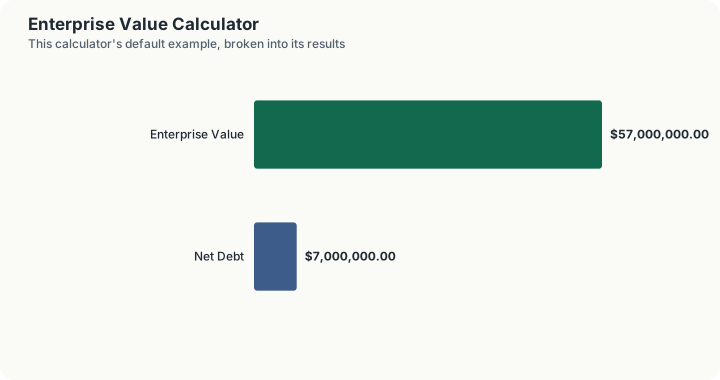
Consider a company with a $50,000,000 market capitalization, $15,000,000 of total debt, and $8,000,000 of cash and equivalents, with no minority interest or preferred equity outstanding.
Step 1: Add debt to market cap.
Step 2: Subtract cash and equivalents.
The resulting enterprise value is $57,000,000, or $7,000,000 above the company's market cap. That $7,000,000 gap is exactly the company's net debt (total debt minus cash), which makes intuitive sense: an acquirer would need to fund an amount above the equity purchase price roughly equal to the debt they are taking on, net of the cash cushion they immediately gain access to.
Expressed as a ratio, EV divided by market cap here works out to 1.14x ($57,000,000 divided by $50,000,000), meaning the whole-business price tag runs about 14% above the pure equity value, driven entirely by that net debt position.
What This Does Not Account For
- Off-balance-sheet liabilities. Operating lease commitments (in jurisdictions or accounting frameworks where they are not fully capitalized), pension underfunding, litigation reserves, and other contingent obligations are not captured in a basic total debt figure, even though a real acquirer would need to account for them.
- Illiquid or non-core assets. Enterprise value nets out cash but does not adjust for other non-operating assets, such as investments in unconsolidated affiliates, real estate held for investment rather than operations, or excess working capital beyond what the core business needs.
- Control premiums. Enterprise value calculated from public market prices reflects the value of a minority, freely-traded share. An actual acquisition of full control typically requires paying a premium above the pre-deal trading price to convince shareholders to sell and to compensate for the value of control itself.
- Convertible securities and options. A fully diluted enterprise value calculation should also account for in-the-money stock options, warrants, and convertible debt that could increase share count or claims on the business, which this basic calculation does not adjust for.
- Timing of the market cap snapshot. Because share prices move constantly, an enterprise value calculated from a stale market cap figure can become outdated within hours in a fast-moving market, even though the debt and cash figures (typically sourced from the most recent quarterly filing) change far less frequently.
Common Pitfalls
- Comparing EV/EBITDA or EV/Revenue multiples using book value of debt instead of market value. For companies with distressed or deeply discounted debt trading well below face value, using book value in the enterprise value calculation can meaningfully overstate the true economic value of what an acquirer would owe.
- Forgetting to include short-term debt. Total debt should capture both the current and long-term portions of interest-bearing obligations. Omitting short-term debt or capital lease obligations understates enterprise value.
- Treating restricted cash the same as freely available cash. Cash that is legally restricted, pledged as collateral, or trapped in a jurisdiction with capital controls is not truly available to offset debt, even though it may appear on the balance sheet as "cash and equivalents."
- Ignoring minority interest in partially-owned subsidiaries. For companies with significant non-wholly-owned subsidiaries, skipping the minority interest adjustment understates enterprise value relative to the fully consolidated operations reflected elsewhere in the financials.
- Assuming a higher EV automatically means a worse deal. A high enterprise value relative to market cap simply reflects a leveraged capital structure; it says nothing on its own about whether the underlying business or the price being paid for it is attractive.
Frequently Asked Questions
Why is cash subtracted rather than added in the enterprise value formula?
Can enterprise value be lower than market capitalization?
What is the difference between enterprise value and market capitalization?
Why do analysts prefer EV/EBITDA over Price/Earnings for comparing companies?
Do I need to include minority interest and preferred equity?
Sources
- U.S. Securities and Exchange Commission, Investor.gov, the official authority for the investing this calculator relates to. investor.gov
Also consulted: Investopedia, "Enterprise Value (EV) Formula and What It Means"; Corporate Finance Institute (CFI), "Enterprise Value vs Equity Value"; Damodaran, Aswath, "Investment Valuation," New York University Stern School of Business.