Quick Answer: The Foreign Tax Credit lets you offset US tax dollar-for-dollar with foreign income tax you already paid, but only up to a statutory limit equal to the share of your US tax attributable to that foreign-source income.
Overview
If you earn income from a foreign country, that country usually taxes it, and the United States, taxing worldwide income, usually taxes it too. Without relief, the same dollar of income could be taxed twice. The Foreign Tax Credit, claimed on Form 1116, is one of two main tools Congress built to prevent that (the other being the Foreign Earned Income Exclusion). Unlike a deduction, which only reduces taxable income, a credit reduces your actual tax bill dollar for dollar, which generally makes it far more valuable when it is fully usable.
The catch is that the credit is not unlimited. Congress does not want US taxpayers using foreign tax credits to wipe out tax on their US-source income; the credit is meant only to offset the US tax that would otherwise apply to the foreign-source income itself. IRC §904(a) enforces this with a limitation formula: the credit cannot exceed the portion of your total US tax that is proportional to how much of your total taxable income came from foreign sources.
In formula form: US tax on foreign-source income (the limitation) = (Foreign-Source Taxable Income ÷ Total Taxable Income) × Total US Tax Before Credits. The actual credit you can claim this year is the smaller of two numbers: the foreign tax you actually paid or accrued, or this limitation amount. Whichever number is smaller "binds," meaning it is the one that determines your real credit.
How This Is Calculated
- Compute total US tax before credits. Using your total worldwide taxable income and filing status, the platform's shared
progressiveTaxprimitive applies the 2026 federal bracket table to determine your total tax liability before any credits are applied. - Compute the Section 904 limitation. Divide your foreign-source taxable income by your total taxable income to get the fraction of your income that is foreign. Multiply that fraction by your total US tax before credits. This is the maximum amount of US tax the IRS will let you offset with foreign tax credits.
- Compare foreign tax paid to the limitation. The allowed credit is whichever of the two numbers is smaller.
- Determine net US tax and any carryover. Subtract the allowed credit from total US tax before credits to get your net US tax liability. If foreign tax paid exceeded the limitation, the unused portion does not disappear; it becomes a carryover that can generally be applied to the prior tax year or carried forward for up to ten years.
Worked Example
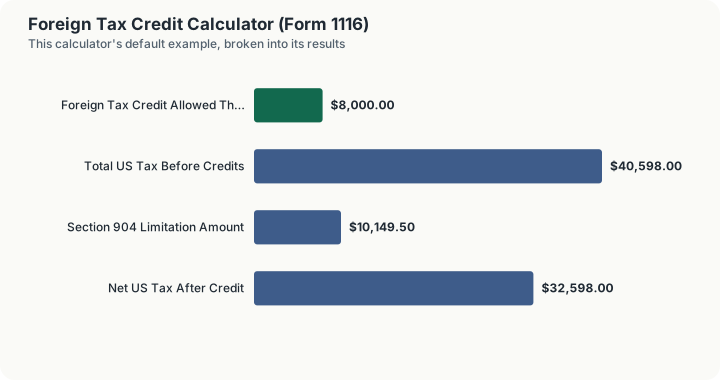
Take a single filer with $200,000 in total taxable income, $50,000 of which is foreign-source, and $8,000 of foreign income tax paid.
- Total US tax before credits (2026 single brackets on $200,000): 10% × $12,400 = $1,240; 12% × $38,000 = $4,560; 22% × $55,300 = $12,166; 24% × $94,300 = $22,632. Total = $40,598
- Limitation = $40,598 × ($50,000 ÷ $200,000) = $40,598 × 0.25 = $10,149.50
- Since foreign tax paid ($8,000) is less than the limitation ($10,149.50), the credit allowed is $8,000 and foreign tax paid is the binding figure.
- Net US tax after credit: $40,598 − $8,000 = $32,598
- Carryover: $0
Now the same taxpayer, but paying $15,000 of foreign tax on that same $50,000 of foreign-source income, perhaps because they live in a high-tax country:
- Total US tax before credits and limitation are unchanged: $40,598 and $10,149.50
- Since foreign tax paid ($15,000) now exceeds the limitation ($10,149.50), the credit allowed is capped at $10,149.50, and the limitation is the binding figure.
- Net US tax after credit: $40,598 − $10,149.50 = $30,448.50
- Carryover: $15,000 − $10,149.50 = $4,850.50, available to carry back one year or forward up to ten years.
A married couple filing jointly with $400,000 in total taxable income, $150,000 foreign-source, and $30,000 of foreign tax paid:
- Total US tax before credits (2026 MFJ brackets on $400,000): 10% × $24,800 = $2,480; 12% × $76,000 = $9,120; 22% × $110,600 = $24,332; 24% × $188,600 = $45,264. Total = $81,196
- Limitation = $81,196 × ($150,000 ÷ $400,000) = $81,196 × 0.375 = $30,448.50
- Foreign tax paid ($30,000) is just under the limitation, so the full $30,000 is creditable.
- Net US tax after credit: $81,196 − $30,000 = $51,196
What This Does Not Account For
- Separate limitation categories (baskets). The real Form 1116 requires computing the limitation separately for different categories of income, most commonly "passive category income" and "general category income," rather than one blended pool. Mixing categories can change which income binds the limitation in each basket.
- Deduction allocation and apportionment. Real Form 1116 filings must allocate certain deductions, like the standard deduction or itemized deductions, between US-source and foreign-source income before arriving at "foreign-source taxable income." This calculator accepts that figure as a direct input rather than deriving it from raw income and expense categories.
- The Alternative Minimum Tax foreign tax credit. A separate, similarly structured limitation applies for AMT purposes, which this calculator does not model.
- Carryback mechanics. While this calculator reports the size of any unused carryover, it does not amend a prior year's return or track a multi-year carryover ledger.
- De minimis exceptions. Taxpayers with $300 or less ($600 married filing jointly) of foreign tax on passive income can sometimes skip Form 1116 entirely and claim the credit directly. This calculator assumes a full Form 1116 computation applies.
Common Pitfalls
- Assuming foreign tax paid is always fully creditable. Many filers are surprised to learn a portion of their foreign tax is stuck in carryover because the limitation formula capped what could be used this year, especially when foreign-source income is a small share of total income.
- Forgetting the credit is calculated per income basket. Blending passive and general category income into a single limitation calculation, instead of keeping them separate as the real form requires, can produce a materially different result than the actual IRS computation.
- Double-dipping with the Foreign Earned Income Exclusion. Income already excluded under the FEIE cannot also generate a foreign tax credit; only foreign tax attributable to income that was not excluded is eligible.
- Letting carryovers expire unused. The ten-year forward carryover window is generous but not infinite. Taxpayers with structurally high foreign tax relative to their US tax rate can lose credits permanently if they never generate enough US tax capacity to absorb them.
- Confusing accrued tax with paid tax. Taxpayers on the accrual method can claim credit for foreign tax accrued but not yet paid, which requires separate tracking and can create later true-up adjustments if the accrued estimate turns out to be wrong.
Frequently Asked Questions
What is the difference between the Foreign Tax Credit and the Foreign Earned Income Exclusion?
Why can't I just deduct all my foreign taxes instead of using the credit?
What happens to foreign tax I cannot credit this year?
Does passive income like dividends and interest qualify for the credit?
Is there a simplified way to claim the credit without filing Form 1116?
Sources
- Internal Revenue Code §901-§904 (Foreign Tax Credit and the Section 904 limitation). law.cornell.edu/uscode/text/26/901
- Internal Revenue Service, Instructions for Form 1116, Foreign Tax Credit. irs.gov/forms-pubs/about-form-1116
- Internal Revenue Service, "IRS releases tax inflation adjustments for tax year 2026, including amendments from the One, Big, Beautiful Bill," Revenue Procedure 2025-32. irs.gov/newsroom/irs-releases-tax-inflation-adjustments-for-tax-year-2026-including-amendments-from-the-one-big-beautiful-bill
- Internal Revenue Service, Publication 514, Foreign Tax Credit for Individuals. irs.gov/publications/p514