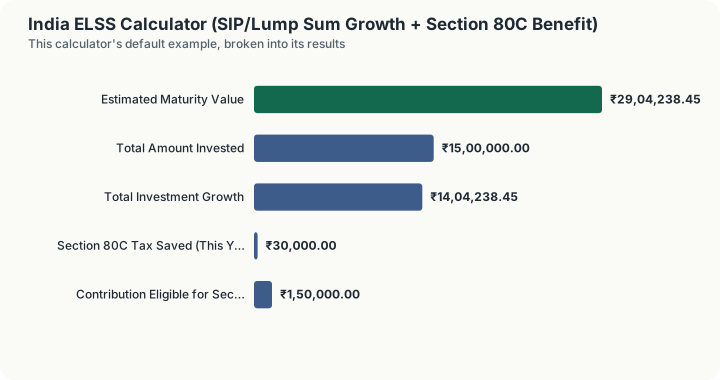
Quick Answer: For an Indian investor putting ₹12,500 a month into an ELSS fund for 10 years at an assumed 12% annual return, the projected maturity value is about ₹29,04,238 on ₹15,00,000 invested (₹14,04,238 of growth) -- and, filing under the old tax regime with a 20% marginal slab, this year's ₹1,50,000 contribution also saves ₹30,000 in tax under Section 80C, since ₹12,500/month exactly maxes out the ₹1,50,000 annual 80C cap.
Overview
This calculator is built for Indian investors evaluating an Equity Linked Savings Scheme (ELSS) -- a category of equity mutual fund that is unique in India for combining two things at once: market-linked equity growth, and eligibility for a Section 80C tax deduction. All figures are in Indian Rupees (₹); this calculator is specific to Indian tax law and does not apply elsewhere.
ELSS funds carry a mandatory 3-year lock-in period, the shortest lock-in of any Section 80C-eligible instrument (compare this to the Public Provident Fund's 15-year term or a 5-year tax-saving fixed deposit). This makes ELSS the most liquid of the traditional 80C options, though "liquid" is relative -- the lock-in is not waivable under any circumstance, unlike some other instruments that allow hardship withdrawals. For a Systematic Investment Plan (SIP), a critical and frequently misunderstood detail is that the lock-in applies per installment, not to the whole SIP as one block: each monthly SIP installment carries its own independent 3-year lock-in starting from that specific installment's allotment date. A SIP that started 1 January 2025 and continues monthly has its first installment unlock on 1 January 2028, but its installment from, say, December 2027 does not unlock until December 2030 -- the SIP as a whole is not "done" locking in until three years after its very last installment.
The Section 80C deduction -- up to ₹1,50,000 per year, shared across all 80C instruments combined (PF, life insurance premium, principal repayment on a home loan, PPF, other ELSS, etc.) -- is available only under the old tax regime. India's new tax regime, the default since FY 2023-24 and further revised by Budget 2025 with wider slabs and a higher Section 87A rebate threshold, does not permit Section 80C or most other Chapter VI-A deductions at all. An investor who has switched to (or defaults into) the new regime still gets the market-linked growth and still faces the same 3-year lock-in on an ELSS investment, but gets zero upfront tax benefit from it -- a distinction this calculator makes explicit rather than assuming the deduction always applies.
How This Is Calculated
Growth (SIP mode): Modeled as a fixed monthly payment annuity-due (SIP installments are typically debited at the start of each month), solved via the standard time-value-of-money future-value formula with monthly compounding:
where $i$ is the monthly rate (annual rate ÷ 12) and $n$ is the number of months.
Growth (lump sum mode): Simple annual compounding:
Section 80C benefit (old regime only):
Under the new regime, tax saved is always ₹0 regardless of contribution size.
Worked Example
An investor starts a ₹12,500 monthly ELSS SIP, assumes a 12% annual return, files under the old regime with ₹10,00,000 of other taxable income, and has used none of the ₹1,50,000 Section 80C cap elsewhere. Because ELSS has both a growth side and a tax side, the two run in parallel below.
Step 1 -- The monthly rate. 12% / 12 = 1% per month
Step 2 -- Amount invested in year 1. ₹12,500 × 12 = ₹1,50,000
Step 3 -- Value after year 1 (12 installments, annuity-due). ₹1,60,116.60 Growth so far: ₹1,60,116.60 - ₹1,50,000 = ₹10,116.60
Step 4 -- Value after year 2 (24 installments). ₹3,40,539.99 Invested: ₹3,00,000. Growth: ₹40,539.99
Year 2 adds ₹30,423.39 of growth against year 1's ₹10,116.60 on the same ₹1,50,000 of new money, because year 1's units are now compounding alongside the new ones.
Step 5 -- Value at the end of year 3, when the first installments unlock. ₹5,43,845.59 on ₹4,50,000 invested, a growth of ₹93,845.59
Step 6 -- Value after 5 years. ₹10,31,079.58 on ₹7,50,000 invested
Step 7 -- Value at the 10-year horizon. ₹29,04,238.45 Total invested: ₹12,500 × 120 = ₹15,00,000 Total growth: ₹29,04,238.45 - ₹15,00,000 = ₹14,04,238.45
Over the full ten years the growth component reaches ₹14,04,238.45 against ₹15,00,000 actually paid in, so just under half the maturity value is money that was never deposited. Push the horizon further and that ratio crosses over, which is the argument for treating ELSS as a long-hold rather than a three-year tax parking spot.
Step 8 -- Lock-in check. A 10-year horizon exceeds the mandatory 3-year lock-in, so the position is realizable. Each installment locks for 3 years from its own allotment date, which is why the last SIP unlocks in year 13, not year 3.
Step 9 -- Section 80C eligible contribution for the year. Remaining cap: ₹1,50,000 - ₹0 already used = ₹1,50,000 Eligible: min(₹1,50,000 contributed, ₹1,50,000 cap) = ₹1,50,000
Step 10 -- Marginal slab rate at ₹10,00,000 of taxable income. 20%
Step 11 -- Tax saved this year. ₹1,50,000 × 20% = ₹30,000
That ₹30,000 recurs every year the same contribution is made under the old regime, which is a materially different proposition from a one-off. Under the new regime the growth projection is unchanged at ₹29,04,238.45, but the Section 80C deduction does not exist and the tax saved falls to ₹0.
What This Does Not Account For
This calculator projects growth using a single constant assumed annual return; ELSS funds are equity-linked and their actual returns are volatile and not guaranteed, unlike a fixed-income instrument. It computes the Section 80C tax benefit for a single year's contribution pattern; it does not project the benefit forward across the entire investment horizon assuming you keep contributing at the same level every year (in practice, the benefit recurs annually as long as you keep contributing and remain in the old regime with cap headroom available). It does not model the tax treatment of the ELSS units themselves at redemption -- gains on ELSS units, being equity-oriented mutual fund units, are subject to the same Section 112A long-term capital gains rules (12.5% above the ₹1,25,000 annual exemption) covered by this platform's separate India Equity LTCG/STCG Calculator, which this growth-focused tool does not compute. It does not model exit loads (ELSS funds typically have none, given the lock-in makes them redundant, but this is not universal) or expense ratios, both of which would reduce the net return below the gross assumed rate. It does not account for a change in tax regime between the year of investment and the year of redemption, or for the Section 87A rebate, which can make the marginal-rate benefit calculation moot for taxpayers whose total income falls below the rebate threshold.
Common Pitfalls
- Assuming the SIP lock-in is 3 years from the first installment. Each installment has its own 3-year lock-in from its own date; the last installment in a long-running SIP doesn't unlock until 3 years after it was invested, not 3 years after the SIP started.
- Forgetting the new regime blocks 80C entirely. Many investors default into the new regime (it's the default since FY 2023-24) without realizing this eliminates the tax-saving half of ELSS's value proposition, even though the growth and lock-in are unaffected.
- Treating the ₹1,50,000 cap as ELSS-specific. It's a combined cap across all Section 80C instruments -- PF, insurance, principal repayment, PPF, and ELSS all draw from the same ₹1,50,000 annual bucket.
- Comparing ELSS to PPF purely on lock-in length without weighing the return profile. ELSS's 3-year lock-in is much shorter than PPF's 15-year term, but ELSS is market-linked equity (volatile, no guaranteed return) while PPF is a fixed, government-guaranteed rate -- the comparison is not apples-to-apples on risk.
- Assuming ELSS redemption after the lock-in is tax-free. Only the 3-year lock-in expires; the redemption gain is still subject to Section 112A LTCG tax exactly like any other equity mutual fund unit held long-term.
Frequently Asked Questions
ELSS vs PPF: which is better for Section 80C?
Does the 3-year ELSS lock-in apply separately to each SIP installment?
Can I claim Section 80C on ELSS if I file under the new tax regime?
Is the ₹1,50,000 Section 80C cap per person or per family?
What happens if I redeem my ELSS units immediately after the 3-year lock-in ends?
Sources
- Section 80C of the Income-tax Act (₹1,50,000 annual aggregate cap, old-regime-only availability). incometax.gov.in/iec/foportal
Also consulted: SEBI (Mutual Funds) Regulations, 1996, and associated Equity Linked Savings Scheme framework (3-year mandatory lock-in); Section 112A of the Income-tax Act, 1961 / Section 198 of the Income-tax Act, 2025 (long-term capital gains treatment of ELSS units on redemption, taxed identically to other equity-oriented mutual fund units).