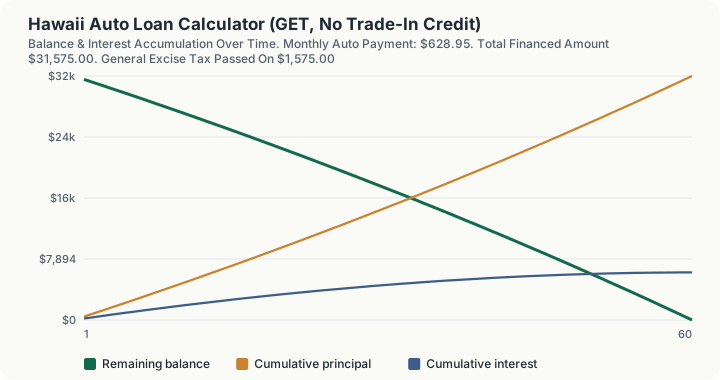
Quick Answer: A $35,000 vehicle in Hawaii with $5,000 cash down, a 60-month term, and a 7.25% APR carries a $628.95 monthly payment. That includes $1,575.00 of General Excise Tax at the 4.5% nominal rate. A trade-in does not reduce that tax in Hawaii, unlike in most states, so the full $35,000 stays in the tax base no matter what you trade.
Overview
Two things about Hawaii break the assumptions most car-buying advice is built on.
There is no trade-in credit. In roughly 40 states, trading your old car in shrinks the taxable price of the new one. Hawaii is one of the exceptions. The General Excise Tax under HRS Ch. 237 is imposed on the dealer's gross income from the sale, and nothing in the statute deducts a trade-in allowance from that gross income. Trade in a $10,000 car against a $35,000 one and the tax base is still $35,000. You save $10,000 on the loan and $0 on the tax. In a state that grants the credit at the same 4.5% rate, that trade-in would have been worth another $450. Some consumer calculators net the trade-in out anyway and understate Hawaii tax as a result.
It is not a sales tax. GET is levied on the seller, not the buyer. Legally the dealer owes it on its gross receipts, and what appears on your buyer's order is the dealer passing that cost on. This is why the visible rate is odd. Because the pass-on amount itself becomes part of the dealer's gross income, the rate is grossed up, and the state permits a maximum visible pass-on of 4.7120% against a nominal 4.5%.
This calculator uses the 4.5% nominal statutory rate by default, being 4.0% state GET plus the 0.5% county surcharge. Set the county surcharge input to 0.712 to model the 4.7120% maximum pass-on instead, which is closer to what most dealer paperwork shows. On the baseline purchase, the difference is $74.20.
Auto Loan APR by Credit Score
The APR columns below are national averages, not Hawaii figures. No primary source publishes average auto loan APR by state: Experian's report has no geographic cut, the CFPB publishes state origination volume but no rates, and the New York Fed publishes state delinquency only. The payment column is the part that is specific to Hawaii, because it runs this calculator's own Hawaii tax and fee rules at each tier's rate.
| Credit Tier | VantageScore 4.0 | Avg New APR | Avg Used APR | Est. Payment in Hawaii |
|---|---|---|---|---|
| Super prime | 781-850 | 4.55% | 6.30% | $589.37 |
| Prime | 661-780 | 6.23% | 8.77% | $613.82 |
| Nonprime | 601-660 | 9.67% | 14.03% | $665.76 |
| Subprime | 501-600 | 13.44% | 19.42% | $725.56 |
| Deep subprime | 300-500 | 16.01% | 21.77% | $768.01 |
Payment assumptions: $35,000 vehicle price, $0 trade-in, $5,000 cash down, $0 dealer documentation fee, 60-month term, new-vehicle APR applied to the Hawaii delivered price including tax and statutory fees. At the 6.39% overall new-car average the same purchase costs $616.18 a month.
The score bands are VantageScore 4.0, not FICO. The same borrower can land in a different tier under each model, so a FICO score pulled from a card issuer will not always match the band here. Source: Experian, State of the Automotive Finance Market, Q1 2026, slide 45.
What Moves Your Payment
Each row changes one input and leaves the rest at the baseline below. The dollar effects are this calculator's own output for Hawaii, not a rule of thumb.
| Factor | What Changes | Effect on Monthly Payment | Effect on Total Interest |
|---|---|---|---|
| Vehicle Price | Each extra $1,000 of price raises both the amount financed and the general excise tax base, so the tax rises with it. | +$20.82 | +$203.94 |
| Trade-In Allowance | A $1,000 allowance cuts the amount financed by $1,000, but it does not reduce the general excise tax base. Hawaii gives no trade-in tax credit, so you are taxed on the full price. | -$19.92 | -$195.16 |
| Cash Down Payment | A $1,000 larger down payment cuts the amount financed by $1,000. It never reduces the general excise tax, which is assessed on the price, not on what you borrow. | -$19.92 | -$195.16 |
| Dealer Doc Fee | A $100 higher documentation fee adds $100 to the amount financed and is inside the general excise tax base, so it is taxed on top of itself. | +$2.09 | +$20.39 |
| Longer Term | Stretching the same balance from 60 months to 72 months spreads the principal over twelve more payments at the same rate. | -$86.83 | +$1,295.47 |
Baseline: $35,000 vehicle price, $0 trade-in, $5,000 cash down, $0 documentation fee, 60 months at 7.25% APR, giving a $628.95 payment and $6,162.30 of total interest.
How This Is Calculated
Hawaii's General Excise Tax falls on the dealer's gross proceeds rather than on your purchase, which is exactly why a trade-in allowance cannot reduce it. Four steps.
1. GET base. The base is the dealer's gross proceeds from the sale, meaning the full selling price plus any dealer charge, with no reduction for a trade-in.
Only a genuine discount, which reduces the dealer's gross proceeds, lowers this figure. A trade-in allowance does not.
2. GET. The 4.0% state retailing rate plus the county surcharge.
3. Title and registration are excluded. See the section below on what is not modeled. Hawaii's title fee is county set, sources conflict on the amount, and registration is weight based with no statewide flat figure. Rather than publish a guess, this calculator leaves both out of the delivered price. Budget for them separately.
4. Amortization. The financed balance amortizes as a fixed-rate installment loan:
where $P$ is the amount financed, $i$ is the monthly rate (APR divided by 12), and $n$ is the term in months. The trade-in and cash down both reduce $P$ here, which is the only place a trade-in helps you in Hawaii.
Hawaii County GET Surcharge Rates
All four counties currently levy the same 0.5% surcharge, so the rate is effectively uniform statewide. The surcharge attaches to the 4.0% retailing activity, which includes vehicle sales, so there is no separate automotive rate to look up.
| Island / Metro | County | State GET | County Surcharge | Nominal | Max Pass-On |
|---|---|---|---|---|---|
| Honolulu | Honolulu (Oahu) | 4.0% | 0.5% | 4.5% | 4.7120% |
| Hilo, Kailua-Kona | Hawaii | 4.0% | 0.5% | 4.5% | 4.7120% |
| Kahului, Wailuku | Maui | 4.0% | 0.5% | 4.5% | 4.7120% |
| Lihue | Kauai | 4.0% | 0.5% | 4.5% | 4.7120% |
The surcharges started at different times. Honolulu's has run since 2007, Kauai's since 2019, Hawaii County's at the full 0.5% since 2020, and Maui's since January 2024. All four are currently authorized through 31 December 2030. Because they expire on a schedule rather than permanently, check the Department of Taxation's county surcharge page before relying on a rate for a future purchase.
Worked Example
Hawaii does not tax the buyer at all. The General Excise Tax falls on the dealer's gross income and is passed through, and because it is the dealer's tax there is no statutory deduction for your trade-in. Watch the tax line refuse to move.
- Vehicle price: $35,000
- Trade-in allowance: $0
- Cash down: $5,000
- Dealer fee: $0
- County surcharge: 0.5%
- Term: 60 months at 7.25% APR
Step 1 -- The GET base. Gross proceeds on the sale, with no trade-in deduction available: $35,000.00
Step 2 -- State GET at 4.0%. $35,000.00 x 4.0% = $1,400.00
Step 3 -- County surcharge at 0.5%. $35,000.00 x 0.5% = $175.00
Step 4 -- Total GET passed on. $1,400.00 + $175.00 = $1,575.00
Step 5 -- Total delivered price. $35,000 + $1,575.00 = $36,575.00
Step 6 -- Amount financed. $36,575.00 - $0 trade-in - $5,000 cash down = $31,575.00
Step 7 -- The monthly payment. $31,575.00 at 7.25% over 60 months = $628.95
Step 8 -- Month 1. $31,575.00 x (7.25% / 12) = $190.77 interest, $438.18 principal, balance $31,136.82
Step 9 -- Month 2. $31,136.82 x (7.25% / 12) = $188.12 interest, $440.83 principal, balance $30,695.99. Cumulative interest: $378.89
Step 10 -- The accumulation. Interest paid through month 12 is $2,110.90, with $26,138.50 still owed. Over 60 months, $6,162.30
Now add a $10,000 trade-in. The GET base stays at $35,000 and the tax stays at exactly $1,575.00. The payment falls to $429.76, entirely because the loan is $10,000 smaller. Tax saved by the trade-in: $0.00.
That result changes how you should think about selling privately. In a trade-in credit state, the dealer's offer carries a hidden bonus equal to the tax you avoid, so a private buyer has to beat the trade offer by that much to be worth the trouble. In Hawaii there is no bonus. A private sale that nets even one dollar more than the dealer's offer leaves you better off.
Switching to the 4.7120% maximum pass-on rate raises the GET to $1,649.20 and the payment to $630.43.
What This Does Not Account For
- Title and registration. Both are excluded from the delivered price on purpose. Hawaii's certificate of title fee is county set and sources disagree, citing a $5 state certificate fee alongside a $10 Honolulu ownership transfer fee. Registration is weight based and county administered: a state registration fee near $45, a state weight tax of roughly 1.75 to 2.25 cents per pound, a county registration fee, a county weight tax around 7 cents per pound on Oahu, plus plate, beautification, and emblem charges. A typical Honolulu passenger car lands somewhere in the $150 to $400 range annually. No single statewide number exists, so none is published here. Get the exact figure from your county motor vehicle office.
- The dealer's own fee. Hawaii's cap on dealer documentary charges, if any, and the typical market amount could not be verified, so the input defaults to zero. Whatever your dealer charges belongs inside the GET base, because GET reaches the dealer's entire gross income from the transaction.
- Private-party purchases. GET applies to a dealer's business activity. A casual sale between individuals is treated differently, and the use tax rules that apply to vehicles brought in from out of state differ again. Check with the Department of Taxation.
- Annual weight tax. Hawaii has no value-based vehicle property tax, but it does levy annual state and county weight taxes collected with registration. That is a recurring cost this calculator does not model.
- Shipping a vehicle to the islands, and the use tax consequences of doing so.
- GAP insurance, extended warranties, and negative equity, unless you fold them into the vehicle price yourself.
Common Pitfalls
- Assuming your trade-in cuts the tax. It does not. This is the single most expensive Hawaii assumption, and it is wrong by 4.5% of the allowance. A $15,000 trade-in that would save $675 of tax on the mainland saves nothing here.
- Using a mainland calculator. Most default to netting the trade-in out of the taxable price. Any tool that shows your Hawaii tax falling when you enter a trade-in is giving you a number that is too low.
- Mixing up 4.5% and 4.7120%. Both are correct for different purposes. The 4.5% is the statutory rate; 4.7120% is the maximum a dealer may visibly pass on, grossed up because the pass-on is itself taxable income to the dealer. Pick one and stay with it when comparing quotes.
- Calling it sales tax when you dispute a charge. GET is the dealer's tax obligation, not yours. A dealer is permitted to pass it on but is not required to itemize it the way a sales tax state requires. That distinction matters if you are questioning a line item.
- Assuming a county has no surcharge. All four currently levy 0.5%, so the effective rate is uniform. The surcharges do have expiry dates, currently the end of 2030.
- Judging a loan by the monthly payment alone. Stretching the baseline $31,575.00 balance from 60 to 72 months lowers the payment to $542.12 but raises total finance charges from $6,162.30 to $7,457.72.
Frequently Asked Questions
Does a trade-in reduce car tax in Hawaii?
What is the sales tax rate on a car in Hawaii?
Why is the rate 4.7120% and not 4.5%?
Which Hawaii counties charge the GET surcharge?
Should I trade in or sell my car privately in Hawaii?
How much are registration and title in Hawaii?
Sources
- Hawaii Department of Taxation, County Surcharge on General Excise and Use Tax (0.5% in all four counties, effective dates and 2030-12-31 expiry, 4.7120% maximum pass-on rate) tax.hawaii.gov
- Consumer Financial Protection Bureau, Truth in Lending Act (Regulation Z, 12 CFR Sec. 1026.22) disclosure requirements for installment credit. ecfr.gov/current/title-12/chapter-X/part-1026
Also consulted: HRS Ch. 237 (General Excise Tax: 4.0% retailing rate imposed on the seller's gross income, no trade-in deduction); Honolulu Department of Customer Services and county motor vehicle fee schedules (weight-based registration components; no statewide flat amount); Experian, State of the Automotive Finance Market, Q1 2026, slide 45 (average new and used auto loan APR by VantageScore 4.0 credit tier; national, no state level cut published).