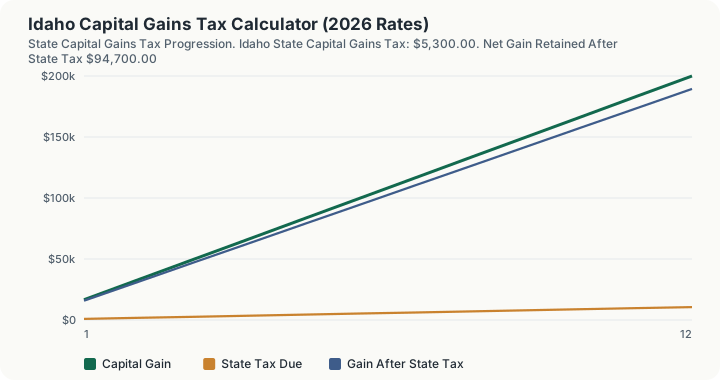
Quick Answer: On a $100,000 capital gain, Idaho's flat 5.30% state tax adds $5,300.00 to your bill, leaving $94,700.00 after state tax.
Idaho's Flat 5.30% on Gain
Idaho taxes capital gains as ordinary income at a flat statutory individual income tax rate of 5.30%, applying uniformly across all realized investment profits regardless of holding period or total taxable income.
Idaho maintains a flat income tax structure where capital gains from stock sales, business equity, real estate, and digital assets are added to gross income and taxed at the uniform statutory rate of 5.30%. No preferential rate distinction exists between short-term and long-term gains at the state level.
High-net-worth individuals, portfolio managers, corporate executives, and real estate investors all need a handle on state-level capital gains taxation, since state income taxes affect net internal rates of return on capital dispositions, 1031 exchange planning, installment sale structuring, and equity compensation exercises (ISOs, NSOs, and RSUs).
In institutional wealth management and private equity underwriting, capital gains calculations must account for both statutory tax rates and multi-jurisdictional residency rules. That holds whether the asset being disposed of is a block of publicly traded securities, a privately held business interest, real property, or a digital asset: evaluating state-level tax exposure is a core part of pre-liquidity tax modeling and post-sale wealth preservation.
Proper capital asset planning in Idaho also means tracking taxable events across federal and state reporting cycles. Timing and holding structure dictate net after-tax proceeds, so investors need to look closely at how federal adjusted gross income (AGI) baselines interact with state modifications before closing substantial transactions.
How This Is Calculated
Idaho taxes a capital gain at its flat 5.3% income tax rate. The state does have a narrow deduction for gains on certain Idaho real and tangible property held long enough to qualify, which this calculator does not model because it does not ask what was sold; for a typical securities sale the flat rate is the whole computation.
That makes the state computation a single multiplication, with the effective rate falling straight out of it.
The full sequence:
- Start with the net gain. Capital losses and loss carryforwards are netted first; what you enter is the net figure.
- No preferential rate. Idaho has no separate capital gains rate and no long-term holding-period break, so the gain is taxed exactly as wages would be.
- Apply the rate. Multiply the net gain by 5.3%. Because the schedule is flat, your other income does not push the gain into a higher band, and the calculator does not need to stack the two.
- Effective rate. Total tax divided by realized gain, which on a flat schedule returns 5.3% at every gain size. Effective and marginal rates are the same number here.
- Net proceeds. Subtract the state tax from the gain to get what you keep before federal tax.
Worked Example
Consider an investor in Idaho who realizes $100,000 in capital gains from a single asset sale during the year.
- Identify the gain. The full $100,000 capital gain is added to gross income, since Idaho taxes capital gains at the same statutory rate as wages and other ordinary income, with no separate preferential rate for long-term holdings.
- Apply the flat rate. Idaho's statutory individual income tax rate is a uniform 5.30%, applied to the entire gain regardless of the investor's total income or how long the asset was held.
- Compute the tax due. $100,000 × 5.30% = $5,300.00, the state tax liability on this sale.
- Net proceeds. Subtracting the $5,300.00 state tax from the $100,000 gain leaves the investor with $94,700.00 in state after-tax proceeds, before any federal capital gains tax is applied separately.
Because Idaho applies one flat rate to every dollar of gain, the effective state tax rate here equals the statutory rate itself: 5.30%.
What the Idaho Sweep Prices, and What It Ignores
Idaho taxes capital gain at its flat 5.30% income tax rate. The twelve tiers above apply that one rate to twelve gain sizes, so the schedule is linear and the effective rate reads 5.30% at every rung.
Two rungs. Row 3 realises $50,000.00 and returns $2,650.00. Row 6, the $100,000 baseline, returns $5,300.00. Row 12 doubles to $200,000.00 and returns $10,600.00. There is no bracket edge, exclusion cliff or holding-period step anywhere on that ladder.
The marginal figure. Each additional $1,000 of Idaho capital gain costs $53.00. The engine returns $5,353.00 on a $101,000 gain against $5,300.00 on $100,000. A $1,000,000 gain returns $53,000.00 at the same 5.30%.
The reverse question. An investor holding Idaho tax to $5,000 can realise $94,339.62 of gain; the engine returns exactly $5,000.00 of tax and $89,339.62 of net proceeds there. That is $5,660.38 below the $100,000 baseline, and because the rate is flat the ceiling scales in proportion to any other budget.
The other-income field changes nothing here. Enter $0 of other taxable income and the engine returns $5,300.00. Enter $200,000 and it returns $5,300.00. The field is part of a shared component built for graduated states, where stacking a gain on top of wage income determines which brackets it meets. Idaho's stored schedule is a single rate applied from the first dollar, so no stacking occurs and the input has no effect on the result.
The Idaho capital gains deduction is not modelled. Idaho allows a deduction for a portion of the gain on qualifying Idaho property, real and tangible personal property held for the statutory period and used in an Idaho business. Nothing on this page asks whether the asset qualifies, and no deduction is applied, so a seller of qualifying Idaho property will owe less than the $5,300.00 shown. The engine also does not implement the zero-rate band that Idaho's published rate schedule applies to the first several thousand dollars of taxable income; the stored array is a single 5.3% bracket.
What sits outside the state figure. Federal capital gains tax at 0%, 15% or 20%, the 3.8% net investment income tax, the short-term versus long-term distinction, basis and selling costs, and any section 1031 exchange deferral are all absent from this calculation.
What This Does Not Account For
While this calculator provides penny-exact state statutory modeling, additional federal and transactional complexities warrant supplementary review: - Federal Capital Gains Taxes: Federal long-term brackets (0%, 15%, 20%) and short-term ordinary rates up to 37% under IRC § 1. - Net Investment Income Tax (NIIT): The 3.8% surtax on net investment income under IRC § 1411 for single filers over $200,000 (married joint over $250,000). - Alternative Minimum Tax (AMT): Federal AMT calculations under IRC § 55 impacting incentive stock option (ISO) exercise spread. - Section 1031 Like-Kind Exchanges: Tax deferral mechanisms for real property held for productive use in trade, business, or investment. - Qualified Small Business Stock (QSBS): Federal Section 1202 gain exclusions where state conformity varies significantly.
Common Pitfalls
- Assuming Federal Rate Parity: Most states do not offer preferential long-term capital gains rates; gains are taxed at standard ordinary income rates.
- Failing to Track Holding Periods: Short-term gains (assets held ≤1 year) generate higher federal tax liabilities even if state rates treat both holding periods identically.
- Underestimating Multi-State Apportionment: Selling real estate or business assets located in other jurisdictions triggers multi-state non-resident return filing obligations.
- Neglecting Underpayment Penalties: Substantial one-time liquidity events require prompt estimated tax payments within the quarter of sale to avoid statutory penalties.
- Mismatched Cost Basis Records: Failure to document reinvested dividends, stock splits, or structural return-of-capital distributions leads to inflated taxable gain calculations.
Frequently Asked Questions
Does Idaho have a state capital gains tax?
How are short-term and long-term capital gains taxed in Idaho?
Are retirement account distributions subject to capital gains tax in Idaho?
Can capital losses offset capital gains in Idaho?
When are estimated state tax payments required on capital gains?
Sources
- Idaho State Tax Commission: 2026 Statutory Individual Income Tax Rate Schedules. tax.idaho.gov
- Internal Revenue Service (IRS): Publication 544 (Sales and Other Dispositions of Assets) and Publication 550 (Investment Income and Expenses). irs.gov/publications/p544