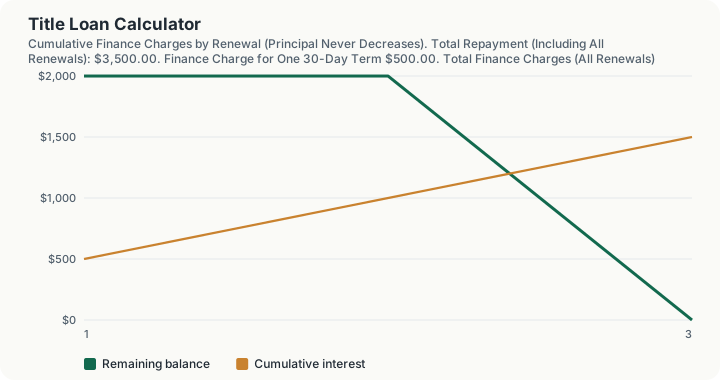
Quick Answer: A $2,000 car title loan at a typical 25% monthly finance charge rate costs $500 every 30 days it isn't paid off, and if renewed twice before final payoff, the total cost balloons to $3,500, $1,500 of which is pure finance charge on a loan whose principal never went down.
Overview
A car title loan is a short-term loan secured by your vehicle's title, usually due in full, principal and finance charge together, within 30 days. If you cannot pay it off, most lenders let you "renew" or "roll over" the loan: you pay the finance charge again, and the original principal stays exactly where it was, untouched. That structure, a flat monthly rate charged repeatedly against a balance that never decreases, is what makes title loans one of the most expensive and misunderstood forms of consumer credit, and it is exactly what this calculator is built to make impossible to miss.
Monthly finance charge rates of 25% or higher are common in this market. Annualized the ordinary way, that alone works out to a 300% rate, and that is before accounting for what actually happens to a large share of title loan borrowers: they do not pay off the loan in 30 days, they renew it, sometimes for months at a stretch, paying the same finance charge over and over on a principal balance that has not shrunk by a single dollar. This calculator shows both numbers side by side: the cost of paying off promptly at the first due date, and the real cost if the loan is renewed a chosen number of times before it is finally paid in full.
This is a general calculator, not tied to any specific state's rate cap. Some states cap title loan rates well below 25% a month, some allow rates even higher, and a number of states ban title lending outright or heavily restrict it. Always check your specific state's consumer lending rules before treating the default 25% rate as what you will actually be charged.
How This Is Calculated
Step 1: Compute the flat monthly finance charge. Title loans do not amortize like a standard installment loan. The finance charge for any 30-day period is simply the loan principal multiplied by the monthly rate:
Step 2: Model each renewal as another identical charge against the same unpaid balance. Because the principal is not reduced during a renewal, the exact same finance charge repeats every 30 days the loan remains outstanding. The calculator generates a genuine period-by-period schedule, using an interest-only structure, to show this explicitly: the balance and the finance charge stay level from period to period, until the loan is finally paid off in full.
Step 3: Total the true cost. Total finance charges are the sum of every period's charge. Total repayment, if the loan is carried through all the renewals you specify and then paid off, is the original principal plus every one of those accumulated finance charges:
Step 4: Show the simple annualized rate. To make the monthly rate comparable to APRs quoted on other kinds of credit, the calculator multiplies the monthly rate by 12, the same "make the true cost obvious" approach used for payday loan APR disclosure.
Worked Example
Take a $2,000 title loan at a 25% monthly finance charge rate, renewed twice (three 30-day periods total: the original term plus two renewals) before finally being paid off.
- Finance charge per 30-day period: $2,000 × 25% = $500. This is the same charge every period, since the $2,000 principal is never reduced during a renewal.
- Total finance charges across 3 periods: $500 × 3 = $1,500.
- Total repayment when finally paid off: $2,000 (original principal) + $1,500 (accumulated finance charges) = $3,500.
- Simple annualized rate: 25% × 12 = 300%.
Compare that to paying off at the very first due date with no renewal at all: a single $500 finance charge, $2,500 total, versus $3,500 if renewed twice. The difference, $1,000, is not a fee for borrowing more money; it is the cost of the exact same $2,000 principal sitting unpaid for two extra months. Carry that same loan for a full year, 11 renewals, 12 total periods, and the finance charges alone reach $6,000 on a $2,000 loan, for a total repayment of $8,000.
What This Does Not Account For
This calculator models the finance charge and renewal structure only. It does not model any state's specific rate cap, licensing requirements, or renewal limits; many states restrict title lending far more tightly than the general 25% monthly figure used here as a default, and a smaller number ban it outright. Repossession costs, late fees, and other add-on charges some lenders apply on top of the base finance charge aren't included either. Nor does it model a partial-paydown structure, where a borrower pays down some principal at each renewal rather than the finance charge alone; some lenders allow or require this, which would reduce the finance charge in later periods compared to what this calculator shows. And the risk of losing the vehicle to repossession isn't accounted for at all, since that's a collateral consequence rather than a dollar cost, even though it's often the most significant real-world outcome of an unpaid title loan.
Common Pitfalls
Borrowers often focus on the monthly finance charge in isolation, "it's only $500 to renew," without connecting that number to how many times they have already renewed and how much they have paid in total finance charges relative to the original loan amount. It is also easy to assume renewing is a cheap alternative to default, when in reality each renewal adds a full new finance charge without reducing what is actually owed, which is precisely the debt trap dynamic that makes this loan type so costly over a period of months rather than weeks. Some borrowers also confuse the monthly rate with an annual rate, comparing a "25%" title loan quote directly against a credit card's 25% APR, when the title loan's 25% is charged every single month, not once a year, a roughly twelvefold difference in actual annualized cost. Finally, borrowers sometimes underestimate how quickly total finance charges can exceed the original loan amount itself; on the example above, four renewals alone would mean paying more in finance charges than the vehicle-secured principal borrowed in the first place.
Frequently Asked Questions
Why doesn't renewing a title loan reduce what I owe?
Is 25% a month a typical or a high rate for a title loan?
What happens if I can't pay off a title loan or keep up with renewals?
How is a title loan different from a payday loan?
Can I pay off a title loan early without penalty?
Sources
- General title loan finance charge structure, consistent with disclosure practices reported by the Consumer Financial Protection Bureau and state consumer credit regulators; this calculator is intentionally general rather than tied to a specific state's rate cap, since state law varies widely. consumerfinance.gov
- Truth in Lending Act (TILA / Regulation Z), governing the disclosure of finance charges and annual percentage rates on consumer credit, the basis for the simple annualization approach used here. ecfr.gov/current/title-12/chapter-X/part-1026