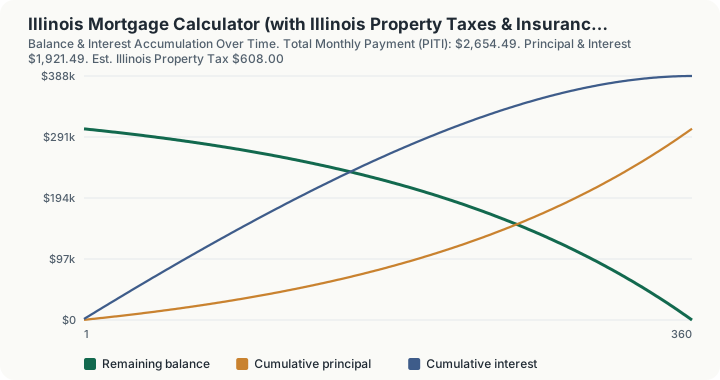
Quick Answer: On a $380,000 Illinois home with 20% down at 6.5% APR over 30 years, principal and interest run about $1,921.49 a month, and Illinois's steep 1.92% effective property tax rate plus a $125 insurance estimate bring the full PITI payment to about $2,654.49.
Overview
Illinois carries the highest effective property tax rate in the United States, just ahead of New Jersey. The 1.92% effective rate used in this calculator reflects that reality, and it changes the shape of an Illinois mortgage payment more than almost any other input. On the same $380,000 home price and loan terms used across this platform's other state mortgage calculators, Illinois's property tax component alone runs to $608.00 a month. That is nearly a quarter of the whole payment before a dollar of it touches the loan balance, and about seven times the $85.50 that the same $380,000 home would generate in Hawaii.
That tax burden is driven primarily by Illinois's heavy reliance on local property tax to fund schools and municipal government, layered across thousands of overlapping taxing districts, a structure that produces significant variation not just between counties but between neighboring municipalities within the same county. Cook County and the collar counties around Chicago see some of the highest nominal rates in the state, though home values there can be higher too, while many downstate Illinois counties see somewhat lower effective burdens on lower-valued homes.
This calculator produces a full PITI (Principal, Interest, Taxes, Insurance) estimate, which matters enormously in Illinois specifically: a buyer who budgets only around the principal-and-interest quote from a lender will be caught badly off guard by the size of the escrowed tax payment once the loan closes.
How This Is Calculated
- Compute the loan principal. Home price minus down payment: $380,000 × (1 − 20%) = $304,000.00 financed.
- Amortize principal and interest. The $304,000.00 balance runs through the platform's amortization primitive at a monthly rate of 6.5% ÷ 12 over 360 months, producing a monthly principal-and-interest payment of approximately $1,921.49.
- Estimate monthly property tax. Illinois's 1.92% effective annual rate is applied to the full home price and divided by twelve: $380,000 × 0.0192 ÷ 12 = $608.00 per month.
- Add a flat insurance estimate. A $125 monthly placeholder represents typical homeowners insurance; Illinois properties exposed to severe wind and hail events may carry higher actual premiums.
- Sum to PITI. Combined, the estimated monthly housing payment comes to approximately $2,654.49.
The core payment formula is $PMT = P \times \dfrac{i}{1-(1+i)^{-n}}$, where $P = \$304{,}000.00$, $i = 6.5\%/12$, and $n = 360$, computed with Decimal.js arbitrary-precision arithmetic so the 360-row schedule reconciles exactly to the total interest figure.
Worked Example
Baseline scenario, matching this calculator's verified test vectors:
- Home price: $380,000.00
- Down payment: 20% ($76,000.00)
- Loan principal: $304,000.00
- Interest rate: 6.5% APR, 30-year fixed
- Monthly principal & interest: approximately $1,921.49
- Estimated Illinois property tax (1.92% effective rate): $608.00/month
- Estimated insurance: $125.00/month
- Total monthly PITI: approximately $2,654.49
- Total interest paid over 30 years: approximately $387,733
Property tax makes up roughly 23% of the total monthly PITI payment in this Illinois example, compared to under 5% in the platform's Hawaii mortgage calculator on the exact same home price and loan terms. That gap alone can be the difference between qualifying for a given loan amount and falling short of a lender's debt-to-income threshold.
What This Does Not Account For
- County and municipal-level variance. Illinois property tax is set by thousands of overlapping taxing districts, including school, park, library, and municipal levies; 1.92% is a statewide effective average, and actual bills in Cook County, the collar counties, and downstate Illinois can differ significantly from that average in either direction.
- General Homestead Exemption and senior exemptions. Illinois offers a General Homestead Exemption plus additional exemptions for seniors, disabled homeowners, and veterans that reduce the equalized assessed value for owner-occupants; this calculator does not model exemption eligibility.
- Assessment and equalization cycles. Illinois counties reassess property values on varying multi-year cycles, and the state applies an equalization factor in some counties (notably Cook County) that further adjusts taxable value; this calculator works from a simplified flat effective rate rather than reconstructing the assessment process.
- Private mortgage insurance (PMI). Down payments below 20% typically require PMI on a conventional loan, not included in this estimate.
- Severe weather insurance riders. Illinois's exposure to tornadoes, hail, and wind events can push homeowners insurance premiums above the flat $125 monthly estimate used here, particularly in central and southern Illinois.
Common Pitfalls
- Budgeting only around the principal-and-interest quote. This is the single most consequential pitfall for Illinois buyers specifically, since the property tax component here is large enough to change loan qualification and monthly affordability far more than in most other states.
- Assuming a single statewide rate applies evenly. Effective rates vary widely by taxing district within Illinois; a buyer should pull the actual local tax rate and recent tax bill history for a specific property before finalizing a budget, rather than relying solely on a statewide average.
- Missing exemption filing deadlines. Failing to file for the General Homestead Exemption or applicable senior or veteran exemptions after closing can mean paying tax on the full equalized assessed value for the first year of ownership.
- Not verifying whether taxes are trending up. Because reassessment cycles and local levy increases can raise Illinois property tax bills meaningfully between purchase and a few years into ownership, buyers should check recent tax bill trends for a specific property rather than assuming a flat, unchanging bill.
- Underestimating severe weather insurance costs. Illinois's tornado and hail exposure, especially in central and southern parts of the state, can push actual insurance premiums above the flat estimate used in this calculator.
Frequently Asked Questions
Why is Illinois property tax so much higher than in most states?
Does this rate apply the same way in Chicago as it does downstate?
Does this calculator apply the Illinois Homestead Exemption?
How much does property tax affect Illinois mortgage affordability compared to other states?
Should I expect my Illinois property tax bill to change after I buy?
Sources
- Illinois Department of Revenue: Property Tax Division, equalization and assessment guidance. tax.illinois.gov
- Consumer Financial Protection Bureau (CFPB): Regulation Z (Truth in Lending Act) mortgage disclosure standards. ecfr.gov/current/title-12/chapter-X/part-1026
Also consulted: Cook County Assessor's Office: Assessment cycle and exemption program details.