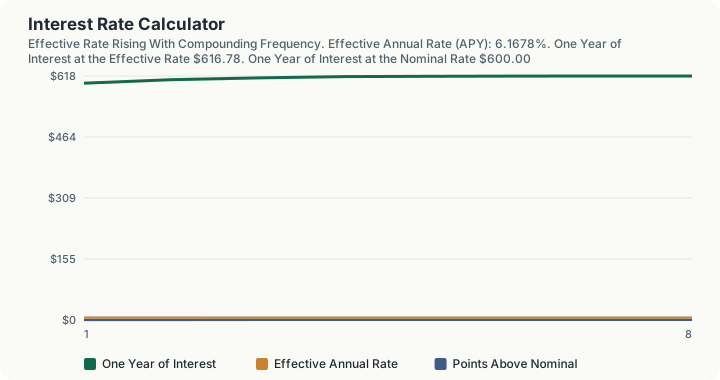
Quick Answer: A 6% nominal rate compounded monthly is really 6.1678%. The gap of 0.1678 points is worth $16.78 a year on a $10,000 balance. Compound the same 6% daily and it becomes 6.1831%; continuously, 6.1837%. A quoted rate is not a rate until you know how often it compounds.
What does this calculator do?
There is no such thing as "the" interest rate on an account. There is a quoted rate and a compounding frequency, and only the two together determine what you earn or pay. This calculator converts between the ways a single underlying rate can be expressed: nominal to effective, effective back to nominal, and one compounding frequency to another.
That conversion matters because the two sides of the market quote differently, and not by accident. Lenders in the United States quote APR, which annualises without compounding and is therefore the smaller number. Deposit-takers quote APY, which includes compounding and is therefore the larger one. Both are legally defined, both describe the same underlying arithmetic, and comparing one against the other directly is a mistake the conventions almost invite.
The second thing this page settles is how much frequency actually matters. Going from annual to monthly compounding on 6% adds 0.1678 points. Going from monthly all the way to continuous adds only a further 0.0159. The returns diminish sharply, which is why the difference between a bank that compounds daily and one that compounds monthly is close to irrelevant, and the difference between 6% and 6.25% is not.
At high rates that changes. A 24% card rate compounded daily has an effective rate of 27.1149%, more than three points above the quoted figure. If you are comparing debts rather than deposits, the blended interest rate calculator handles a portfolio of them.
How is this calculated?
EAR = (1 + r/m)ᵐ − 1; Continuous: EAR = e^r − 1
Equivalent nominal at m₂ = m₂[(1 + r/m₁)^(m₁/m₂) − 1]
Step 1: Convert the quoted rate to a decimal. $6\% \div 100 = 0.06$
Step 2: Divide by the number of compounding periods a year. $0.06 \div 12 = 0.005$, that is 0.500000% per period
Step 3: Compound that periodic rate across the year. (1.005)¹² = 1.06167781
Step 4: Subtract one for the effective annual rate. $1.06167781 - 1 = 6.1678\%$
Step 5: Subtract the nominal rate to isolate the effect of compounding. $6.1678 - 6.0000 = 0.1678 points$
Step 6: Apply both rates to the balance for one year. $10,000 \times 0.0616778 = \$616.78$ against $10,000 \times 0.06 = \$600.00$, a difference of $16.78
Step 7: Compute the continuous ceiling. e^(0.06) − 1 = 6.1837%
Step 8: Convert to the equivalent nominal rate at the target frequency. With quarterly selected: (1.005)^(12/4) − 1 = 1.015075125 − 1, then × 4 = 6.0301% compounded quarterly.
Step 8 is the one worth understanding. 6% compounded monthly and 6.0301% compounded quarterly are the same deal. They produce an identical balance after a year. Two different quoted numbers, one economic reality.
The table repeats steps 2 through 6 at all eight frequencies.
Worked Example
6% on $10,000, compounded monthly.
- Periodic rate: 0.500000% across 12 periods
- Effective annual rate: 6.1678%
- Interest in a year: $616.78 rather than $600.00
- Compounding is worth $16.78
The full frequency ladder at 6%: annually 6.0000%, semiannually 6.0900%, quarterly 6.1364%, monthly 6.1678%, biweekly 6.1763%, weekly 6.1800%, daily 6.1831%, continuously 6.1837%.
Read that ladder carefully. The first step, from annual to semiannual, buys 0.09 points. Every remaining step from monthly onward buys 0.0159 points combined. Compounding frequency is subject to steeply diminishing returns and hits a hard ceiling at e^r − 1.
The same 6%, expressed at other frequencies. 6% monthly equals 6.0301% compounded quarterly. Both give 6.1678% effective. If a bank offers you 6.02% compounded quarterly against 6% compounded monthly, that is genuinely, if marginally, the better offer, and the only way to see it is to convert.
A credit card at 24% compounded daily. The effective rate is 27.1149%, a spread of 3.1149 points, which on a $10,000 balance is $311.49 a year of pure compounding effect. The card is legally allowed to advertise 24%, and does.
What does this calculator not account for?
- Fees. This converts between expressions of a rate. It does not add origination fees, points or account charges, which is what separates a rate from an APR. Use the APR calculator for that.
- Variable and tiered rates. One constant rate is assumed for the whole year. Introductory rates, rate tiers by balance, and repricing are not modelled.
- Day-count conventions. Daily compounding here uses 365 periods. Instruments using actual/360 or 30/360 produce slightly different figures.
- Taxes. All rates are pre-tax.
- Grace periods and how interest is applied. Credit cards commonly compute interest on an average daily balance and grant a grace period on new purchases when the balance is paid in full, neither of which is a rate conversion.
- Minimum balances or activity requirements that a quoted APY is conditional on.
- The regulatory rounding rules in the disclosure regimes, so a lender's published figure may differ in the last decimal place.
What mistakes do people make with this?
- Comparing an APR to an APY. They are computed differently on purpose. Convert both to an effective annual rate before deciding.
- Assuming daily compounding is a meaningful advantage. At 6% it beats monthly by 0.0153 points, which is $1.53 a year on $10,000.
- Ignoring compounding at high rates. At 24% the gap is 3.1149 points, not 0.17. The effect scales with the rate, not with your intuition about it.
- Thinking more frequent compounding grows without limit. It converges on e^r − 1 and stops. There is nothing above continuous.
- Applying a nominal annual rate directly to a monthly balance. Divide by the periods first. Applying 6% monthly rather than 0.5% monthly overstates a year by an enormous margin.
- Treating the effective rate as the payment rate on a loan. Your loan payment is computed from the periodic nominal rate. The effective rate tells you the true cost, not the instalment.
Frequently Asked Questions
What is the difference between nominal and effective interest rate?
Is APY the same as effective annual rate?
Is APR the same as nominal rate?
How much does compounding frequency really matter?
What is continuous compounding?
Which rate should I use to compare two offers?
Sources
- Consumer Financial Protection Bureau, "What is the difference between a mortgage interest rate and an APR?" consumerfinance.gov/ask-cfpb/what-is-the-difference-between-a-mortgage-interest-rate-and-an-apr-en-135
- Regulation Z (Truth in Lending), 12 CFR Part 1026, including the Appendix J annual percentage rate computation. ecfr.gov/current/title-12/chapter-X/part-1026
The formulas are standard financial mathematics and have no statutory origin. They are implemented as aprToApy, apyToApr, convertRateFrequency and periodicRate in engine/primitives/rate-conversion.ts, with golden vectors in engine/vectors/rate-conversion.test.ts.
Two real United States standards govern how the results are quoted, and both are cited accurately here rather than invented. The annual percentage yield on deposit accounts is defined by the Truth in Savings Act and implemented in Regulation DD, 12 CFR Part 1030, with the calculation in Appendix A to that part; it is an effective, compounded figure. The annual percentage rate on consumer credit is defined by the Truth in Lending Act and implemented in Regulation Z, 12 CFR Part 1026, with the computation at 12 CFR 1026.22 and Appendix J; it annualises the periodic rate by multiplication, without compounding.
That asymmetry is the reason a deposit and a loan quoted at the same headline number are not the same cost of money, and it is the reason this calculator exists. Both regulations are published in the Electronic Code of Federal Regulations at ecfr.gov.