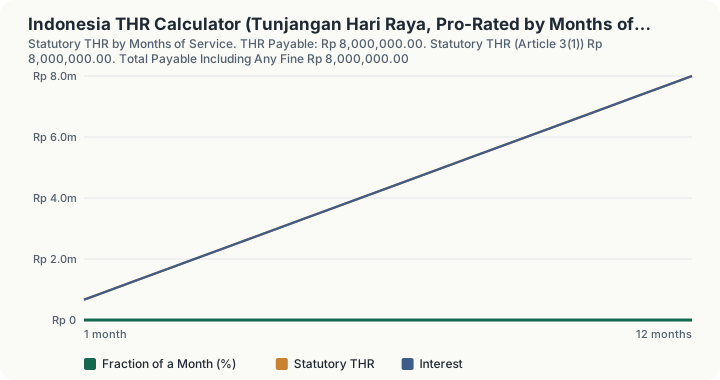
Quick Answer: With twelve months or more of continuous service, THR is exactly one month of wage. On a Rp 8,000,000 wage that is Rp 8,000,000. Below twelve months it is pro-rated as months over twelve, so seven months gives Rp 4,666,666.67, not a seventh and not a full month. Entitlement starts at one month of service, not twelve, and payment is due no later than seven days before the holiday.
What does this calculator do?
Tunjangan Hari Raya Keagamaan is not a bonus and not a discretionary thirteenth month. It is a statutory non-wage payment that every employer must make before the religious holiday that applies to each worker, and it is governed by Peraturan Menteri Ketenagakerjaan Nomor 6 Tahun 2016.
Two things about it are misunderstood far more often than anything else, and both are structural rather than arithmetic.
The pro-rata denominator is always twelve. Article 3(1)(b) writes the formula into the regulation itself: employment period divided by 12, multiplied by one month of wage. It is not the months worked over the months worked, and it is not divided by thirteen. Seven months of service produces seven twelfths of a month's wage.
Entitlement begins at one month of continuous service, not twelve. Article 2(1) is explicit. A worker who joined three months before Idul Fitri is owed three twelfths of a month's wage. An employer who pays nothing to anyone under a year of service is in breach of the regulation, and this is probably the single commonest THR dispute.
The regulation applies to both PKWTT (indefinite) and PKWT (fixed-term) workers under Article 2(2). It is a floor, not a ceiling: Article 4 provides that where a work agreement, company regulation, collective bargaining agreement or established custom promises more, the larger amount is what must be paid.
How is this calculated?
1. Test entitlement against the one month floor. Article 2(1) obliges the employer to pay THR to workers who have continuously worked for one month or more. Service below one month produces no entitlement at all, and the calculator returns zero rather than a small fraction.
2. Cap the months of service at twelve. Article 3(1)(a) fixes the statutory entitlement at one month of wage once twelve months is reached. The calculator therefore counts min(m, 12) months, so thirty months of service and twelve months of service return the same statutory figure.
3. Apply the pro-rata fraction to one month of wage. The denominator is fixed at twelve by the regulation.
THR_statutory = (min(m, 12))/12 × W
where $m$ is the months of continuous service and $W$ is upah 1 bulan. At m ≥ 12 the fraction is exactly 1 and the formula returns a full month's wage.
4. Compare against any contractual amount and take the larger. Article 4 provides that where a contract, company regulation, CBA or practiced custom gives a bigger amount than Article 3(1), that bigger amount is paid.
THR_payable = max(THR_statutory, THR_contractual)
The contractual figure is only ever what you enter. Nothing is assumed about your contract.
5. Apply the late payment fine, if the deadline was missed. Article 5(4) requires payment no later than seven days before the religious holiday. Article 10(1) then imposes a fine of 5% of the total THR that must be paid.
Fine = 0.05 × THR_payable
This is charged once, as a single percentage of the total. It is not a daily or weekly accrual, and the calculator does not scale it by how late the payment was. Article 10(2) confirms the fine does not discharge the obligation to pay the THR itself.
6. Estimate the PPh 21 withheld in the THR month. THR is taxable employment income. Since PP 58/2023 the employer withholds using a Tarif Efektif Rata-rata read against the month's gross income, and Pasal 2(4) applies that tariff to penghasilan bruto bulanan. The calculator reads the TER rate twice, once against the wage alone and once against wage plus THR, and takes the difference:
Tax_THR = (W + THR) × r_combined − W × r_wage
where $r$ is the TER rate for your category. There is no separate rate for THR. When the larger gross crosses into a higher TER band, the higher rate applies to the wage as well, which is why the tax taken out of a THR routinely exceeds the headline TER percentage. The calculator reports that band change explicitly rather than burying it.
Worked Example
A worker on a Rp 8,000,000 monthly wage, single with no dependents, with a full year of service.
Step 1 (entitlement). 12 months is at or above the one month floor, so THR is owed.
Step 2 (cap). min(12, 12) = 12 months counted
Step 3 (fraction). 12 / 12 = 1.0000, so THR = Rp 8,000,000 x 1 = Rp 8,000,000
Now the same worker, hired seven months before the holiday.
Step 4 (the fraction that matters). 7 / 12 = 58.3333%
Step 5 (the statutory THR). Rp 8,000,000 x 7 / 12 = Rp 56,000,000 / 12 = Rp 4,666,666.67
Step 6 (the error to avoid). Dividing by the months worked instead of by twelve gives 7 / 7 = 1, and a THR of Rp 8,000,000. That overstates the entitlement by Rp 3,333,333.33, and the opposite error, paying nothing at all because the worker is under a year, understates it by the whole Rp 4,666,666.67.
Back to the full-year worker, paid two days after the deadline.
Step 7 (the fine). Rp 8,000,000 x 5% = Rp 400,000
Step 8 (the total). Rp 8,000,000 + Rp 400,000 = Rp 8,400,000, and the THR itself is still owed in full.
Now the tax, for the full-year worker at status TK/0, which is TER category A.
Step 9 (the rate on the wage alone). Rp 8,000,000 falls in the band above Rp 7,500,000 and up to Rp 8,550,000, so the rate is 1.5%, and the wage-only withholding is Rp 8,000,000 x 1.5% = Rp 120,000.
Step 10 (the rate on wage plus THR). Rp 8,000,000 + Rp 8,000,000 = Rp 16,000,000, which falls in the band above Rp 15,100,000 and up to Rp 16,950,000, so the rate is 7%. The withholding is Rp 16,000,000 x 7% = Rp 1,120,000.
Step 11 (the tax attributable to the THR). Rp 1,120,000 - Rp 120,000 = Rp 1,000,000, leaving Rp 7,000,000 of THR in hand.
Step 12 (why that is 12.5%, not 7%). Rp 1,000,000 / Rp 8,000,000 = 12.50% of the THR, well above the 7% headline rate. Applying 7% to the THR alone would have given Rp 560,000 and understated the withholding by Rp 440,000. The gap exists because the higher band applies to the whole month's gross, wage included, not only to the THR.
Step 13 (a larger contractual promise). A contract promising two months, Rp 16,000,000, exceeds the Rp 8,000,000 statutory floor, so Article 4 requires Rp 16,000,000, an uplift of Rp 8,000,000.
What does this calculator not account for?
- Working out upah 1 bulan for you. Article 3(2) defines it as clean wage, or basic wage plus fixed allowances. Deciding which of your allowances are fixed rather than variable is a classification question this calculator does not attempt. You enter the resulting figure.
- Daily freelance workers. Article 3(3) computes their one month wage as an average, over the last twelve months where service is twelve months or more and over the whole employment period otherwise. The calculator takes a single wage figure and does not perform that averaging.
- Partial months of service. The calculator counts whole months. Practice on rounding part months varies between employers and is not settled by the regulation.
- Termination timing rules. Article 7(1) preserves entitlement for a PKWTT worker terminated within thirty days before the holiday, and Article 7(3) removes it for a PKWT that ends before the holiday. Neither test is modelled; the calculator assumes the worker is entitled.
- Transfers between companies. Article 8 gives THR in the new company where service is continuous and the previous employer did not pay it.
- Administrative sanctions. Article 11 imposes these separately from the Article 10(1) fine, and their severity is not a fixed percentage of anything.
- Which holiday applies and when. THR is paid against each worker's own religious holiday, and the calendar date is not modelled.
- The December reconciliation. The tax figure here is the withholding in the THR month only. The employer recomputes the whole year against the Pasal 17 ladder in the final tax period, and the THR is simply part of annual gross there.
What mistakes do people make with this?
- Paying nothing below one year of service. Entitlement starts at one month. This is the most frequent breach.
- Dividing by the months worked. The denominator is twelve in every case under twelve months. Nine months is 9/12, not 9/9.
- Assuming long service earns more. The statutory THR is flat at one month of wage from the twelfth month onward. Anything above that has to come from a contract or a CBA.
- Using total take-home pay as the wage. Variable allowances are excluded from upah 1 bulan, so the THR base is usually smaller than a full payslip.
- Treating the 5% fine as a daily charge. Article 10(1) sets one fine on the total THR, triggered once the deadline passes.
- Assuming the fine settles the debt. Article 10(2) is explicit that it does not.
- Expecting THR to be taxed at a flat rate. It is taxed as part of the month's gross under the TER schedule, and the band it pushes you into is what determines the cost.
- Paying in instalments. The 2026 ministerial circular states THR must be paid in full and may not be spread.
Frequently Asked Questions
Do I get THR if I have only worked three months?
Does twenty years of service earn more THR than one year?
When exactly must THR be paid?
What happens if my employer pays late?
Is THR taxed?
Which allowances count towards the THR wage?
Do fixed-term contract workers get THR?
Sources
- Directorate General of Taxes (Indonesia), the official authority for the national tax authority this calculator relates to. pajak.go.id
All figures verified on 31 August 2026.
Also consulted: Peraturan Menteri Ketenagakerjaan Nomor 6 Tahun 2016 tentang Tunjangan Hari Raya Keagamaan bagi Pekerja/Buruh di Perusahaan, official Kemnaker JDIH English translation. Articles 2(1), 2(2), 3(1), 3(2), 3(3), 4, 5(4), 7, 8, 10 and 11; Peraturan Pemerintah Nomor 58 Tahun 2023, BPK JDIH text, Pasal 2(4), for the monthly effective tariff applied to penghasilan bruto bulanan and the TER category assignment; Surat Edaran Menteri Ketenagakerjaan Nomor M/3/HK.04.00/III/2026, as published by Sekretariat Negara, restating the seven day deadline, the one month entitlement at twelve months of service, the months over twelve pro-rata, and the requirement to pay in full; the articles of Permenaker 6/2016 above were read in the Ministry of Manpower's own English translation of the instrument.