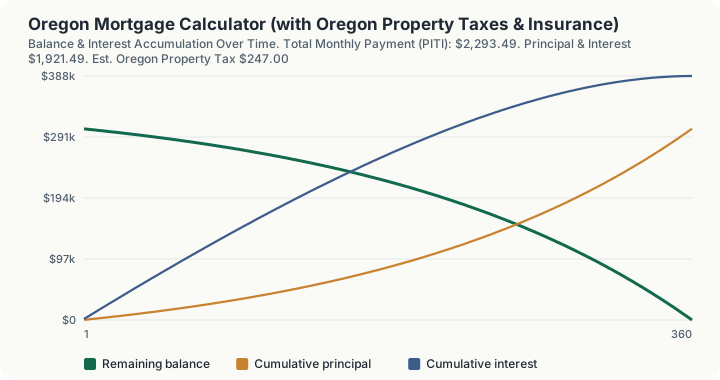
Quick Answer: A $380,000 Oregon home bought with 20% down at a 6.5% rate runs about $2,293.49 a month, driven by principal and interest of $1,921.49 plus roughly $247.00 in Oregon property tax and a flat insurance estimate.
Overview
Oregon's property tax system runs on a different mechanic than most states. Since voters passed Measure 5 in 1990 and Measure 50 in 1997, Oregon caps the assessed value growth of a property at 3% per year, even in years when the actual market value rises much faster. That decouples the tax bill from real-time market swings, which is part of why Oregon's statewide average effective property tax rate sits close to 0.78% of market value, a figure this calculator uses as its baseline, even in a market experiencing rapid appreciation. A buyer who purchases at the top of a hot Portland or Bend market is not automatically facing runaway tax increases the way they might be in a state that reassesses to full market value annually.
The tradeoff is that Oregon has no homestead exemption program of the kind found in states like Florida or Texas, and property tax relief instead comes through the assessed-value cap itself plus targeted senior and disabled deferral programs. This calculator folds Oregon's 0.78% effective rate estimate together with a full 360-month amortization of the mortgage and a flat monthly insurance placeholder to produce a single PITI number that reflects what actually leaves a homeowner's account each month.
How This Is Calculated
- Loan principal. The down payment percentage is applied against the home price and subtracted to determine the financed balance. At the defaults, 20% down on $380,000 leaves a $304,000 loan.
- Principal and interest. The $304,000 balance amortizes over 360 monthly periods at the entered annual rate. The monthly periodic rate is
i = APR / 12, and the fixed payment isM = P × i × (1 + i)^n / ((1 + i)^n − 1), computed period by period through the full schedule rather than approximated. - Escrow stack. Monthly property tax is home price times 0.78% divided by 12, and a flat $125 monthly insurance estimate is layered on top. The 0.78% is a statewide average of what Oregon owners actually pay against market value; the calculator does not rebuild a county's Measure 50 assessed value to get there.
- Total PITI. Principal and interest, property tax, and insurance are summed into the single headline monthly figure.
Worked Example
Using the platform defaults ($380,000 home price, 20% down, 6.5% APR), the engine produces:
- Loan principal: $304,000.00
- Monthly principal & interest: $1,921.49
- Monthly Oregon property tax (0.78% of price, over 12 months): $247.00
- Monthly insurance estimate: $125.00
- Total monthly PITI: $2,293.49
- Total interest paid over 30 years: $387,735.24
The property tax line comes from $380,000 × 0.0078 = $2,964.00 per year, divided by 12 months to reach $247.00. Add that to the $1,921.49 principal and interest payment and the $125.00 insurance estimate, and the total lands at $2,293.49 a month. Because Oregon's assessed value growth is capped at roughly 3% annually under Measure 50 regardless of how fast the home's market value climbs, that $247.00 monthly tax estimate tends to be a reasonably stable starting point even in appreciating neighborhoods, unlike states that reassess to full market value every year.
What This Does Not Account For
- Local option levies and bond measures. Oregon school districts, fire districts, and cities frequently pass local bond measures that stack on top of the base rate, so a specific address inside Portland, Eugene, or Bend can carry a meaningfully different effective rate than the 0.78% statewide average.
- The gap between assessed value and market value. Because Measure 50 caps assessed value growth at 3% annually, a home that has appreciated rapidly may have a market value far above its assessed value, meaning the current tax bill can be lower than 0.78% of today's price, while a newly purchased home is typically reassessed closer to its purchase price in the following cycle.
- Senior and disabled property tax deferral programs. Oregon offers deferral programs for qualifying homeowners that are not modeled in this flat-rate estimate.
- PMI on low down payment loans. Below roughly 20% equity, conventional loans typically require private mortgage insurance, which is separate from the flat $125 hazard insurance line used here.
- Wildfire zone insurance premiums. Homeowner's insurance costs in Oregon's wildfire interface zones can run well above the flat estimate used in this calculator.
Common Pitfalls
- Assuming the 0.78% rate applies uniformly statewide. Oregon's 36 counties and their overlapping taxing districts each set their own combined rate, so Multnomah County and a rural eastern Oregon county can differ noticeably from the statewide average.
- Confusing assessed value with market value. Oregon's Measure 50 system means the number on the tax bill is often not the same as what the home would sell for, which trips up buyers used to states that tax full market value directly.
- Underestimating the reassessment that follows a purchase. A newly purchased home is generally reassessed closer to the sale price, so a buyer inheriting a long-owned seller's low assessed value should not assume that low tax bill carries forward.
- Skipping PMI in a low-down-payment scenario. Buyers modeling 5% or 10% down should add an estimated PMI cost on top of the numbers shown here until they reach 20% equity.
- Treating the insurance line as final. Oregon's flat $125 monthly estimate is a planning placeholder; actual premiums vary with wildfire risk zone, roof age, and coverage limits.
Frequently Asked Questions
Why does Oregon's property tax estimate use 0.78% instead of a round number?
Does Oregon charge a real estate transfer tax on top of this?
How does Measure 50 change my tax bill over time?
Why is there no state sales tax mentioned on a mortgage calculator?
Can I model a smaller down payment or a higher purchase price?
Sources
- Oregon Department of Revenue: property tax assessment and Measure 50 assessed value growth limits. oregon.gov/dor
- Consumer Financial Protection Bureau: Regulation Z disclosure requirements for fixed-rate mortgage APR and finance charges. ecfr.gov/current/title-12/chapter-X/part-1026
Also consulted: Oregon Secretary of State Voters' Pamphlet archives: Ballot Measure 5 (1990) and Measure 50 (1997) text and summaries; Freddie Mac Primary Mortgage Market Survey: benchmark 30-year fixed conventional rate ranges.