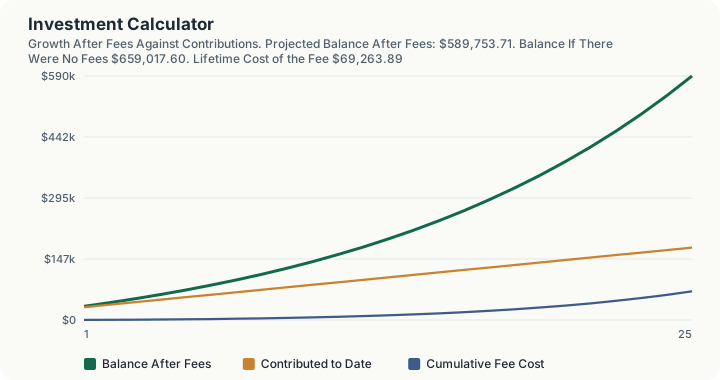
Quick Answer: $25,000 invested today plus $500 a month, at an 8% expected return with a 0.60% annual fee, grows to $589,753.71 over 25 years. Without the fee it would have been $659,017.60. The fee cost $69,263.89, which is 16.70% of your entire investment gain, and in present-day money the ending balance is worth $318,107.60.
What does this calculator do?
This is the general growth projection: a lump sum, a monthly contribution, an expected return, a horizon. What makes it worth using rather than a plain compound interest calculator is that it charges you for the two things that actually happen to real portfolios and are almost always left out of the projection. Fees, and inflation.
Both are removed for a reason. A projection that shows 8% gross growth in nominal dollars produces a number no investor will ever see. The 0.60% default is not conservative; it is roughly what a retail investor pays once a fund expense ratio and a platform or advisory charge are combined, and many pay two or three times that.
The fee figure reported here is not the fees you pay. It is the fees you pay plus everything those fees would have earned had they stayed invested. That is why 0.60% a year turns into $69,263.89 over 25 years on a portfolio that only ever received $175,000 of contributions. The fee is levied on the balance, not on the gain, so it grows exactly as fast as the portfolio does.
For a projection with no fee layer, the compound interest calculator is the cleaner tool. For reinvested dividends specifically, see the dividend reinvestment calculator.
How is this calculated?
FV = PV(1 + i)ⁿ + PMT × ((1 + i)ⁿ − 1)/i; i = (r_gross − f)/12
The fee is applied as a straight deduction from the annual return before compounding. That is the standard approximation, and it is the whole of what the engine does: there is no separate fee schedule and no modelling of when in the year the fee is charged.
Step 1: Deduct the fee from the expected return. $8.00\% - 0.60\% = 7.40\%$
Step 2: Convert both rates to monthly. Gross $8\% \div 12 = 0.66666667\%$ and net $7.40\% \div 12 = 0.61666667\%$
Step 3: Count the months. $25 \times 12 = 300$
Step 4: Project the balance at the net rate. $25,000 \times (1.00616667)^{300} + 500 \times \frac{(1.00616667)^{300} - 1}{0.00616667} = \$589,753.71$
Step 5: Project the same plan at the gross rate. $25,000 \times (1.00666667)^{300} + 500 \times \frac{(1.00666667)^{300} - 1}{0.00666667} = \$659,017.60$
Step 6: Subtract to get the lifetime cost of the fee. $659,017.60 - 589,753.71 = \$69,263.89$
Step 7: Total the contributions. $25,000 + (500 \times 300) = \$175,000.00$
Step 8: Subtract contributions from the net balance for the gain. $589,753.71 - 175,000 = \$414,753.71$, so the fee took $69,263.89 \div 414,753.71 = 16.70\%$ of it.
Step 9: Discount the ending balance for inflation. $589,753.71 \div 1.025^{25} = 589,753.71 \div 1.85394 = \$318,107.60$
Step 10: Express the result as a rate on total contributions. (589, 753.71 ÷ 175, 000)^(1/25) − 1 = 4.980%
Step 10 needs care. It is not your investment return. It is the rate that would have produced this balance if every dollar you will ever contribute had been invested on day one, and it is much lower than 7.40% because most of the money is invested for far less than 25 years. It is reported because it is the honest answer to "what did my whole savings effort return", which is not the same question as "what did the fund return".
Worked Example
The default plan. $25,000 now, $500 a month, 8% gross, 0.60% fee, 25 years, 2.5% inflation.
- Net rate applied: 7.40%
- Ending balance: $589,753.71
- Contributed: $175,000.00
- Gain: $414,753.71
- Fee cost: $69,263.89, or 16.70% of the gain
- Worth in today's money: $318,107.60
Switch to an index fund at 0.03%. The balance becomes $655,343.68 and the lifetime fee cost falls to $3,673.92. That single change is worth $65,589.97 over the period, for an identical portfolio and identical contributions.
Go the other way to an active fund plus an adviser at 1.75%. The balance drops to $478,922.71 and the fee cost reaches $180,094.89, which is 59.26% of the gain. More than half of everything the portfolio earned above your contributions went to costs.
Assume a more sober 5% return. The balance is $347,425.28 and the same 0.60% fee now consumes 21.67% of the gain rather than 16.70%. Fees hurt proportionally more when returns are lower, which is the opposite of how most people intuit it.
Carrying The Balance To The Year Growth Takes Over
Step 1: Year one. Balance $33,121.80 against $31,000.00 contributed, a gain of $2,121.80 and a fee cost of $178.15
Step 2: Year two. Balance $41,865.41 against $37,000.00 contributed, gain $4,865.41, cumulative fees $423.38
Step 3: Year fourteen, the last year contributions are still ahead. Contributed $109,000.00, gain $107,897.75. Fourteen years in, the money you put in is still doing more of the work than the market.
Step 4: Year fifteen, where that flips. Contributed $115,000.00, gain $124,711.65. From here the portfolio grows faster than you can fund it.
Step 5: Year twenty-five. Balance $589,753.71, contributed $175,000.00, gain $414,753.71, cumulative fee cost $69,263.89
The crossover at year fifteen is the number worth carrying away. Everything before it rewards contributing more; everything after it rewards leaving it alone and keeping the fee small, because by then the fee is charged against a balance that dwarfs anything you are still adding.
What does this calculator not account for?
- Volatility and sequence of returns. This applies a constant rate. Real markets do not deliver 8% a year; they deliver a scattered series averaging something, and the order matters enormously once withdrawals begin.
- Taxes. No capital gains, dividend or income tax is applied. In a taxable account the after-tax result is materially lower.
- Rising contributions. The monthly amount is fixed. Most people increase contributions as income grows.
- Transaction costs, bid-ask spreads and fund turnover. Only the stated annual fee is charged.
- When the fee is levied. It is deducted from the annual return rather than charged as a periodic amount against the balance.
- Withdrawals. Nothing is taken out before the end of the horizon.
- Currency and platform charges for investors holding assets outside their home currency.
What mistakes do people make with this?
- Reading the gross projection as the outcome. Every headline projection you see elsewhere is the $659,017.60 number, not the $589,753.71 one, and neither is the $318,107.60 you can actually spend.
- Dismissing a fee because it is under 1%. 0.60% took 16.70% of the gain. 1.75% took 59.26%. The annual percentage is a bad intuition pump; the share of the gain is the right frame.
- Comparing a nominal projection to today's costs. A balance in 25 years cannot be judged against today's prices without discounting.
- Assuming 8% is a promise. It is a long-run nominal equity assumption, not a guarantee, and the last decade's returns are not a forecast.
- Confusing the equivalent rate with the return. 4.980% here is the rate on total contributions, not the portfolio return of 7.40%.
- Ignoring the fee because the fund performed well. Fees are certain; outperformance is not, and the fee is charged either way.
Frequently Asked Questions
What return should I assume?
How much difference does the expense ratio really make?
Why is the fee cost so much larger than the fees I pay?
What does the inflation-adjusted figure mean?
Why is the equivalent annual rate so much lower than my return?
Should I use this for a retirement account?
Sources
- U.S. Securities and Exchange Commission, Investor.gov, the official authority for the investing this calculator relates to. investor.gov
There is no statutory source for these formulas. The future value of a lump sum plus an annuity of regular contributions is standard financial mathematics, implemented as solveFV in engine/primitives/tvm.ts. The inflation adjustment uses purchasingPowerFutureToPresent and the contribution-equivalent rate uses calculateCAGR, both proven against hand-derived vectors under engine/vectors/.
The treatment of fees as a straight deduction from the gross annual return is a modelling convention, not a regulatory rule, and it is stated as such above. In the United States the expense ratio itself is a disclosed figure: funds are required to publish it in the fee table of the prospectus under SEC Form N-1A, and the SEC's own investor bulletins make the same point this calculator makes numerically, that small differences in ongoing costs compound into large differences in outcome.
The return assumptions are yours to set. No historical return series is embedded in this calculator, and no source is invented to justify the 8% default, which is an illustrative long-run nominal equity figure and nothing more.