Quick Answer: Exercising Incentive Stock Options can trigger the Alternative Minimum Tax on the "bargain element" between the strike price and fair market value, even though no regular income tax is due at exercise, and this calculator shows exactly how much extra AMT that creates.
Overview
Incentive Stock Options are the tax-advantaged sibling of the more common Non-Qualified Stock Option. Exercise an ISO and hold the shares (rather than immediately selling), and you owe zero regular federal income tax at exercise, no matter how far the stock has run up since your grant. That is the entire appeal of ISOs: potential long-term capital gains treatment on the whole gain if you hold long enough, instead of ordinary income tax on the spread.
The catch is the Alternative Minimum Tax. The AMT is a parallel tax system with its own income definition, its own exemption, and its own two flat rates, designed to make sure high earners with a lot of deductions and preference items still pay some minimum amount of tax. The spread between what you paid to exercise your ISOs (the strike price) and what the shares were actually worth that day (fair market value) is explicitly added back as an AMT preference item under IRC §56(b)(3), even though the regular tax system ignores it entirely at exercise.
That creates a genuinely strange situation: you can owe a five- or six-figure tax bill in the same year you exercised options on a private company's illiquid stock, with no cash sale to fund it. This calculator computes exactly how large that AMT preference item is, what your Alternative Minimum Taxable Income becomes once it is added in, and whether your Tentative Minimum Tax actually exceeds your regular tax, since AMT is only owed on the excess.
How This Is Calculated
- Compute the ISO preference item. Multiply the number of shares exercised by the spread between fair market value at exercise and the strike price. This is the core AMT-only addback; it never appears anywhere on your regular Form 1040 income calculation.
- Build Alternative Minimum Taxable Income (AMTI). Add the ISO preference item, and any other AMT adjustments you specify, to your regular taxable income (before AMT-specific add-backs, but already net of your standard or itemized deductions).
- Apply the AMT exemption, with phase-out. Every filer gets an AMT exemption, $90,100 for single filers and $140,200 for married filing jointly in 2026, but it phases out once AMTI crosses a threshold, at a rate of 50 cents of exemption lost per dollar of AMTI above that threshold. High earners can lose the exemption entirely.
- Compute Tentative Minimum Tax (TMT). AMTI minus the exemption is taxed at 26% up to $244,500, and 28% above that line, using this platform's shared
progressiveTaxprimitive with the exemption passed in as the deduction. - Compare TMT to regular tax. Compute regular federal tax on your ordinary taxable income (excluding the ISO spread, since that never enters the regular calculation). If TMT exceeds regular tax, the difference is the additional AMT you owe. If regular tax already exceeds TMT, no additional AMT is due from this exercise.
Worked Example
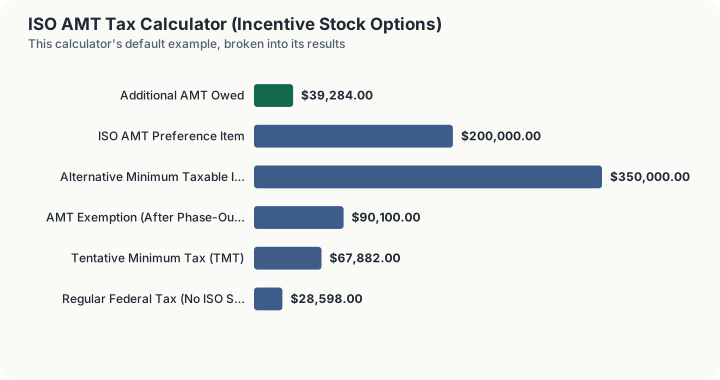
Take an employee who exercises 10,000 ISO shares with a $5 strike price when the stock is worth $25 per share, has $150,000 of other taxable income, and files single.
- ISO preference item: 10,000 × ($25 − $5) = $200,000
- AMTI: $150,000 + $200,000 = $350,000
- AMT exemption: AMTI of $350,000 is below the $500,000 phase-out floor for single filers, so the full $90,100 exemption applies
- AMTI after exemption: $350,000 − $90,100 = $259,900
- Tentative Minimum Tax: 26% × $244,500 = $63,570; 28% × ($259,900 − $244,500 = $15,400) = $4,312; total = $67,882
- Regular tax on $150,000 (single, 2026 brackets): 10% × $12,400 = $1,240; 12% × $38,000 = $4,560; 22% × $55,300 = $12,166; 24% × $44,300 = $10,632; total = $28,598
- Additional AMT owed: $67,882 − $28,598 = $39,284
Compare that to a much smaller exercise: 1,000 shares with a $10 strike, $15 fair market value, and $80,000 of other income, single filer.
- ISO preference item: 1,000 × ($15 − $10) = $5,000
- AMTI: $80,000 + $5,000 = $85,000, still below the $500,000 phase-out floor, so the full $90,100 exemption applies
- AMTI after exemption: max(0, $85,000 − $90,100) = $0, so Tentative Minimum Tax is $0
- Regular tax on $80,000: $12,312
- Additional AMT owed: max(0, $0 − $12,312) = $0. No AMT is triggered by a small exercise that stays below the exemption.
And a high-income married couple filing jointly who exercise 50,000 shares at a $2 strike and $12 fair market value, with $900,000 of other taxable income:
- ISO preference item: 50,000 × ($12 − $2) = $500,000
- AMTI: $900,000 + $500,000 = $1,400,000, above the $1,280,400 MFJ phase-out ceiling, so the exemption is fully phased out to $0
- Tentative Minimum Tax: 26% × $244,500 = $63,570; 28% × $1,155,500 = $323,540; total = $387,110
- Regular tax on $900,000 (MFJ, 2026 brackets, adding up all seven brackets): $255,164.50
- Additional AMT owed: $387,110 − $255,164.50 = $131,945.50
What This Does Not Account For
- AMT credit carryforward. AMT paid because of an ISO exercise generally becomes a minimum tax credit that can offset regular tax in future years, once regular tax exceeds TMT again. This calculator computes the current-year AMT liability only, not the multi-year credit recovery.
- Disqualifying dispositions in the same year. If you exercise and sell ISO shares within the same calendar year (a disqualifying disposition), the AMT preference item generally does not apply at all, and the transaction is instead taxed as ordinary income under regular rules. This calculator assumes the shares are exercised and held past year-end.
- State AMT. A handful of states, notably California, impose their own parallel minimum tax with different exemption amounts and rates. This calculator models federal AMT only.
- Net Investment Income Tax and other surtaxes. High-income taxpayers may owe an additional 3.8% Net Investment Income Tax on certain income once they eventually sell the shares, which this calculator does not model since it only covers the exercise-year AMT calculation.
- Multiple AMT adjustment items interacting. Real AMT returns often combine ISO preference items with other adjustments like state tax addbacks or depreciation differences. This calculator lets you add a single lump "other AMT adjustments" figure rather than itemizing each one.
Common Pitfalls
- Exercising a large ISO grant without modeling the AMT bill first. Employees at pre-IPO companies have historically owed large AMT bills on paper gains they could not yet sell to fund, sometimes on stock that later declined in value.
- Confusing the ISO spread with taxable income. The spread never shows up as W-2 income or regular taxable income at exercise. It only matters for the separate AMT calculation, which is easy to overlook if you are only checking your regular Form 1040 projection.
- Not tracking your AMT cost basis separately. For AMT purposes, your basis in ISO shares becomes fair market value at exercise, not the strike price, which differs from your regular tax basis and matters enormously when you eventually sell.
- Forgetting the exemption phases out. High earners sometimes assume the AMT exemption always applies at its full statutory amount, missing that it can shrink to zero well before AMTI reaches seven figures, especially for married couples with substantial other income.
- Ignoring year-end exercise timing. Because AMT liability is calculated for the calendar year of exercise, spreading a large ISO exercise across two tax years (partly in December, partly in January) can sometimes reduce or eliminate AMT exposure compared to exercising the full grant at once.
Frequently Asked Questions
If I exercise ISOs and immediately sell them, do I still owe AMT?
What happens to the AMT I pay because of an ISO exercise?
Why did the phase-out rate for the AMT exemption change?
Can I avoid AMT entirely by exercising fewer shares?
Does AMT apply to Non-Qualified Stock Options (NSOs) the same way?
Sources
- Internal Revenue Code §55 (Alternative Minimum Tax) and §56(b)(3) (ISO adjustment for AMT purposes). law.cornell.edu/uscode/text/26/55
- Internal Revenue Service, "IRS releases tax inflation adjustments for tax year 2026, including amendments from the One, Big, Beautiful Bill," Revenue Procedure 2025-32. irs.gov/newsroom/irs-releases-tax-inflation-adjustments-for-tax-year-2026-including-amendments-from-the-one-big-beautiful-bill
- Internal Revenue Service, Instructions for Form 6251, Alternative Minimum Tax - Individuals. irs.gov/forms-pubs/about-form-6251
- Internal Revenue Service, Instructions for Form 3921, Exercise of an Incentive Stock Option. irs.gov/forms-pubs/about-form-3921
- Internal Revenue Service, Instructions for Form 8801, Credit for Prior Year Minimum Tax. irs.gov/forms-pubs/about-form-8801