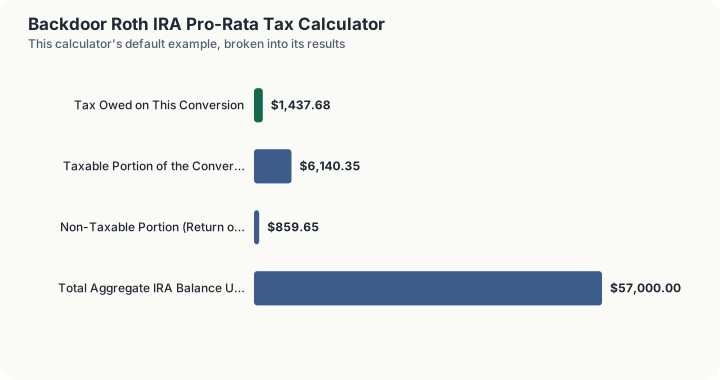
Quick Answer: If you have any pre-tax money sitting in a Traditional, SEP, or SIMPLE IRA, the IRS pro-rata rule taxes a proportional share of every backdoor Roth conversion, and this calculator computes exactly how much of your conversion is taxable and what it costs you.
Overview
A "backdoor Roth IRA" is not a special account type. It is a two-step maneuver: you make a non-deductible (after-tax) contribution to a Traditional IRA, since anyone with earned income can contribute regardless of income level, and then you convert that contribution to a Roth IRA, since Roth conversions have no income limit even though direct Roth contributions do. Done in isolation, with no other Traditional IRA money anywhere in your name, the conversion is essentially tax-free because you are simply moving after-tax dollars from one account type to another.
The complication is the IRS pro-rata rule. The tax code does not let you treat your Traditional IRAs as separate buckets where you can choose to convert "just the non-deductible part." Instead, the IRS requires you to aggregate the year-end balance of every Traditional, SEP, and SIMPLE IRA you own (excluding employer 401(k) plans, which are not included in this aggregation) and treat any distribution or conversion as coming out proportionally from the pre-tax and after-tax portions of that combined total. If most of your aggregate IRA balance is old pre-tax rollover money from a former employer's 401(k), most of your "backdoor" conversion ends up taxable, even though the specific dollars you intended to convert were after-tax.
How This Is Calculated
The pro-rata calculation, drawn from IRS Form 8606, works in two stages.
Stage 1: Determine the taxable fraction. Add your existing pre-tax IRA balance to the new non-deductible contribution to get your total aggregate IRA balance. The taxable fraction is the pre-tax portion divided by that total:
`
Taxable Fraction = Existing Pre-Tax IRA Balance / (Existing Pre-Tax IRA Balance + New Non-Deductible Contribution)
`
Apply that fraction to the amount you convert to find the taxable and non-taxable (return of basis) portions.
Stage 2: Determine the tax owed. The taxable portion of the conversion is added on top of your other taxable income for the year and taxed at your marginal federal rate, using the current year's progressive bracket schedule. This calculator computes the tax two ways, once on your other income alone and once with the taxable conversion amount stacked on top, and reports the difference. This correctly captures cases where the conversion itself pushes you across a bracket boundary, so part of it is taxed at one rate and part at the next rate up, rather than naively multiplying the whole taxable portion by a single marginal rate.
Worked Example
A single filer earning $120,000 wants to use the backdoor route into a Roth, and has $50,000 sitting in a Traditional IRA from an old 401(k) rollover. They contribute $7,000 non-deductible and convert it the same week, expecting no tax. The pro-rata rule has other ideas.
Step 1 -- Aggregate every Traditional, SEP and SIMPLE IRA. $50,000 pre-tax + $7,000 new contribution = $57,000
Step 2 -- The pre-tax fraction of that total. $50,000 / $57,000 = 87.72%
This ratio, not the account the money physically leaves, decides what is taxable. Basis cannot be cherry-picked.
Step 3 -- Taxable portion of the conversion. $7,000 x 87.72% = $6,140.35
Step 4 -- Tax-free return of basis. $7,000 - $6,140.35 = $859.65
Step 5 -- Taxable income before the conversion. $120,000 - $16,100 standard deduction = $103,900
Step 6 -- Federal tax on that income. 2026 single brackets applied to $103,900 = $17,570.00
Step 7 -- Taxable income with the conversion stacked on top. $120,000 + $6,140.35 - $16,100 = $110,040.35
Step 8 -- Federal tax on that income. = $19,007.68
Step 9 -- Incremental tax caused by the conversion. $19,007.68 - $17,570.00 = $1,437.68
Step 10 -- Effective rate on the taxable portion. $1,437.68 / $6,140.35 = 23.41%
Step 10 is worth pausing on. The filer's marginal rate before the conversion was 22% and after it is 24%, yet the conversion itself was taxed at neither -- it straddled the boundary, so part of it filled the remainder of the 22% bracket and the rest spilled into 24%. Quoting a single marginal rate would have understated the bill by roughly $86 or overstated it by $36, which is why the calculator runs the bracket engine twice and differences the results rather than multiplying by one rate.
The headline problem, though, is step 3. This filer put in $7,000 of already-taxed money and is being taxed on $6,140.35 of it, because the $50,000 legacy balance dominates the ratio. Rolling that $50,000 into an employer 401(k) first, where plans accept it, is what makes the backdoor clean.
What This Does Not Account For
- The Net Investment Income Tax (NIIT) or Additional Medicare Tax, which can apply separately at higher income levels and are not calculated here.
- State income tax on the taxable portion of the conversion, which varies by state and is not modeled here.
- Growth between contribution and conversion. If the non-deductible contribution earns any return before you convert it, that growth is fully taxable regardless of the pro-rata rule and is not included in this calculation, which assumes an immediate, same-value conversion.
- SEP and SIMPLE IRA balances you may have forgotten about. The pro-rata rule aggregates all of them, not just the account you're converting from, and it is a common and costly mistake to overlook one.
- The option to roll pre-tax IRA money into an employer 401(k) plan first (if your plan allows incoming rollovers), which is the standard way high earners "clear out" their pre-tax IRA balance to make future backdoor conversions clean. This calculator shows the tax cost of converting today; it does not model that alternative strategy.
- Form 8606 basis tracking across years, including basis carried over from prior non-deductible contributions you may not have fully converted yet.
Common Pitfalls
- Forgetting an old rollover IRA. Many people set up a clean backdoor Roth years ago, then later roll an old 401(k) into a Traditional IRA without realizing it poisons the pro-rata calculation for every future backdoor conversion.
- Converting only part of the non-deductible contribution and assuming the rest stays untaxed later. The pro-rata fraction applies to whatever amount you convert in a given year; it does not let you "save" the tax-free portion for later.
- Not filing Form 8606. Failing to report non-deductible contributions and conversions on Form 8606 each year can cause the IRS to treat the entire contribution as if it had no basis, resulting in double taxation when eventually withdrawn.
- Assuming the pro-rata rule only looks at the account you're converting. It aggregates every Traditional, SEP, and SIMPLE IRA you own as of December 31 of the conversion year, not just the specific account holding the non-deductible contribution.
- Timing the contribution and conversion at year-end without checking the balance snapshot date. The IRS uses your December 31 aggregate balance for the pro-rata calculation, so a conversion completed in January followed by a large rollover in December of the same year can still be pulled into the pro-rata math.
Frequently Asked Questions
Does the pro-rata rule apply to my 401(k) balance too?
Is the backdoor Roth strategy legal?
What if I have basis from non-deductible contributions in prior years?
Can I undo a Roth conversion if the tax bill is larger than expected?
Why did my effective rate come out between two bracket percentages?
Sources
- Internal Revenue Service Form 8606 and Instructions, Nondeductible IRAs. irs.gov
- Internal Revenue Service Publication 590-A, Contributions to Individual Retirement Arrangements (IRAs). irs.gov/publications/p590a
Also consulted: Internal Revenue Service Revenue Procedure 2025-32 (Internal Revenue Bulletin 2025-45), 2026 inflation-adjusted federal income tax brackets and standard deduction amounts.