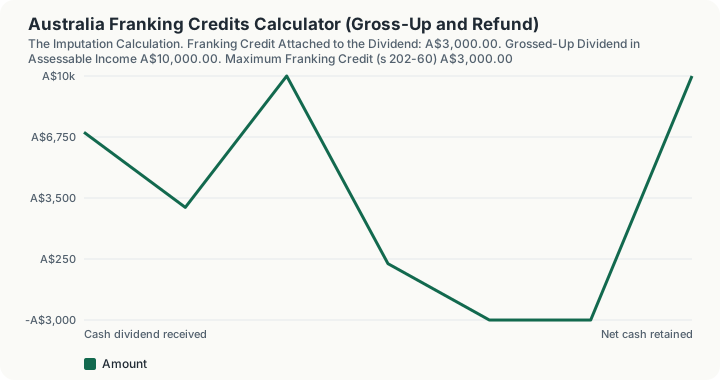
Quick Answer: A A$7,000 fully franked dividend from a 30% company carries a franking credit of A$3,000.00, grossing up to A$10,000.00 of assessable income. On no other income, the whole A$3,000.00 comes back as a refund and the shareholder ends with A$10,000.00.
What does this calculator do?
Imputation exists so that company profits are taxed once, at the shareholder's rate, rather than twice. The A$10,000 gross-up is not an abstraction: it is the company's pre-tax profit, because A$10,000 taxed at 30% leaves exactly the A$7,000 paid out and the A$3,000 of company tax the credit represents.
What distinguishes Australia from most countries operating imputation is not the gross-up but s 207-20(2) read with Division 67. Section 207-20(1) adds the credit to assessable income; s 207-20(2) then gives a tax offset equal to the credit; and Division 67 makes that offset refundable for resident individuals and complying superannuation funds. Elsewhere an imputation credit typically reduces tax to nil and stops. In Australia it can produce a cash payment.
Three outcomes follow directly:
- A shareholder with no other income pays no tax on the grossed-up A$10,000, because it sits below the A$18,200 tax-free threshold. Nothing absorbs the A$3,000 offset, so the whole amount is refunded and the total received is A$10,000.
- A shareholder whose marginal rate is exactly 30% owes A$3,000 and holds a A$3,000 offset. Nothing further is payable and nothing is refunded.
- A shareholder at the top rate of 45% plus the 2% Medicare levy owes A$4,700, less the A$3,000 offset, so A$1,700 of further tax is payable and A$5,300 of the cash is kept.
The credit is identical in all three cases. Only what happens to the offset differs.
How is this calculated?
The defaults: a A$7,000 cash dividend, 100% franked, from a company that is not a base rate entity, no other taxable income, the 2026-27 income year, and the Medicare levy included.
- Step 1: Establish the corporate tax rate. The company is not a base rate entity, so Income Tax Rates Act 1986 s 23(2)(b) applies. corporate tax rate = 30%
- Step 2: Derive the corporate tax gross-up rate (ITAA 1997 s 995-1). (1 - 0.30) / 0.30 = 2.333333
- Step 3: Compute the maximum franking credit (s 202-60(2)). The maximum is the distribution times one divided by the gross-up rate, that is, rate / (1 - rate). A$7,000 x 0.30 / 0.70 = A$3,000.00
- Step 4: Scale by the franking percentage. A$3,000.00 x 100% = A$3,000.00 franking credit
- Step 5: Gross up into assessable income (s 207-20(1)). A$7,000 + A$3,000.00 = A$10,000.00
- Step 6: Compute the income tax through the statutory rate scale, less the low income tax offset. The grossed-up dividend is stacked on the other income entered, and the tax with it is compared with the tax without it. At each end the LITO (ITAA 1997 s 61-115: A$700, tapering out by A$66,667) is deducted first, because it is non-refundable and reduces income tax only (s 63-10), and the refundable franking offset comes last. (tax on A$10,000 - LITO) - (tax on A$0 - LITO) = A$0.00
- Step 7: Add the incremental Medicare levy on the same comparison. The levy is nil at or below the A$28,011 low-income threshold, shades in at 10% of the excess, then reaches the full 2%. levy on A$10,000 - levy on A$0 = A$0.00
- Step 8: Total the tax attributable to the dividend. A$0.00 + A$0.00 = A$0.00
- Step 9: Apply the s 207-20(2) offset, which equals the credit. A$0.00 - A$3,000.00 = -A$3,000.00
- Step 10: Treat the negative position under Division 67. The offset is refundable, so the excess is paid out rather than wasted. refund = A$3,000.00, further tax = A$0.00
- Step 11: Compute the net cash retained. A$7,000 - A$0.00 + A$3,000.00 = A$10,000.00
Worked Example
Change only the other taxable income to A$200,000 and the same dividend produces a very different result. The grossed-up A$10,000 lands in the 45% band, and with the 2% Medicare levy the incremental tax is A$4,700. The A$3,000 offset reduces that to A$1,700 of further tax, leaving A$5,300 of the original A$7,000.
Now change the paying company. A base rate entity is taxed at 25% under s 23(2)(a), so its gross-up rate is (1 - 0.25) / 0.25 = 3, and the credit is one third of the distribution rather than three sevenths. A A$7,500 fully franked dividend from a 25% company carries a A$2,500 credit and grosses up to the same A$10,000. The pre-tax profit behind the two dividends is identical; the split between cash and credit is not.
Section 23AA sets two requirements for base rate entity status, and both must be satisfied: no more than 80% of assessable income is base rate entity passive income, and aggregated turnover under A$50 million. The calculator applies that test to the figures entered and reports the result alongside the rate selected, so a mismatch is visible rather than silent.
The trap sits one layer further in. Section 995-1 defines the "corporate tax rate for imputation purposes" by reference to the company's aggregated turnover, base rate entity passive income and assessable income for the previous income year. A company that crosses the threshold this year still franks at the rate implied by last year's figures. Because that lag depends on a prior year the calculator has no data for, the corporate rate is an explicit input rather than something inferred from the turnover figure.
A low-income shareholder. With A$15,000 of other income the grossed-up dividend lifts taxable income to A$25,000. Tax is (A$25,000 - A$18,200) x 15% = A$1,020, of which the A$700 LITO absorbs A$700, leaving A$320; A$25,000 is below the A$28,011 levy threshold, so no levy. The A$3,000 credit covers the A$320 and A$2,680 is refunded. Without LITO in the calculation the refund would be understated at A$1,980. The marginal rate reported is the tax, LITO taper and levy on the next A$100 at the income where the dividend lands, so it reads 0% for the default retiree, not the 2% levy rate.
Partial franking scales the credit proportionately: 50% franking on the same A$7,000 gives a A$1,500 credit and an A$8,500 gross-up. An unfranked dividend carries no credit and no gross-up, and is taxed as ordinary income.
What does this calculator not account for?
- The holding period rule. Division 1A of Part IIIAA of the ITAA 1936 requires shares to be held at risk for a qualifying period before the credit can be used. The calculator assumes the shareholder is qualified. The small shareholder exemption and the related payments rule are likewise not modelled.
- Franking account integrity rules. No benchmark rule, no disclosure rule, no franking deficit tax, and no anti-streaming provisions.
- Entities other than resident individuals. The refundability switch reflects Division 67, but the tax and levy are computed on the resident individual rate scale. Superannuation funds, companies and trusts are taxed differently, and non-residents are subject to withholding rules not modelled here.
- Medicare levy variations. The levy uses the singles low-income threshold; the higher family and seniors thresholds, the surcharge, and any exemption personal to the taxpayer are not applied.
- Offsets other than LITO and the franking offset. The seniors and pensioners tax offset (SAPTO), which matters to many retirees receiving franked dividends, and the Working Australians tax offset from 2027-28 are not applied, so a SAPTO-eligible shareholder's refund is understated. Deductions and losses are not modelled: other income is taken exactly as entered.
- Foreign income, foreign tax offsets and foreign dividends, which carry no Australian franking credits.
Every rate and threshold used comes from the two Acts cited below. There are no estimated values in this calculator.
What mistakes do people make with this?
- Treating the credit as extra income with no tax attached. It is assessable under s 207-20(1) before it is offset under s 207-20(2). Both halves apply.
- Applying three sevenths to a dividend from a 25% company. The credit is three sevenths of the cash at 30%, one third at 25%.
- Assuming this year's turnover sets the franking rate. The s 995-1 imputation definition looks at the previous income year.
- Satisfying only one limb of s 23AA. Turnover under A$50 million is not enough on its own; the passive income test must also be met.
- Expecting a refund for an entity that cannot get one. A non-refundable holder simply wastes the excess.
- Comparing franked and unfranked dividends on cash yield. A$7,000 franked and A$7,000 unfranked are not the same return.
Frequently Asked Questions
Why is the grossed-up dividend exactly A$10,000?
Does a refund mean the shareholder paid no tax?
Why use the bracket scale rather than a flat marginal rate?
What changes if the Medicare levy is switched off?
Does the franking percentage change the maximum credit?
Sources
- Income Tax Assessment Act 1997 (No. 38, 1997), Compilation No. 266, compilation date 1 July 2026: ss 202-60(2), 202-60(3), 207-20(1), 207-20(2), 995-1, and Division 67. legislation.gov.au/C2004A05138/latest/text
- Income Tax Rates Act 1986, Compilation No. 66, compilation date 1 July 2026: ss 23(2) and 23AA, and Schedule 7. legislation.gov.au/C2004A03348/latest/text
- Medicare Levy Act 1986, Compilation No. 53, compilation date 1 July 2026. legislation.gov.au/C2004A03351/latest/text
- Income Tax Assessment Act 1997, Subdivision 61-D (low income tax offset) and s 63-10 (non-refundable offsets applied before refundable ones). legislation.gov.au/C2004A05138/latest/text
Verification was against the Federal Register of Legislation.