Quick Answer: A Health Savings Account is the only account in the U.S. tax code that lets money go in tax-free, grow tax-free, and come out tax-free for qualified expenses, and that third layer, tax-free growth, is what separates it from every retirement account you're probably more familiar with.
Overview
Health Savings Accounts get called a triple tax advantage for a specific reason: three separate points in the account's life are shielded from federal tax. Money going in reduces your taxable income the year you contribute it. Money sitting in the account, if invested rather than left in cash, grows without generating an annual tax bill on dividends, interest, or capital gains. And money coming out, as long as it pays for a qualified medical expense, is never taxed at all, not now and not decades from now.
Compare that to a 401(k) or traditional IRA, which gives you the first advantage (a deduction now) and the second (tax-deferred growth) but taxes withdrawals as ordinary income later. Compare it to a Roth IRA, which skips the upfront deduction but gives you tax-free growth and tax-free qualified withdrawals. An HSA is the only vehicle that gets all three, provided the money is eventually used for medical costs, which, for most people over a lifetime, it eventually is.
The catch is that most HSA holders never invest the money. Roughly half of account balances just sit in a low-interest cash sweep account, functioning as a slightly-better-than-nothing emergency medical fund rather than an investment vehicle. This calculator is built around the assumption that you invest the contribution, hold it for years, and let compounding do its work, then compares that outcome against putting the same after-tax dollars into an ordinary taxable brokerage account instead.
How This Is Calculated
The model runs in three stages.
First, the contribution limit. The IRS sets an annual HSA contribution ceiling that depends on whether your High-Deductible Health Plan covers just you or your whole family, plus an extra catch-up amount if you're 55 or older. For 2026, that's $4,400 for self-only coverage, $8,750 for family coverage, and an additional $1,000 catch-up at 55+ (this catch-up is fixed by statute, not inflation-adjusted, so it hasn't changed in years and generally won't). Whatever contribution you enter gets capped at whichever limit applies to you.
Second, the upfront deduction. The calculator uses the platform's shared progressive tax engine to find your actual marginal tax bracket, comparing your federal tax bill with and without the HSA contribution deducted from your taxable income. This correctly captures cases where the deduction straddles two tax brackets, rather than just multiplying your contribution by a single assumed rate.
Third, the growth comparison. The HSA balance is projected forward year by year, growing at your assumed investment return with zero tax drag, since qualified withdrawals are never taxed. The comparison taxable account starts with a smaller contribution, because that money was already taxed at your marginal rate before it could be invested, and its growth is taxed annually at your long-term capital gains rate, a simplification that approximates (rather than precisely replicates) how a real brokerage account is taxed.
The total triple-tax-advantage figure adds up the ending balance gap between the HSA and taxable account, plus every year's cumulative upfront deduction savings, giving you one number that represents the full value of routing the money through an HSA instead of an ordinary account.
Worked Example
A household with family HDHP coverage, a 45-year-old account holder too young for the catch-up, contributing the full $8,750 limit, filing Married Filing Jointly on $140,000 of other taxable income, assuming a 7% return. The first two years are shown in full so the mechanics are visible, then the same account is carried out to the default 20-year horizon.
Step 1 -- The applicable IRS limit. Family coverage in 2026 is $8,750, and at 45 there is no catch-up, so the limit is $8,750
Step 2 -- Find the marginal bracket by differencing, not by assuming. $140,000 and $131,250 both sit inside the 2026 MFJ 22% bracket, which runs from $100,800 to $211,400, so the deduction is worth 22%
Step 3 -- This year's deduction saving. $8,750 x 22% = $1,925.00
Step 4 -- What the taxable comparison account actually gets to invest. $8,750.00 - $1,925.00 = $6,825.00
That $1,925 gap is the first of the three tax advantages, and it is the one people notice. It is also the smallest of the three over a long horizon.
Step 5 -- The capital gains drag on the taxable account. At $140,000 of MFJ income the marginal long-term rate is 15%, so the taxable account grows at 7% x (1 - 15%) = 5.95%
Step 6 -- Year 1. HSA: ($0 x 1.07) + $8,750.00 = $8,750.00 Taxable: ($0 x 1.0595) + $6,825.00 = $6,825.00
Step 7 -- Year 2. HSA: ($8,750.00 x 1.07) + $8,750.00 = $9,362.50 + $8,750.00 = $18,112.50 Taxable: ($6,825.00 x 1.0595) + $6,825.00 = $14,056.09
Step 8 -- Cumulative position after two years. Deduction savings banked: 2 x $1,925.00 = $3,850.00 Balance gap: $18,112.50 - $14,056.09 = $4,056.41 Total triple-tax-advantage value: $7,906.41
Two years in, the balance gap has already overtaken the cumulative deduction savings, and it was created entirely by the second advantage, the growth that never gets taxed.
Step 9 -- Year 3. HSA: $28,130.38, of which $1,880.38 is growth above contributions Taxable: $21,717.42
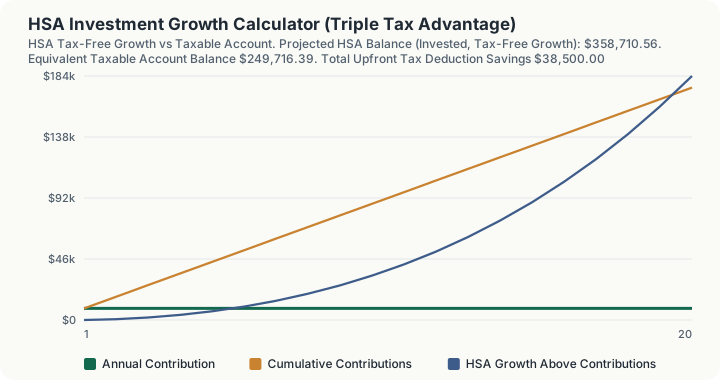
Step 10 -- The ten-year milestone. HSA: $120,893.92 on $87,500.00 of contributions, so $33,393.92 of untaxed growth Taxable: $89,747.97 Gap: $31,145.95
Step 11 -- The full 20-year horizon. HSA: $358,710.56 on $175,000.00 of contributions Untaxed growth: $183,710.56 Taxable: $249,716.39 Balance gap: $108,994.17
Step 12 -- Total value of routing the money through an HSA. $108,994.17 balance gap + $38,500.00 of cumulative deduction savings = $147,494.17
Look at how the three advantages divide that $147,494.17. The upfront deduction contributed $38,500 across twenty years of contributions. The tax-free growth contributed $108,994.17, nearly three times as much, and it did so without a single additional dollar being deposited. The third advantage, tax-free qualified withdrawal, does not appear as a line item at all here; it is what allows the entire $358,710.56 to be spent on medical costs rather than a portion of it going to tax on the way out.
What This Does Not Account For
- Non-qualified withdrawals. Money pulled from an HSA for non-medical expenses before age 65 is taxed as ordinary income plus a 20% penalty. After 65, non-medical withdrawals are taxed as ordinary income but the penalty goes away, functioning similarly to a traditional IRA at that point.
- Real-world taxable account complexity. Actual brokerage accounts generate a mix of qualified dividends, ordinary dividends, and short-term or long-term capital gains, taxed at different rates depending on holding period and income. This model uses a single simplified long-term capital gains drag rate rather than replicating that full complexity.
- State income tax. A small number of states (notably California and New Jersey) tax HSA contributions and growth even though the federal government doesn't. This calculator models federal tax treatment only.
- HSA account and investment fees. Many HSA custodians charge monthly maintenance fees or investment fees once a balance is invested, which aren't modeled here.
- Medical expense reimbursement timing. You can technically pay for a qualified medical expense out of pocket now and reimburse yourself from the HSA years later (as long as you kept the receipt and had the HSA open at the time of the expense), a strategy that lets the account keep growing tax-free even longer. This tool doesn't model that specific strategy's timing.
Common Pitfalls
- Confusing HSA eligibility with FSA rules. You can't contribute to an HSA if you're also covered by a general-purpose Flexible Spending Account (yours or a spouse's), and enrolling in Medicare ends your HSA eligibility going forward, even though you can still spend down an existing balance.
- Treating the HSA as just a cash cushion. Leaving the full balance in cash forfeits the second leg of the triple tax advantage entirely; the tax-free growth benefit only compounds meaningfully when the money is actually invested.
- Missing the family catch-up contribution nuance. The $1,000 catch-up must be contributed to an HSA in the name of the spouse who is 55 or older; if both spouses are 55+, each needs their own HSA to claim their own catch-up.
- Assuming HSA funds must be used by year-end. Unlike a Flexible Spending Account, HSA balances roll over indefinitely and are never forfeited, which is exactly what makes long-horizon investing inside the account worthwhile.
- Forgetting the deduction phases with your actual bracket, not a flat estimate. Someone near a bracket boundary will find their true tax savings differs from a simple "contribution times my top rate" guess, which is why this calculator computes it from the full bracket table rather than a shortcut.
Frequently Asked Questions
Who is eligible to contribute to an HSA?
What are the 2026 HSA contribution limits?
What happens to my HSA when I turn 65?
Is an HSA really better than a 401(k) for retirement savings?
Can I invest my HSA balance like a brokerage account?
Sources
- Internal Revenue Service, Revenue Procedure 2025-19, 2026 HSA contribution limits and High-Deductible Health Plan requirements. irs.gov
- Internal Revenue Service, Publication 969, "Health Savings Accounts and Other Tax-Favored Health Plans.". irs.gov/publications/p969
Also consulted: IRS Revenue Procedure 2025-32, 2026 federal income tax brackets, standard deduction, and long-term capital gains brackets.