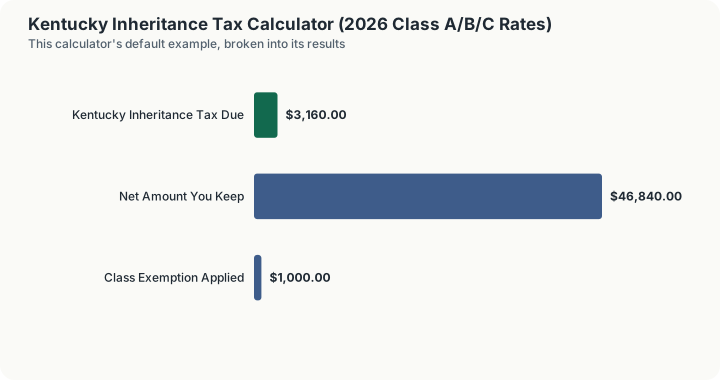
Quick Answer: An aunt or uncle (Class B) inheriting a $50,000 distributive share owes $3,160 in Kentucky inheritance tax. A cousin or unrelated beneficiary (Class C) inheriting $25,000 owes $1,870. A spouse, child, sibling, or -- as of a 2026 law change -- a niece or nephew (all Class A) owes $0, no matter the amount.
Overview
Kentucky is one of only five states that still tax beneficiaries directly on the specific share they individually inherit, rather than taxing the whole estate the way an estate tax does. Kentucky has not levied a separate state estate tax since 2005 -- see the Kentucky estate tax calculator, which correctly returns $0 for every estate size -- so the inheritance tax computed here is the only Kentucky-level death tax that applies to any bequest.
Kentucky sorts every beneficiary into one of three classes -- A, B, or C -- and applies a completely different rate schedule to each. Class A is fully exempt. Classes B and C are taxed on a progressive bracket schedule, each with its own small dollar exemption and its own set of rate tiers climbing to 16%. The change that matters most: Kentucky changed who belongs to Class A effective for deaths on or after January 1, 2026 (2026 Ky. Acts ch. 198, sec. 40, effective April 27, 2026): nieces and nephews, including half-blood nieces and nephews, moved out of the taxable Class B and into the fully exempt Class A. Many older guides and calculators still describe nieces and nephews as Class B beneficiaries -- that description is now out of date for any death on or after January 1, 2026.
How This Is Calculated
Kentucky Class B and Class C use progressive brackets, with each class's exemption "chargeable against the lowest bracket" under KRS 140.080 -- meaning the exemption reduces the tax owed within whichever bracket it falls, rather than shifting the bracket boundaries themselves.
Kentucky's Three Classes
| Class | Who's Included | Exemption | Rates |
|---|---|---|---|
| A | Spouse, parent, child (incl. stepchild/adopted), grandchild via a qualifying child, brother, sister, niece, nephew (incl. half-blood) | Unlimited | 0% |
| B | Daughter/son-in-law, aunt, uncle, great-grandchild via a qualifying child | $1,000 | 4%-16% |
| C | All other beneficiaries (cousins, friends, unrelated individuals, non-exempt organizations) | $500 | 6%-16% |
Class B Bracket Schedule (KRS 140.070(2))
| Distributive Share | Rate |
|---|---|
| $0-$10,000 | 4% |
| $10,000-$20,000 | 5% |
| $20,000-$30,000 | 6% |
| $30,000-$45,000 | 8% |
| $45,000-$60,000 | 10% |
| $60,000-$100,000 | 12% |
| $100,000-$200,000 | 14% |
| Over $200,000 | 16% |
Class C Bracket Schedule (KRS 140.070(3))
| Distributive Share | Rate |
|---|---|
| $0-$10,000 | 6% |
| $10,000-$20,000 | 8% |
| $20,000-$30,000 | 10% |
| $30,000-$45,000 | 12% |
| $45,000-$60,000 | 14% |
| Over $60,000 | 16% |
These bracket dollar breakpoints have not changed since a 1998 statutory recodification; only Class A's membership changed in 2026.
Worked Example
- Start with the distributive share. This example uses a $50,000 bequest to an aunt -- a Class B beneficiary.
- Locate the bracket. $50,000 falls in the $45,000-$60,000 tier, which the Kentucky Department of Revenue's rate table expresses as "$2,660 plus 10% of the amount over $45,000."
- Apply the formula. $2,660 + 10% × ($50,000 − $45,000) = $2,660 + $500 = $3,160.
- Net to the aunt. $50,000 − $3,160 = $46,840.
- Compare to a cousin (Class C). The same $50,000 to a Class C beneficiary falls in the $45,000-$60,000 tier at "$4,170 + 14% of the amount over $45,000": $4,170 + 14% × $5,000 = $4,870 -- noticeably more than the Class B tax on an identical bequest.
- Compare to a niece under the 2026 law. Before 2026, that same $50,000 to a niece would have been taxed exactly like the aunt example above ($3,160), since nieces were Class B. Starting with deaths on or after January 1, 2026, the same niece is Class A and owes $0.
The 2026 Reclassification of Nieces and Nephews
This is the single most consequential recent change to Kentucky inheritance tax, and it is easy to miss because so much existing content on the web has not caught up: - Before: nieces and nephews (including half-blood) were Class B beneficiaries, taxed 4%-16% after a $1,000 exemption, alongside aunts, uncles, and in-laws. - Now: for any decedent who died on or after January 1, 2026, nieces and nephews (including half-blood) are Class A -- fully exempt, the same as a spouse or child. - Statutory basis: KRS 140.070, as amended by 2026 Ky. Acts ch. 198, sec. 40, effective April 27, 2026, with the Legislative Research Commission confirming the amendment applies retroactively to estates of decedents who died on or after January 1, 2026. - Aunts, uncles, and in-laws did not move -- they remain Class B, still taxed on the bracket schedule above.
What This Does Not Account For
- Kentucky's separate exemptions for certain qualified retirement annuities and IRA/retirement-bond payouts structured as substantially equal periodic payments under KRS 140.063, which can be excluded from the taxable distributive share under specific conditions.
- Federal estate tax, assessed separately against estates above the federal exemption ($15 million per decedent in 2026) -- Kentucky itself has had no state estate tax since 2005 (see the Kentucky estate tax calculator).
- The Affidavit of Exemption procedure, which lets an estate skip filing a full inheritance tax return when every asset passes to Class A beneficiaries or exempt organizations and no federal estate tax return is required.
- Real property Kentucky decedents owned in other states, which may be subject to that state's own estate or inheritance tax rules.
- Agricultural-value elections for qualifying farmland, which can change the taxable value used as the starting distributive share.
Common Pitfalls
- Using a pre-2026 Class B assumption for a niece or nephew. This is now the single most common error in Kentucky inheritance tax planning, since the change is recent and many published guides have not been updated.
- Confusing the distributive-share bracket with a marginal-tax-on-everything calculation. Kentucky's published rate table already bakes the class exemption into the lowest bracket; subtracting the exemption again before applying the table double-counts it.
- Assuming Kentucky has a state estate tax. It does not, and has not since 2005 -- only the inheritance tax computed here applies.
- Missing the 18-month filing deadline. If any tax is due, Kentucky requires the return within 18 months of death, longer than Pennsylvania's nine months but still enforced with interest and penalties for late payment.
- Treating cousins as Class B. Cousins fall into Class C, not Class B -- a distinction that changes both the exemption ($500 vs. $1,000) and every bracket rate.
Frequently Asked Questions
Are nieces and nephews taxed in Kentucky?
Does Kentucky have a state estate tax?
What is the Kentucky inheritance tax exemption for Class B beneficiaries?
What is the Kentucky inheritance tax exemption for Class C beneficiaries?
Who is in Kentucky's Class A?
When is the Kentucky inheritance tax return due?
Sources
- KRS 140.070 (Inheritance tax rates): As amended by 2026 Ky. Acts ch. 198, sec. 40, effective April 27, 2026, applicable to estates of decedents dying on or after January 1, 2026. sec.gov
- Kentucky Department of Revenue, A Guide to Kentucky Inheritance and Estate Taxes (Form 92F101): revenue.ky.gov/Individual/Inheritance-Estate-Tax.
Also consulted: KRS 140.080 (Exemptions): Class A unlimited exemption; Class B $1,000; Class C $500; Kentucky estate tax calculator: Confirms Kentucky's separate state estate tax is $0 for every estate size; estate tax calculator: For the federal estate tax computation.