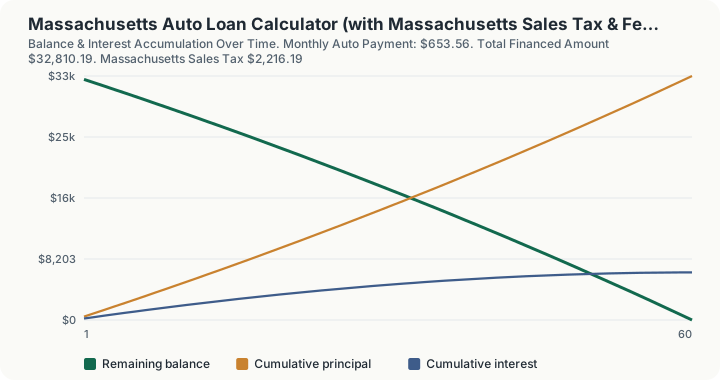
Quick Answer: A $35,000 vehicle in Massachusetts with $5,000 cash down, a $459 dealer documentation fee, a 60-month term, and a 7.25% APR carries a $653.56 monthly payment. That figure includes $2,216.19 of Massachusetts sales tax at the flat 6.25% statewide rate and $135.00 in title and two-year registration fees, financing $32,810.19 in total.
Overview
Massachusetts taxes vehicle purchases at 6.25% under M.G.L. c. 64H, with no local option sales tax anywhere in the state. A buyer in Boston, Springfield, and Provincetown pays the same rate, and 830 CMR 64H.25.1 applies it uniformly to motor vehicles. That makes the purchase-time calculation straightforward.
The part that is not straightforward, and where real money is lost, is the trade-in rule.
Massachusetts allows a trade-in credit under 830 CMR 64H.25.1(5)(c), but the credit is measured on the gross allowance, not on your equity. DOR Directive 02-4 is explicit about this. If a dealer allows you $10,000 for your trade and you still owe $6,000 on it, your equity is $4,000 but your tax credit is based on the full $10,000. The $6,000 payoff rolls into the new loan and changes what you borrow. It does not change what you are credited.
That distinction is worth $375 in this example, and it cuts the other way too: enter your equity instead of the gross allowance and you will overstate your tax by exactly that amount. The trade-in field on this calculator asks for the gross figure for that reason.
The credit also applies only to a purchase from a registered Massachusetts motor vehicle dealer. A private-party purchase gets no reduction at all, and use tax there is assessed on the greater of the actual price or the NADA clean trade-in value, so a cheap private purchase is taxed on book rather than on what you paid.
Separately, Massachusetts levies an annual municipal motor vehicle excise under M.G.L. c. 60A section 1. It is not a purchase-time tax and is not in any total here, but it is a recurring cost of ownership and it is calculated on original list price rather than on what you paid.
Auto Loan APR by Credit Score
The APR columns below are national averages, not Massachusetts figures. No primary source publishes average auto loan APR by state: Experian's report has no geographic cut, the CFPB publishes state origination volume but no rates, and the New York Fed publishes state delinquency only. The payment column is the part that is specific to Massachusetts, because it runs this calculator's own Massachusetts tax and fee rules at each tier's rate.
| Credit Tier | VantageScore 4.0 | Avg New APR | Avg Used APR | Est. Payment in Massachusetts |
|---|---|---|---|---|
| Super prime | 781-850 | 4.55% | 6.30% | $612.43 |
| Prime | 661-780 | 6.23% | 8.77% | $637.83 |
| Nonprime | 601-660 | 9.67% | 14.03% | $691.80 |
| Subprime | 501-600 | 13.44% | 19.42% | $753.94 |
| Deep subprime | 300-500 | 16.01% | 21.77% | $798.05 |
Payment assumptions: $35,000 vehicle price, $0 trade-in, $5,000 cash down, $459 dealer documentation fee, 60-month term, new-vehicle APR applied to the Massachusetts delivered price including tax and statutory fees. At the 6.39% overall new-car average the same purchase costs $640.28 a month.
The score bands are VantageScore 4.0, not FICO. The same borrower can land in a different tier under each model, so a FICO score pulled from a card issuer will not always match the band here. Source: Experian, State of the Automotive Finance Market, Q1 2026, slide 45.
What Moves Your Payment
Each row changes one input and leaves the rest at the baseline below. The dollar effects are this calculator's own output for Massachusetts, not a rule of thumb.
| Factor | What Changes | Effect on Monthly Payment | Effect on Total Interest |
|---|---|---|---|
| Vehicle Price | Each extra $1,000 of price raises both the amount financed and the sales tax base, so the tax rises with it. | +$21.16 | +$207.36 |
| Trade-In Allowance | A $1,000 allowance cuts the amount financed by $1,000 and reduces the sales tax base by the same amount, so it saves tax as well as principal. | -$21.17 | -$207.36 |
| Cash Down Payment | A $1,000 larger down payment cuts the amount financed by $1,000. It never reduces the sales tax, which is assessed on the price, not on what you borrow. | -$19.92 | -$195.16 |
| Dealer Doc Fee | A $100 higher documentation fee adds $100 to the amount financed and is inside the sales tax base, so it is taxed on top of itself. | +$2.11 | +$20.74 |
| Longer Term | Stretching the same balance from 60 months to 72 months spreads the principal over twelve more payments at the same rate. | -$90.23 | +$1,346.15 |
Baseline: $35,000 vehicle price, $0 trade-in, $5,000 cash down, $459 documentation fee, 60 months at 7.25% APR, giving a $653.56 payment and $6,403.28 of total interest.
How This Is Calculated
Massachusetts credits the gross trade-in allowance rather than your equity in the trade, which matters when the trade still carries a loan. Five steps.
1. Net taxable sales price. Document preparation fees charged as part of the sale are included in sales price under c. 64H section 1, so the doc fee is taxed. The gross trade-in allowance is then subtracted.
2. Sales tax. One rate, statewide.
3. Title and registration. A fixed $135.00, being the $75 RMV certificate of title fee and the $60 standard private passenger plate registration, which runs a mandatory two-year term rather than an annual one. Neither is weight-based or value-based.
4. Amount financed. The gross allowance works twice: it lowered the tax base in step one, and it reduces the balance you borrow. If you have a loan payoff on the trade, add it back yourself, because the payoff raises what you borrow without touching the credit.
5. Amortization. The financed amount amortizes as a fixed-rate installment loan:
where $P$ is the financed amount, $i$ is the monthly rate (APR divided by 12), and $n$ is the term in months. Each period's interest is the outstanding balance times $i$, the remainder reduces principal, and the schedule reconciles to zero at maturity.
There is no local rate control on this calculator because Massachusetts has no local option sales tax.
Worked Example
Massachusetts credits the gross trade-in allowance, not your equity in the trade, which is the detail that trips up buyers who still owe money on the car they are handing over. The baseline first.
- Vehicle price: $35,000
- Trade-in allowance: $0
- Cash down: $5,000
- Dealer doc fee: $459
- Term: 60 months at 7.25% APR
Step 1 -- The taxable sales price. Sales price including the doc fee, less the gross trade-in allowance: $35,000 + $459 - $0 = $35,459.00
Step 2 -- Massachusetts sales tax at 6.25%. $35,459.00 x 6.25% = $2,216.19
Step 3 -- Title and two-year registration, outside the base. $75.00 title + $60.00 registration = $135.00
Step 4 -- Total delivered price. $35,000 + $459.00 + $2,216.19 + $135.00 = $37,810.19
Step 5 -- Amount financed. $37,810.19 - $0 trade-in - $5,000 cash down = $32,810.19
Step 6 -- The monthly payment. $32,810.19 at 7.25% over 60 months = $653.56
Step 7 -- Month 1. $32,810.19 x (7.25% / 12) = $198.23 interest, $455.33 principal, balance $32,354.86
Step 8 -- Month 2. $32,354.86 x (7.25% / 12) = $195.48 interest, $458.08 principal, balance $31,896.78. Cumulative interest: $393.71
Step 9 -- The accumulation. Interest through month 12 is $2,193.48, balance $27,160.95. Over the full term, $6,403.28
Add a $10,000 gross trade-in from a registered dealer and the base drops to $25,459, tax falls to $1,591.19, and the payment drops to $441.91. The trade saved $625.00 in tax.
That $625 figure holds whether you own the trade outright or still owe $6,000 on it. In the second case the dealer pays off the $6,000 and adds it back to your financing, so the payment is higher, but the tax credit is identical. Entering $4,000 of equity instead of the $10,000 allowance would have shown $375 too much tax.
Negotiate the doc fee away and the base drops to $35,000, tax to $2,187.50, and the payment to $643.84. The $459 fee costs $487.69 all in.
What This Does Not Account For
- The annual municipal motor vehicle excise. Under M.G.L. c. 60A section 1, at $25 per $1,000 of valuation, where valuation is a statutory percentage of the original manufacturer's list price: 50% in the year before the model year, 90% in the model year, then 60%, 40%, 25%, and 10% from the fifth year on, with a $5 minimum. The $25 per $1,000 rate is uniform statewide and only the valuation schedule varies with age. It is not financed and it is not in any figure here.
- Loan payoff on a trade-in. The tax credit uses the gross allowance, but any outstanding balance on the traded vehicle is added to the new loan. Add it to the vehicle price yourself if you want the financing to reflect it.
- Private-party purchases. No trade-in credit applies, and use tax is based on the greater of the price paid or the NADA clean trade-in value. A purchase-price-only model understates tax on a below-book private sale.
- Doc fee taxability nuance. DOR Directive 14-1 addresses document and title preparation fees charged by dealers. Fees charged as part of the sale sit inside sales price under c. 64H section 1, which is the treatment applied here.
- Non-standard plates. The $60 figure is standard private passenger for a two-year term. Vanity, specialty, and commercial plates differ.
- GAP insurance, service contracts, and aftermarket add-ons, unless you fold them into the vehicle price yourself.
Common Pitfalls
- Entering trade-in equity instead of the gross allowance. This is the Massachusetts-specific error. Directive 02-4 credits the full allowance regardless of what you owe on the vehicle. On a $10,000 allowance with a $6,000 payoff, using equity overstates your tax by $375.
- Expecting a trade-in credit on a private purchase. The credit under 830 CMR 64H.25.1(5)(c) requires a registered Massachusetts dealer. Buying from a neighbor earns nothing, and the use tax base is the greater of price or NADA clean trade-in value.
- Confusing the 6.25% sales tax with the municipal excise. They are separate: one is charged once on what you paid, the other every year on a percentage of original list price. Paying one does not reduce the other.
- Estimating the excise from your purchase price. A car bought used for $12,000 that listed new at $45,000 is valued off the $45,000 and the age schedule, not off the $12,000.
- Forgetting the doc fee is taxable. Massachusetts caps nothing, charges run roughly $399 to $899, and each dollar carries 6.25 cents of tax with it.
- Judging a loan by the monthly payment alone. Stretching this $32,810.19 balance from 60 to 72 months drops the payment to $563.33 and raises total finance charges from $6,403.28 to $7,749.36.
Frequently Asked Questions
What is the sales tax on a car in Massachusetts?
Does a trade-in reduce sales tax in Massachusetts?
What does "gross trade-in allowance" mean?
Is there a local car tax in Massachusetts?
How is the Massachusetts excise tax calculated?
How much are Massachusetts title and registration fees?
Sources
- Consumer Financial Protection Bureau, Truth in Lending Act (Regulation Z, 12 CFR 1026.22) disclosure requirements for installment credit. ecfr.gov/current/title-12/chapter-X/part-1026
Also consulted: M.G.L. c. 64H section 2 (sales tax) and c. 64I (use tax), 6.25% rate; 830 CMR 64H.25.1 (Motor Vehicles), including subsection (5)(c) on the trade-in allowance; Massachusetts DOR Directive 02-4 (Calculation of Trade-in Allowance on Purchase of a Motor Vehicle), gross allowance rule; Massachusetts DOR Directive 14-1 (document and title preparation fees charged by motor vehicle dealers); M.G.L. c. 64H section 1 (definition of sales price); M.G.L. c. 60A section 1 (annual municipal motor vehicle excise, $25 per $1,000 of valuation and the age-based valuation schedule); Massachusetts RMV fee schedule (certificate of title $75; standard passenger registration $60 for two years); Experian, State of the Automotive Finance Market, Q1 2026, slide 45 (average new and used auto loan APR by VantageScore 4.0 credit tier; national, no state level cut published).