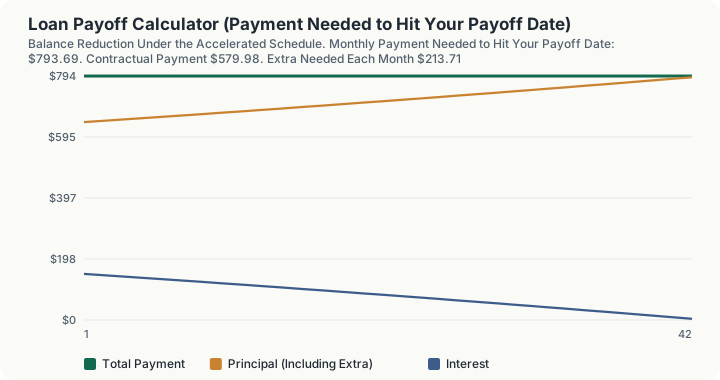
Quick Answer: To clear a $30,000 loan at 6% with 60 months left in only 42 months, you need to pay $793.69 a month. That is $213.71 more than the $579.98 contractual payment, and it cuts total interest from $4,799.09 to $3,334.86, a saving of $1,464.23 and 18 months.
What does this calculator do?
Most payoff calculators run in one direction: you supply an extra payment and they tell you what it buys. That is useful once you already know the number you can spare, but it is not how the decision usually starts. People start with a date. They want the car loan gone before the baby arrives, the personal loan cleared before they apply for a mortgage, the consolidation loan finished before a fixed-rate period ends.
This calculator runs in the other direction. You give it the date, and it solves for the payment. It computes the contractual payment that retires your balance over the remaining term, computes the payment that would retire the same balance over your target term, and reports the difference as the extra you have to find each month. Only then does it price the plan, regenerating the full amortization schedule to show exactly how much interest the acceleration removes.
It applies to any single amortizing installment loan: mortgage, auto, personal, student, or a consolidation loan. It does not apply to revolving credit card debt, where the minimum payment is a percentage of a moving balance rather than a fixed instalment, and it does not order multiple debts by rate or balance. Those are the credit card payoff and debt payoff pages.
How is this calculated?
- Convert the APR to a monthly periodic rate. The annual rate is divided by 12. At 6% the periodic rate is 0.005.
- Clamp the target. A target later than the remaining contract term is not a payoff plan but a refinance, so the target is capped at the contractual term.
- Solve for the contractual payment. The shared payment solver finds the level monthly payment that takes the current balance to zero over the remaining contract months.
- Solve for the required payment. The same solver is run again with the target number of months instead of the contract term.
- Subtract to get the extra. Required payment less contractual payment, floored at zero, is the extra needed each month.
- Regenerate the schedule. The shared amortization primitive rebuilds the loan month by month with that extra applied to principal, stopping the moment the balance reaches zero.
- Compare against the baseline. The primitive also builds the contractual schedule internally, so the interest and months saved are a genuine difference between two full schedules, not an approximation.
The payment solved in steps 3 and 4 is the standard annuity payment:
PMT = P × (i(1 + i)ⁿ)/((1 + i)ⁿ − 1)
where $P$ is the current balance, $i$ is the monthly periodic rate, and $n$ is the number of months over which the balance must be retired.
Worked Example
Take the defaults: a $30,000 balance at 6% APR with 60 months remaining, and a target of being debt-free in 42 months.
Step 1. Monthly rate: 6% divided by 12 equals 0.005.
Step 2. Growth factor over the contract term: 1.005 raised to the 60th equals 1.348850.
Step 3. Contract numerator: $30,000 times 1.348850 equals $40,465.50.
Step 4. Contract annuity factor: (1.348850 minus 1) divided by 0.005 equals 69.770031.
Step 5. Contractual payment: $40,465.50 divided by 69.770031 equals $579.98.
Step 6. Growth factor over the target term: 1.005 raised to the 42nd equals 1.233033.
Step 7. Target numerator: $30,000 times 1.233033 equals $36,990.98.
Step 8. Target annuity factor: (1.233033 minus 1) divided by 0.005 equals 46.606537.
Step 9. Required payment: $36,990.98 divided by 46.606537 equals $793.69.
Step 10. Extra needed each month: $793.69 minus $579.98 equals $213.71.
Step 11. Baseline interest, running the contract to term: $4,799.09.
Step 12. Accelerated interest, with the extra applied every month: $3,334.86.
Step 13. Interest saved: $4,799.09 minus $3,334.86 equals $1,464.23, a 30.5% reduction.
Step 14. Months saved: 60 minus 42 equals 18 months.
Push harder and the arithmetic scales predictably. Targeting 24 months instead of 42 raises the required payment to $1,329.62, an extra $749.64 a month, and cuts accelerated interest to about $1,911.
Carrying The Accelerated Schedule Forward
Step 15: Month one. Of the $793.69 payment, $150.00 is interest and $643.69 reduces the balance to $29,356.31
Step 16: Month two. Interest has already fallen to $146.78 and principal risen to $646.91. Cumulative interest: $296.78.
Step 17: Month twelve. Principal $679.99 against interest $113.70, balance $22,059.74, cumulative interest $1,584.02
Step 18: Month twenty-four, halfway to the target date. Principal $721.93 against interest $71.76, balance $13,629.73, cumulative interest $2,678.29
Step 19: Month forty-two, the payoff. Cumulative interest $3,334.86, balance $0.00
At the halfway mark she has already paid 80.3% of the total interest but cleared 54.6% of the balance. That front-loading is exactly why an extra payment made in month two is worth far more than the same money in month thirty: interest is charged on a balance that only the early payments meaningfully reduce.
What does this calculator not account for?
- Prepayment penalties. Some auto, personal, and non-conforming mortgage products charge a fee for early payoff. The model assumes extra principal is accepted penalty-free.
- How your servicer applies extra money. Many servicers treat an unlabelled overpayment as a prepaid future instalment rather than a principal reduction. Unless the payment is designated principal-only, the schedule shown here will not happen.
- Precomputed interest and Rule of 78s. A minority of consumer loans, particularly some older auto and personal loans, precompute the full interest charge at origination. Paying such a loan early saves far less than a simple-interest schedule implies, and this model assumes simple interest.
- Variable rates. The rate is held constant for the whole term. An adjustable-rate loan will not follow this schedule.
- Opportunity cost. Clearing a 6% loan early is equivalent to a guaranteed 6% return. If the same cash could reasonably earn more elsewhere, the interest saved here is only one side of the comparison.
- Fees, insurance and escrow. Only principal and interest are modeled. Any escrowed tax, insurance, or servicing fee is outside the schedule.
- Multiple debts. One loan at a time. Ordering several balances by rate or by size is what the debt payoff and snowball versus avalanche pages do.
What mistakes do people make with this?
- Entering the original loan amount instead of the current balance. The calculator solves from where you are now. Using the origination figure will overstate both the payment and the interest by the amount you have already repaid.
- Assuming the extra payment is a loss. The $8,975.82 of extra cash in the worked example is not money spent; almost all of it is principal you owed anyway, paid sooner. The actual saving is the $1,464.23 interest line, and the real benefit is being free of the obligation 18 months early.
- Expecting the saving to scale with the payment. Raising the payment from $579.98 to $793.69 is a 37% increase and saves 30.5% of interest. Doubling the extra does not double the saving, because each increment removes fewer remaining interest periods.
- Accelerating the wrong loan. With more than one debt, the highest-rate balance almost always deserves the extra dollar first. Running this page on a 3% mortgage while carrying 22% card debt inverts the priority.
- Draining the emergency fund to do it. Principal paid into an instalment loan is not retrievable. A borrower who prepays aggressively and then has to borrow again at a higher rate has gone backwards.
- Ignoring the tax angle on deductible interest. For a filer who itemises and deducts mortgage or student loan interest, the effective cost of that interest is lower than the stated rate, which reduces the real value of prepaying.
Frequently Asked Questions
What payment do I need to pay off my loan by a specific date?
How is this different from the mortgage payoff calculator?
Why can I not set a target later than my contract term?
Does paying extra reduce my required monthly payment?
Should I pay off the loan or invest the money?
Sources
- Consumer Financial Protection Bureau, guidance on making extra payments toward loan principal and on how servicers must apply them: consumerfinance.gov/ask-cfpb
- Truth in Lending Act, Regulation Z (12 CFR Part 1026), for the definition of the annual percentage rate this calculator takes as input: consumerfinance.gov/rules-policy/regulations/1026
Also consulted: The amortization arithmetic follows the standard annuity payment relation and is implemented once in this project's shared amortization and time-value primitives, with its own reconciled test vectors.