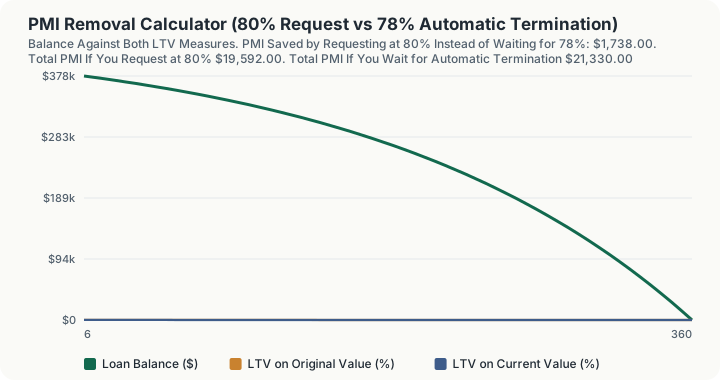
Quick Answer: Writing to the servicer at month 124, when a $380,000 loan on a $400,000 house first reaches 80% of original value, saves $1,738 of premium against waiting for automatic termination at month 135. That is eleven months of $158 PMI paid for nothing. A new appraisal is earlier still: at 3% annual appreciation the investor policy threshold is met in month 60.
What does this calculator do?
Private mortgage insurance protects the lender, not you, and it comes off through four separate routes that do not use the same denominator. Confusing them is the reason people pay it for years longer than they need to.
The written request at 80%. Under the Homeowners Protection Act you may request cancellation when the balance reaches 80% of original value, which is the lesser of the sale price and the appraised value at closing. It is measured on the original amortisation schedule or on payments actually made, so extra principal accelerates it. It is not automatic. You must ask, in writing.
Automatic termination at 78%. The servicer must terminate PMI when the balance is first scheduled to reach 78% of original value under the original amortisation schedule. Extra principal does not move this date at all, because the schedule is unchanged by prepayment.
Final termination at the midpoint. A backstop at the midpoint of the amortisation period regardless of balance, provided the loan is current.
A new appraisal. This is not an HPA right. Removing PMI because the property gained value is investor policy: Fannie Mae's seasoning rule requires an appraisal at your expense plus either two years at 75% LTV or five years at 80% LTV of current value.
The whole point of this page is that the first two run on original value and the fourth runs on current value, and in an appreciating market those two denominators diverge enormously. For how PMI fits into the rest of the monthly payment, alongside principal, interest, property tax and insurance, see how a mortgage payment is calculated.
How is this calculated?
The engine runs a monthly loop to the end of the term, carrying two balances and one property value in parallel.
B_scheduled: original schedule only; B_actual: schedule + extra principal
Step 1: Find the starting loan-to-value. $380,000 / $400,000 = 95%
Step 2: Size the payment. $380,000 at 6.5% / 12 over 360 months = $2,401.86 a month
Step 3: Set the 80% target against original value. $400,000 x 80% = $320,000
Step 4: Set the 78% target against original value. $400,000 x 78% = $312,000
Step 5: Run the actual balance down until it reaches the 80% target. The actual balance first falls to or below $320,000 in month 124, which is 10.3 years
Step 6: Run the scheduled balance down until it reaches the 78% target. The scheduled balance first falls to or below $312,000 in month 135, which is 11.3 years
Step 7: The midpoint backstop. 360 / 2 = month 180, which is 15.0 years
Step 8: Grow the property value monthly and test the investor thresholds. At 3% a year, current-value LTV first satisfies a seasoning tier in month 60, which is 5.0 years
Step 9: Pick the earliest of the four. Month 60, by the route new appraisal on appreciated value (investor policy, not HPA)
Step 10: Price each route at $158 a month. Request at 80%: $158 x 124 = $19,592 Wait for automatic: $158 x 135 = $21,330 Appraisal route: $158 x 60 = $9,480
Step 11: The saving from asking rather than waiting. $21,330 - $19,592 = $1,738
Step 12: Project the home value at the 80% milestone, for reference. $400,000 grown at 3% a year for 124 months = $545,159.11
Worked Example
The most valuable thing on this page is the comparison between the two denominators, so run them side by side.
Step 1: The amortisation route needs your balance to fall. From $380,000 to $320,000 is $60,000 of principal, and at 6.5% the early payments are mostly interest. That takes 124 months.
Step 2: The appraisal route needs your value to rise. The balance barely has to move. At month 60 the loan is still well above $320,000, but the property has grown from $400,000 toward roughly $464,000, and the ratio between them clears the investor threshold.
Step 3: Price the difference. $19,592 - $9,480 = $10,112 of premium avoided by taking the appraisal route rather than waiting for the balance to fall
Step 4: Net off the appraisal fee. An appraisal costs several hundred dollars, which the engine does not model. Against $10,112 it is not a close call, but the fee is real and it is yours.
Now the second comparison, which is about extra principal.
Step 5: Add $300 a month of extra principal. The actual balance falls faster, so the month-124 request date pulls forward.
Step 6: But month 135 does not move. The automatic termination date is measured on the original schedule, which prepayment does not change. Not by one month.
Step 7: Which means the value of prepaying is entirely conditional on your asking. If you prepay and then sit quietly, you pay PMI until month 135 exactly as you would have without prepaying, and every dollar of extra principal bought you nothing on this particular front.
That is the single most expensive misunderstanding in the whole subject, and it is why the guidance line on this page says what it says: write to the servicer at month 124.
Carrying Both Denominators Forward
Step 8: Month six. Balance $377,910.73. LTV on original value 94.48%, LTV on current value 93.07%. PMI paid to date $948.00.
Step 9: Month twelve. Balance $375,752.62. LTV on original value 93.94%, LTV on current value 91.17%. PMI paid to date $1,896.00. Across those six months the original-value ratio fell 0.54 points while the current-value ratio fell 1.91.
Step 10: Month sixty. Balance $355,721.61. LTV on original value 88.93%, LTV on current value 76.56%. PMI paid to date $9,480.00. The appraisal denominator has cleared the threshold; the statutory one is not close.
Step 11: Month 126, the first six-month row below 80% of the original value. Balance $318,153.95, LTV on original value 79.54%, PMI paid to date $19,908.00.
Over ten and a half years the balance fell from $380,000.00 to $318,153.95, moving the original-value ratio 15.46 points. The current-value ratio moved 36.93 points over the same stretch on exactly the same balance. That is the entire argument for the appraisal route in one comparison: amortisation is a slow, contractual process and appreciation is not, and a borrower who watches only the balance is watching the slower of the two numbers.
What does this calculator not account for?
- The appraisal fee, and whether your servicer accepts a broker price opinion instead. The appreciation route has a real cost that is not netted from the figures shown.
- The good-payment-history requirement. The HPA conditions cancellation and termination on the loan being current and, for the request route, on no payment being 30 days late in the last twelve months or 60 days late in the last twenty-four. The engine assumes a clean record.
- Substantial junior liens or a decline in value, either of which can block the 80% request.
- FHA mortgage insurance. The HPA governs conventional PMI on a single-family principal residence with a closing date on or after 29 July 1999. FHA annual MIP works entirely differently and, at higher LTVs, runs for the life of the loan.
- Lender-paid PMI, which cannot be cancelled at all because there is no borrower premium to stop.
- Investment properties and second homes, which are outside the HPA's coverage and where investor policy is stricter.
- Whether your servicer will actually process the request promptly. The engine models the date you become eligible, not the date the premium stops appearing on your statement.
- Any change in the PMI premium over time. The monthly premium you enter is held constant.
What mistakes do people make with this?
- Waiting for automatic termination. It costs $1,738 here for doing nothing. The 80% request is available eleven months earlier and it is yours to make.
- Believing extra principal moves the automatic date. It does not. It moves the request date only, and only if you then make the request.
- Using the current value for the HPA routes. Both the 80% request and the 78% automatic termination are measured against original value, which is the lesser of sale price and appraisal at closing. A later appraisal does not change it.
- Assuming appreciation-based removal is a right. It is investor policy, not statute. Fannie Mae wants two years of seasoning at 75% of current value or five years at 80%, plus an appraisal you pay for, and other investors differ.
- Forgetting the midpoint backstop exists. At month 180 here PMI ends regardless of balance, provided the loan is current. It is rarely the binding route but it is a floor.
- Confusing this with the decision to take PMI at all. That is a different question, and the piggyback loan calculator answers it.
Frequently Asked Questions
When can I ask my lender to cancel PMI?
What is the difference between the 80% and 78% rules?
Does paying extra principal get rid of PMI faster?
Can I remove PMI because my home went up in value?
What counts as original value?
Does this apply to my FHA loan?
Sources
- Homeowners Protection Act of 1998, 12 U.S.C. 4901 to 4910. The cancellation date at 80% is 12 U.S.C. 4901(2) and the termination date at 78% is 12 U.S.C. 4901(18); read 2026-08-30 at law.cornell.edu/uscode/text/12/4901
- Automatic termination at 78% and final termination at the amortisation midpoint, 12 U.S.C. 4902(b) and 4902(c): read 2026-08-30 at law.cornell.edu/uscode/text/12/4902
Also consulted: The appreciation route is Fannie Mae investor policy, not statute: two years of seasoning at 75% of current value or five years at 80%, with an appraisal at the borrower's expense. It is modelled here as a fourth path so the two denominators can be compared, and it is labelled as policy rather than as a right; The interest rate, the monthly premium, the extra principal and the appreciation rate are all user inputs, not sourced constants. Your closing disclosure states the premium.