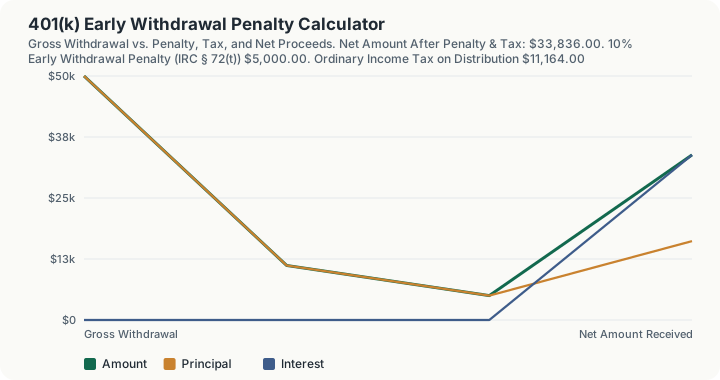
Quick Answer: Withdrawing $50,000.00 from a traditional 401(k) at age 45, stacked on $80,000.00 of other taxable income (single filer), costs $5,000.00 in the 10% early withdrawal penalty plus $11,164.00 in ordinary income tax, for $16,164.00 in total cost. That leaves $33,836.00 net, an effective 32.33% total tax rate on the withdrawal.
Overview
Taking money out of a traditional 401(k) or traditional IRA before age 59½ triggers two separate costs, and it is easy to underestimate both. First, the distribution is included in gross income and taxed at your ordinary marginal rate, exactly like a paycheck, because contributions to a traditional account were made pre-tax and have never been taxed yet. Second, IRC § 72(t)(1) adds a flat 10% additional federal tax on top of that income tax, specifically as a disincentive against tapping retirement savings early, unless a statutory exception applies.
Combined, these two costs routinely consume 30-45% or more of an early withdrawal for anyone in a moderate-to-high tax bracket, a fact that is easy to lose sight of when a lump sum shows up as a single account balance. This calculator computes both pieces explicitly, stacking the withdrawal on top of your other income to find its real marginal tax cost (not a flat assumed rate), and adds the 10% penalty on top, so you can see the true net proceeds before deciding to withdraw.
How This Is Calculated
- Penalty eligibility. The 10% additional tax under IRC § 72(t)(1) applies to distributions taken before age 59½, unless a statutory exception applies (see the reference list below).
- Ordinary income tax on the distribution. Computed by running this platform's progressive-bracket engine twice against the full 2026 federal bracket schedule for your filing status: once on your other taxable income alone, and once with the withdrawal stacked on top. The difference is the distribution's true incremental tax cost, which correctly reflects however many brackets the withdrawal spans.
- Total cost and net proceeds.
Worked Example
Using the calculator's default inputs:
- Withdrawal Amount: $50,000.00
- Your Age at Withdrawal: 45
- Other Taxable Income This Year: $80,000.00
- Filing Status: Single
Step by step:
- Taxable income without the withdrawal: $80,000 − $16,100 standard deduction = $63,900.00, spanning the 10%, 12%, and 22% brackets. Tax on that base: $8,770.00.
- Taxable income with the withdrawal: $130,000 − $16,100 = $113,900.00, now reaching into the 24% bracket. Tax on that combined amount: $19,934.00.
- Income tax on the distribution: $19,934.00 − $8,770.00 = $11,164.00.
- Age 45 is well under 59½, so the 10% penalty applies in full: $50,000 × 10% = $5,000.00.
- Total cost: $11,164.00 + $5,000.00 = $16,164.00.
- Net amount received: $50,000.00 − $16,164.00 = $33,836.00, an effective total tax rate of 32.33% on the gross withdrawal.
Compare that to the same $50,000 withdrawn at age 60 instead of 45: the $5,000.00 penalty disappears entirely, but the $11,164.00 in ordinary income tax still applies in full, since crossing 59½ only removes the penalty, not the underlying tax on a pre-tax account.
Penalty Exceptions (Reference)
The 10% additional tax does not apply if a statutory exception under IRC § 72(t)(2) covers the distribution. Ordinary income tax is still generally owed even when an exception applies; these exceptions remove only the 10% penalty. Verify current details with a tax professional or IRS Publication 590-B before relying on any of these:
- Rule of 55. If you separate from service (quit, are laid off, or retire) in or after the calendar year you turn 55, distributions from that specific employer's 401(k) or 403(b) plan are penalty-free. This does not apply to IRAs, and does not apply to 401(k) plans from previous employers you left before turning 55.
- First-time homebuyer (IRA only). Up to $10,000 lifetime from an IRA, penalty-free, toward buying, building, or rebuilding a first home for yourself, your spouse, or certain family members. This exception is not available for a 401(k) distribution; funds would need to be rolled to an IRA first to qualify.
- Qualified higher-education expenses (IRA only). Penalty-free IRA withdrawals for tuition, fees, books, and required supplies at an eligible institution, for yourself, your spouse, children, or grandchildren. Like the homebuyer exception, this applies to IRAs, not directly to 401(k) plans.
- Substantially equal periodic payments (SEPP / Rule 72(t)). A structured series of at least annual payments computed under one of three IRS-approved methods, continued for the longer of 5 years or until age 59½. Available for both 401(k)s and IRAs. See the companion Rule 72(t) SEPP Calculator for how those payment amounts are actually computed; this calculator does not duplicate that math.
- Unreimbursed medical expenses exceeding the AGI threshold. The portion of unreimbursed medical expenses that exceeds 7.5% of your adjusted gross income for the year can be withdrawn penalty-free, available for both 401(k)s and IRAs.
- Total and permanent disability. Distributions after a qualifying disability determination are penalty-free from both 401(k)s and IRAs.
- Other narrower exceptions exist (qualified birth or adoption expenses up to $5,000, certain federally declared disaster distributions, terminal illness, domestic abuse victims, IRS levy on the account, and active-duty military reservists called to duty), each with its own specific conditions under §72(t)(2) and later legislative additions. Confirm eligibility and current dollar limits directly with a tax advisor or the IRS before withdrawing.
What This Does Not Account For
- State income tax. Most states also tax traditional 401(k)/IRA distributions as ordinary income, and some apply their own early-withdrawal penalty on top of the federal 10%. This calculator computes federal tax and the federal penalty only.
- Mandatory 20% withholding on 401(k) distributions. Plan administrators are generally required to withhold 20% of a 401(k) distribution for federal income tax automatically (unlike an IRA, where withholding is typically optional and defaults lower). That withholding is a prepayment toward the actual tax liability computed here, not an additional cost; your actual tax owed at filing is the figure this calculator computes, reconciled against whatever was withheld.
- Roth account distributions. This calculator applies to traditional (pre-tax) 401(k) and IRA accounts. Qualified Roth distributions are generally tax-free and penalty-free; non-qualified Roth withdrawals follow different, contribution-basis-first ordering rules not modeled here.
- Any of the statutory penalty exceptions listed above. This calculator always applies the 10% penalty when age is under 59½; it does not attempt to determine whether your specific withdrawal qualifies for an exception. Toggle the age input above 59 to model the "no penalty" case if an exception applies to your situation.
- Net unrealized appreciation (NUA) or other specialized distribution strategies for employer-stock-heavy 401(k) accounts, which can change the tax treatment substantially.
Common Pitfalls
- Assuming the "10% penalty" is the whole cost. The penalty is on top of ordinary income tax, not instead of it. A withdrawal in a high tax bracket routinely costs 35-45%+ of the gross amount between the two combined, as shown in the worked example above.
- Forgetting the distribution can push you into a higher bracket. A large withdrawal stacked on existing income can span multiple tax brackets, so the marginal cost of the last dollar withdrawn can be meaningfully higher than your "average" tax rate; this calculator's bracket-stacking method captures that correctly.
- Confusing 20% mandatory 401(k) withholding with the actual tax owed. The 20% withheld at distribution time is a prepayment, not the final bill. If your actual marginal rate plus the 10% penalty exceeds 20% (common), you will owe more at filing; if it is lower, you get the difference back as a refund.
- Assuming an exception applies without confirming eligibility. Several of the most well-known exceptions (first-time homebuyer, higher-education expenses) apply to IRAs but not directly to 401(k) plans, a distinction that trips up many people who assume the rules are identical across account types.
- Not comparing against alternatives. A 401(k) loan (if the plan allows one), a home equity line, or simply delaying the expense can sometimes cost far less than the combined tax-and-penalty hit of an early withdrawal; run the numbers here before deciding.
Frequently Asked Questions
Does the 10% penalty apply to Roth 401(k) or Roth IRA withdrawals?
I separated from my employer at 54. Can I use the Rule of 55?
If I roll my 401(k) into an IRA, do I lose the Rule of 55?
Is the 10% penalty deductible or creditable against anything?
How does this differ from the Rule 72(t) SEPP Calculator on this site?
Sources
- Internal Revenue Code § 72(t), Additional Tax on Early Distributions. law.cornell.edu/uscode/text/26/72
- Internal Revenue Service: Publication 590-B, Distributions from Individual Retirement Arrangements (IRAs). irs.gov/publications/p590b
- Internal Revenue Service: Form 5329, Additional Taxes on Qualified Plans (Including IRAs) and Other Tax-Favored Accounts. irs.gov
Also consulted: Internal Revenue Service: Revenue Procedure 2025-32, 2026 federal income tax brackets and standard deduction amounts.