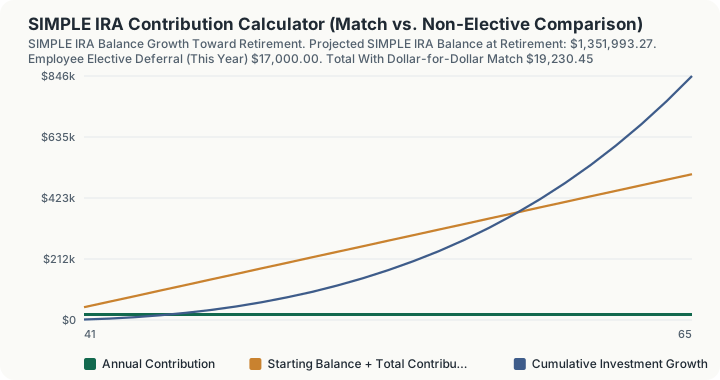
Quick Answer: For 2026 a SIMPLE IRA participant can defer up to $17,000 ($18,100 under the SECURE 2.0 higher limit for small employers), plus a 3% employer match or a flat 2% non-elective contribution. On the defaults, $80,000 of self-employment income and the match method give $19,230.45 a year, which from age 40 to 65 on a $25,000 starting balance at 7% projects to $1,351,993.27.
Overview
A SIMPLE IRA (Savings Incentive Match Plan for Employees) sits between a SEP-IRA and a 401(k) in both complexity and contribution room. Like a 401(k), employees (including a self-employed owner covering themselves) can defer their own salary into the account. Like a SEP-IRA, the setup and ongoing administration are lighter than a full 401(k), with no Form 5500 filing requirement and a simpler adoption process. The tradeoff is a lower employee deferral ceiling than a 401(k), and an employer contribution that must follow one of exactly two formulas, chosen once per year and applied uniformly across the whole plan, not customized employee by employee.
Those two formulas produce meaningfully different results depending on who is deferring how much, which is why this calculator always computes both side by side rather than assuming one is obviously better.
How This Is Calculated
Employee elective deferral. The 2026 standard limit is $17,000. SECURE 2.0 allows a higher limit, $18,100 for 2026, for SIMPLE plans sponsored by employers with 25 or fewer employees (automatically), or by employers with 26 to 100 employees who elect an enhanced employer-contribution formula. On top of either deferral limit, a standard catch-up of $4,000 applies at age 50 or older, or an enhanced $5,250 "super catch-up" applies for anyone who turns 60, 61, 62, or 63 during the year (replacing, not stacking with, the standard catch-up). For a self-employed sole proprietor covering themselves, "compensation" for these purposes is net earnings from self-employment, meaning net profit reduced by the deductible one-half of self-employment tax, the same adjustment used for a Solo 401(k) or SEP-IRA.
Employer contribution, Method A: dollar-for-dollar match. The employer matches whatever the employee defers, dollar for dollar, up to 3% of the employee's compensation. An employee who defers nothing receives no match under this method; the employer's total cost scales directly with employee participation.
Employer contribution, Method B: flat 2% non-elective. The employer contributes a flat 2% of every eligible employee's compensation, regardless of whether that employee defers anything at all, computed on compensation capped at the IRC Sec. 401(a)(17) limit ($360,000 for 2026). This method costs the employer more when participation is low and can cost less than a full 3% match when participation is high.
Which method produces a bigger contribution for a given person depends entirely on how much they defer relative to 3% of their compensation. Defer more than 3% of pay, and the match (worth up to 3% of pay) usually beats the flat 2%. Defer less than roughly 2/3 of what 3% of pay would be, and the flat 2% non-elective can come out ahead instead, since it doesn't depend on the deferral amount at all.
Worked Example
Comparing the two employer formulas at $100,000 of net profit
A 45-year-old sole proprietor, under 50 so no catch-up, standard deferral limit, deferring the full statutory maximum.
Step 1 -- Self-employment tax. $100,000 x 92.35% x 15.3% = $14,129.55
Step 2 -- Net earnings from self-employment, which is the compensation base. $100,000 - ($14,129.55 / 2) = $92,935.22
Step 3 -- Employee elective deferral. The 2026 standard limit is $17,000 and compensation far exceeds it, so the deferral is $17,000.00
Step 4 -- Method A, the dollar-for-dollar match. 3% of $92,935.22 = $2,788.06. The $17,000 deferral is far above that, so the match pays its full ceiling.
Step 5 -- Method A total. $17,000.00 + $2,788.06 = $19,788.06
Step 6 -- Method B, the flat 2% non-elective. $92,935.22 x 2% = $1,858.70
Step 7 -- Method B total. $17,000.00 + $1,858.70 = $18,858.70
Step 8 -- The difference. $19,788.06 - $18,858.70 = $929.36 in favour of the match
That $929.36 is simply 1% of compensation, which is the whole comparison in a sentence: a participant who defers at least 3% of pay collects the match's full 3%, against the non-elective's 2%, and the gap can never be wider than that one point. It reverses only for someone deferring under 2% of pay, where the match falls below the flat 2% that arrives regardless.
The default case, carried to retirement
The calculator's defaults are $80,000 of net profit, age 40 to 65, a $25,000 existing balance, a $17,000 deferral, the match method and a 7% return.
Step 9 -- Compensation base on $80,000 of net profit. $74,348.18 of net earnings from self-employment
Step 10 -- The annual contribution. $17,000.00 deferral + (3% x $74,348.18 = $2,230.45) match = $19,230.45
Step 11 -- Age 41, the first year. ($25,000 + $19,230.45) x 1.07 = $45,980.45, growth of $1,750.00
Step 12 -- Age 42, the second year. ($45,980.45 + $19,230.45) x 1.07 = $68,429.53, cumulative growth $4,968.63
Step 13 -- Age 52, twelve years in. Balance $400,307.76, of which $144,542.36 is growth
Step 14 -- Age 65. Balance $1,351,993.27, from $480,761.25 of contributions and $846,232.02 of growth
Growth overtakes contributions somewhere in the mid-fifties and never looks back: by 65 the account has earned $1.76 for every dollar paid in. The same twenty-five years under the non-elective formula finishes at $1,304,968.25, which is $47,025.02 less. A $743.49 difference in a single year, compounded for twenty-five, is what that gap actually is, and it is the reason the formula choice is worth a few minutes even for a one-person business.
The SECURE 2.0 tier, at age 61
Step 15 -- The enhanced deferral for a small employer. $18,100 higher limit + the $5,250 super catch-up for ages 60 through 63 = $23,350.00
Step 16 -- The match on the same compensation. $74,348.18 x 3% = $2,230.45
Step 17 -- Total for the year. $23,350.00 + $2,230.45 = $25,580.45
The super catch-up replaces the standard $4,000 catch-up rather than stacking with it, and it is available only in the four years someone turns 60, 61, 62 or 63. Combined with the higher deferral limit, a 61-year-old on this compensation can put away $6,350 more than the same person could at 45 -- a narrow window, and one that closes at 64 when the standard $4,000 catch-up resumes.
Choosing Between the Two Employer Formulas
For a solo business owner covering only themselves, the choice is straightforward: run both numbers (this calculator does it automatically) and pick whichever is larger, since there's no other employee whose incentives to defer more or less come into play. For a business with multiple employees, the decision is more strategic. The non-elective 2% guarantees every eligible employee gets a contribution, useful for recruiting and retention among employees who might not defer much on their own. The match rewards and encourages higher deferral rates, but costs the employer nothing for employees who opt out entirely, which can make total employer cost lower in a workforce with uneven participation.
Common Pitfalls
- Assuming the match is automatically better. Whether the match or the flat 2% produces more total money depends entirely on the deferral rate relative to 3% of compensation; this calculator computes both explicitly rather than assuming.
- Missing that the employer formula applies to the whole plan, not per employee. An employer cannot offer some employees the match and others the non-elective contribution in the same plan year; one formula applies uniformly.
- Confusing the standard and SECURE 2.0 higher deferral limits. The $18,100 higher limit only applies to specific employer sizes and plan elections; defaulting to it without checking eligibility overstates what's actually allowed.
- Forgetting the mid-year formula-change notice requirement. An employer generally must notify employees of the SIMPLE IRA's contribution formula before the start of the plan year; switching formulas requires advance notice, not a same-year change.
- Treating SIMPLE IRA and 401(k) catch-up amounts as identical. They are not; the SIMPLE IRA's standard catch-up ($4,000 for 2026) and super catch-up ($5,250) are both lower than the corresponding 401(k) figures ($8,000 and $11,250).
What This Does Not Account For
- Two-year withdrawal restriction. SIMPLE IRA funds withdrawn within the first two years of participation are subject to a steeper 25% early-withdrawal penalty (versus the standard 10%) if not rolled over correctly; this calculator models growth, not withdrawal penalties.
- Multiple eligible employees. This calculator models one participant's contribution; a business with several eligible employees needs to budget the chosen employer formula across everyone, not just the owner.
- Plan setup and custodian costs. SIMPLE IRA administration and investment fees are not modeled.
- Employer's ability to reduce the match in a lean year. A SIMPLE IRA match can be reduced below 3% (to as low as 1%) in no more than 2 of any 5 consecutive years with advance employee notice; this calculator assumes a consistent formula across the full projection horizon.
Frequently Asked Questions
SIMPLE IRA vs. Solo 401(k), which is better for me?
Can a self-employed person really have a SIMPLE IRA?
Does the higher SECURE 2.0 deferral limit apply automatically?
What happens if I contribute more than the SIMPLE IRA limit?
Sources
- Internal Revenue Service, "401(k) limit increases to $24,500 for 2026, IRA limit increases to $7,500," irs.gov/newsroom, IRS Notice 2025-67 (SIMPLE IRA figures). irs.gov
- Internal Revenue Service, Publication 560, "Retirement Plans for Small Business (SEP, SIMPLE, and Qualified Plans)," Chapter 3, SIMPLE IRA Plans. irs.gov/publications/p560
- SECURE 2.0 Act of 2022, Sec. 117 (higher SIMPLE deferral limit for small employers) and Sec. 109 (age 60-63 enhanced catch-up). sec.gov
Also consulted: Internal Revenue Service, COLA Increases for Dollar Limitations on Benefits and Contributions (401(a)(17) compensation limit, 2026).