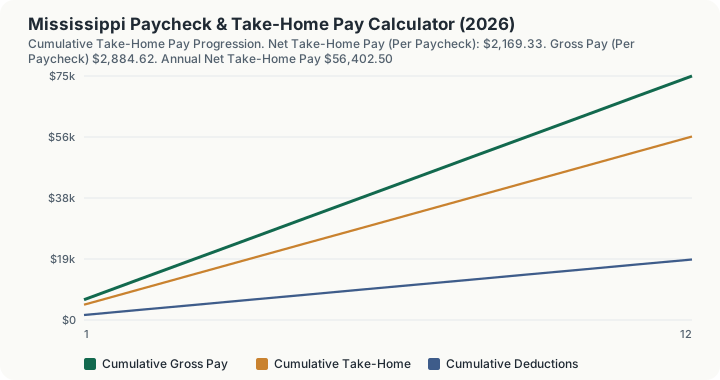
Quick Answer: A $75,000 annual salary in Mississippi, paid bi-weekly and filing single, takes home about $2,169.33 per paycheck ($56,402.50 per year) after federal tax, FICA, and Mississippi state withholding.
A Flat 4% Above a Zero Band
Mississippi advertises a flat 4.00% income tax rate, but the first $10,000 of taxable income is actually taxed at 0%, which functions like a built-in exemption before the flat rate kicks in on everything above it. The Mississippi Paycheck Calculator models both pieces, the zero-rate band and the flat rate above it, alongside federal withholding and FICA.
For most full-time workers earning well above that $10,000 threshold, the practical effect is close to a flat tax on the bulk of their income, with only a small sliver taxed at zero.
How This Is Calculated
Mississippi exempts the first $10,000 of taxable income entirely and taxes everything above it at a single 4% rate, with statute stepping that rate down in future years. The exempt band means the share of a Mississippi salary actually paid in state tax is always below 4%, and it falls further the lower the salary. The subtraction behind the paycheck:
Four steps produce the per-paycheck figure:
- FICA Payroll Tax Computation: - Social Security (OASDI): 6.20% withheld on wages up to the 2026 statutory wage base ($184,500). - Medicare (HI): 1.45% withheld on all gross earnings (no wage cap), plus 0.90% Additional Medicare Tax on earnings exceeding $200,000 (single) or $250,000 (married filing jointly).
- Federal Income Tax Withholding: Evaluated using 2026 progressive federal tax brackets (10%, 12%, 22%, 24%, 32%, 35%, 37%) after applying standard deduction thresholds ($16,100 single / $32,200 married joint).
- Mississippi State Income Tax Withholding: No tax on the first $10,000 of taxable income, then a flat 4% above that.
- Pay Period Proration: Annual net compensation is divided across the designated pay frequency (26 bi-weekly, 24 semi-monthly, 12 monthly, or 52 weekly pay periods).
Worked Example
Consider an employee in Mississippi earning $75,000 annually, paid bi-weekly (26 paychecks per year), filing single, with $3,500 in annual pre-tax 401(k) contributions.
- Gross pay per paycheck. $75,000 ÷ 26 pay periods = $2,884.62 before any withholding.
- Pre-tax deduction. The $3,500 annual 401(k) contribution reduces each paycheck by $134.62 and also shrinks the wages used to calculate federal and state income tax; FICA is still assessed on the full gross amount.
- FICA payroll taxes. Social Security withholds 6.2% of gross pay ($178.85) and Medicare withholds 1.45% ($41.83), for $220.67 per paycheck.
- Federal income tax withholding. Applying the 2026 IRS withholding tables to the reduced taxable wage withholds $265.38 per paycheck.
- Mississippi state tax withholding. The 4.00% rate applies to the reduced taxable wage above the $10,000 zero-rate band, withholding $94.62 per paycheck.
- Net take-home pay. $2,884.62 gross, minus $134.62 pre-tax, minus $220.67 FICA, minus $265.38 federal tax, minus $94.62 state tax leaves $2,169.33 per paycheck, or about $56,402.50 per year, an effective total tax rate of 20.13%.
Carrying The Year Forward
Mississippi exempts the first $10,000 of taxable income entirely and then charges a flat 4%, which gives its cumulative line a lower intercept than a pure flat tax.
Step 7 -- Two months of cumulative pay. The schedule's first row shows $6,250.00 of cumulative gross against $4,700.21 of cumulative take-home. Row two doubles both: $12,500.00 gross, $9,400.42 take-home, with $3,099.58 accumulated on the deduction side.
Step 8 -- The full year. By month twelve the schedule reaches $75,000.00 of cumulative gross and $56,402.50 of cumulative take-home, adding $4,700.21 every month without variation.
Step 9 -- What the year actually withheld. The cumulative deduction column closes at $18,597.50. That column carries the $3,500 pre-tax 401(k) contribution alongside the tax, so tax alone is $18,597.50 - $3,500 = $15,097.50, an effective total tax rate of 20.13% on $75,000.00 of gross pay.
Step 10 -- Why the monthly increment never changes. The rows climb in equal steps, and it is worth knowing why. FICA is resolved annually -- 6.2% on wages up to the $184,500 Social Security base, 1.45% on everything, and 0.9% more above $200,000 filing single -- and that annual number is then apportioned evenly over twelve months. Nothing in the schedule steps down partway through the year. On a $75,000 salary nothing would step down in reality either; both thresholds sit far above this wage.
$56,402.50 lands over the year. The $10,000 exemption is worth a fixed amount regardless of salary, so it shrinks as a share of the $15,097.50 total as pay rises.
The Highest Retention in This Batch, and Why
Mississippi withholds less state tax on a $75,000 salary than any other state in this group, and each lever the sweep exposes shows the same thing from a different angle.
The marginal cost of the next unit. Raising gross salary from $75,000 to $76,000 takes annual take-home from $56,402.50 to $57,066.00, so each additional $1,000 of Mississippi salary is worth $663.50 in the hand, the highest retention on any of these pages. The $336.50 withheld is roughly 22 cents of federal income tax, 7.65 cents of FICA and 4 cents of Mississippi tax per marginal dollar. At $100,000 the engine returns $72,990.00 of annual take-home at an effective total tax rate of 23.51%, against 20.13% at $75,000, with the whole of that rise coming from the federal schedule.
Pricing the pre-tax deferral. Raising the annual pre-tax contribution from $3,500 to $8,500 moves annual take-home from $56,402.50 to $52,702.50. Diverting $5,000 into the plan costs $3,700.00 of spendable pay and $1,300.00 is funded by tax no longer withheld, an effective subsidy of 26.00%, the lowest in this batch. The reason is the same one behind the high retention: at a 4.00% state rate there is less state tax for the deferral to avoid than there is in Minnesota, where the same $5,000 buys $1,440.00 of relief.
A filing-status limitation that Mississippi happens to escape. Switching to married filing jointly moves annual take-home from $56,402.50 to $59,082.50, a gain of exactly $2,680.00, all federal, with Mississippi withholding unchanged at $94.62 per paycheck. The config calls the state primitive without a filing status, so the single schedule is used for everyone. Mississippi publishes no separate joint rate schedule, so this produces the correct state figure by coincidence rather than by design; on the Maryland and Minnesota pages the same code path overstates joint withholding.
Pay frequency changes the cheque, not the year. Moving from bi-weekly to monthly takes the headline from $2,169.33 to $4,700.21 while annual take-home stays at exactly $56,402.50.
What the $94.62 is and is not. The engine runs the reduced taxable wage through the two-band Mississippi schedule with no state standard deduction and no personal exemption, so the $10,000 zero band is the only relief applied. Mississippi's real withholding allows a standard deduction and exemptions that would reduce that figure. The stored 4.00% rate is the tax year 2026 figure; the scheduled 2027 rate is 3.75%, which would lower the per-paycheck state line by roughly $6, and the calculator does not project forward.
What This Does Not Account For
- Local municipal, city, or county wage taxes where applicable.
- Post-tax wage garnishments (child support, tax levies, student loans).
- Voluntary post-tax deductions (Roth 401k, charitable giving, supplemental insurance).
Common Pitfalls
- Confusing Bi-Weekly with Semi-Monthly Pay: Bi-weekly pay results in 26 paychecks per year (two 3-paycheck months), whereas semi-monthly pay results in 24 equal paychecks.
- Failing to Update Form W-4: Inaccurate withholding allowances on Form W-4 can lead to substantial underpayment penalties or large unexpected tax bills.
- Forgetting Pre-Tax Deduction Benefits: Contributions to 401(k) and HSA accounts directly reduce taxable income, lowering both federal and state tax burdens.
- Overlooking Additional Medicare Tax: Failing to anticipate the 0.9% surtax on high-earning households with multiple income sources.
- Using an Outdated Mississippi Rate: The 2026 rate is 4.00%, lower than earlier schedules, so older references overstate state withholding.
Frequently Asked Questions
Does Mississippi have a state income tax on paychecks?
How is overtime pay taxed in Mississippi?
What is the Social Security wage cap for 2026?
Can I adjust my state tax withholding?
Sources
- Internal Revenue Service (IRS): Publication 15 (Circular E) and Publication 15-T (2026). irs.gov/publications/p15
- Social Security Administration (SSA): 2026 Social Security Wage Base Limit. ssa.gov
- Mississippi Department of Revenue: Employer Withholding Tax Tables (2026). dor.ms.gov