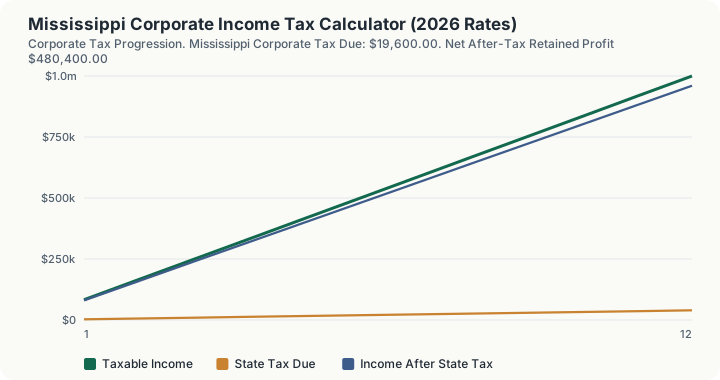
Quick Answer: On $500,000 of pre-apportioned taxable income, Mississippi's two-tier corporate income tax schedule (0% on the first $10,000, then 4.00% above it) produces $19,600.00 in state tax due and $480,400.00 in net after-tax profit, a 3.92% effective rate against a 4.00% marginal rate.
Two Brackets, and the First One Is Zero
Mississippi taxes corporate income on a two-bracket schedule: the first $10,000 of apportioned taxable income is exempt at a 0% rate, and every dollar above that threshold is taxed at 4.00%. The exempt slice is small enough that it makes little practical difference for an established corporation, but it is the reason a Mississippi filer's effective rate always sits below the 4.00% marginal rate rather than equalling it.
With a top rate of 4.00%, Mississippi's schedule undercuts Kentucky's flat 5.00% and South Carolina's flat 5.00%, and sits well below Alabama's flat 6.50% and Georgia's flat 5.19%, its two closest regional comparisons. That places Mississippi among the lightest corporate income tax burdens in the Southeast.
At the calculator's $500,000 baseline, Mississippi's bracket structure produces $19,600.00 in state tax: nothing on the first $10,000, plus $19,600.00 taxed at 4.00% on the remaining $490,000. That is $400.00 less than a flat 4.00% applied to the full $500,000 would produce, which is exactly the value of the zero bracket.
How This Is Calculated
Mississippi exempts the first $10,000 of corporate income outright and taxes the rest at 4.00%, so the state's schedule is best read as a flat rate with a small zero bracket in front of it. Mississippi has also been phasing out its franchise tax on capital, a levy that for decades cost asset-heavy Mississippi filers more than the income tax did.
where $c_i$ are the bracket ceilings ($10{,}000$, then unlimited) and $r_i$ the corresponding rates ($0\%$, $4.00\%$).
- Read the income field as the taxable base. The single income input is taken as Mississippi taxable corporate income exactly as typed. The code applies no modification, allocation or deduction to it before the rate stage; it is the base.
- Walk the bracket schedule slice by slice. Each band is charged only on the income that falls inside it and the pieces are summed: 0.00% on the slice from $0 to $10,000 ($10,000 of the entered income, $0.00); 4.00% on the slice from above $10,000 ($490,000 of the entered income, $19,600.00). On $500,000 that totals $19,600.00.
- Subtract credits and floor the result at zero. The credits field is subtracted from the step-2 figure and the difference is clamped at $0.00, so no credit entry can drive the liability negative. With the field at its $0 default the $19,600.00 stands; enter $8,000 of credits and the page returns $11,600.00, a reduction of exactly the credit entered because the subtraction is a straight one.
- Derive the reported rates from those two numbers. The effective rate is the tax divided by the income entered, 3.92% here, and the top statutory bracket is reported separately as 4.00%. Net after-tax retained profit is the income less the tax, $480,400.00. Those four outputs are the whole of what the engine produces.
Worked Example
Using this calculator's baseline scenario: a corporation with $500,000 in taxable income apportioned to Mississippi.
- Start with apportioned taxable income. The corporation has already apportioned $500,000 of its total taxable income to Mississippi using the state's statutory apportionment formula, before any state-level tax is applied.
- Tax the first bracket. The first $10,000 of apportioned income falls in Mississippi's 0% bracket: $10,000 × 0% = $0.00.
- Tax the remainder at the top bracket. The remaining $490,000 ($500,000 − $10,000) is taxed at Mississippi's 4.00% top rate: $490,000 × 4.00% = $19,600.00.
- Mississippi corporate tax due: $0.00 + $19,600.00 = $19,600.00.
- Net retained profit. Subtracting the state tax liability from taxable income leaves $500,000 − $19,600.00 = $480,400.00 in after-tax profit retained by the corporation, before any separate federal tax liability is applied.
The two rates this produces are not the same number and should not be quoted interchangeably. The marginal rate is 4.00%, the rate on the next dollar earned. The effective rate is $19,600.00 divided by $500,000, or 3.92%, held below the marginal rate by the untaxed first $10,000. That gap narrows as income grows: a corporation earning $5 million apportioned to Mississippi pays $199,600.00, an effective rate of 3.99%.
The $10,000 Edge: The Only Bracket Walk in This Family
Mississippi is the one state in this batch whose corporate schedule contains a genuine threshold, and the calculator's income sweep crosses it at the bottom of the range.
The threshold walk. At $9,900 of apportioned income the engine returns $0.00, with both the effective and the marginal rate reported as 0.00%. At $10,100 it returns $4.00, an effective rate of 0.04% and a marginal rate of 4.00%. Two hundred dollars of additional income across that line cost $4.00, and every dollar after it costs four cents. The step is small in dollars but it is a genuine discontinuity in the reported marginal rate, from 0.00% to 4.00% in a single dollar, and it is the only such point anywhere in Mississippi's corporate schedule.
The marginal cost of the next unit. Above $10,000, each additional $1,000 of income costs $40.00. The engine returns $19,600.00 at $500,000 and $19,640.00 at $501,000, and $19,200.00 at $490,000. The zero bracket is worth a flat $400.00 to every filer above it, no matter how large: $3,600.00 at $100,000 of income against a full-rate $4,000, $39,600.00 at $1,000,000 against $40,000, and $199,600.00 at $5,000,000 against $200,000.
The reverse question. How much can be earned before Mississippi takes anything? Exactly $10,000 of apportioned income, which the engine confirms at $0.00. Above that the inversion is linear: a $19,600.00 bill corresponds to $500,000 of income, and each further $10,000 of tax to $250,000 of income.
Effective and marginal rates are different numbers here, and converge slowly. The engine reports 3.60% effective at $100,000, 3.92% at $500,000, 3.96% at $1,000,000 and 3.99% at $5,000,000, against a 4.00% marginal rate throughout. Quoting the marginal rate as the effective rate overstates the bill by $400.00 at every income level above the threshold, which is 10% of the tax at $100,000 and 0.2% of it at $5,000,000.
What the credit field does, and where it stops. Entering $10,000 of credits against $500,000 of income takes the tax from $19,600.00 to $9,600.00, an exact $10,000.00 saving and an effective rate of 1.92%. The same relief pursued as a deduction, reducing income to $490,000, saves only $400.00, so the credit is worth 25 times the deduction, the widest multiple in this batch because Mississippi's rate is the lowest. Credits above the liability are discarded: the engine takes net tax as the greater of zero and tax less credits, with no carryforward.
What the stored schedule does not carry. Mississippi's corporate franchise tax, levied on capital rather than income and phased down under recent legislation, has no representation in this code path, so a capital-intensive filer computing $19,600.00 here may owe more in fact. The engine also performs no apportionment: the figure entered is treated as already apportioned to Mississippi.
What This Does Not Account For
- Federal Taxable Income Starting Point. Net corporate earnings are determined under IRC § 63 before Mississippi modifications. This calculator starts one step later: the income box is read as the finished Mississippi taxable figure and nothing is derived from a federal return.
- Mississippi Additions & Subtractions. The Mississippi tax deducted federally is added back, and the state applies its own depreciation position. No addback and no subtraction is computed anywhere in this page's code path, so enter an income figure that already reflects them.
- Apportionment Factor Allocation. Mississippi apportions under statutory formulas that vary by industry, with the general formula weighting sales, property, and payroll and specific formulas for manufacturers, retailers, and regulated businesses. The engine performs no apportionment of any kind. The word does not appear in the primitive this page binds to; the figure you type is taken as the Mississippi figure and multiplied by the rate as it stands.
- Net Operating Loss (NOL) Deductions. Allowable Mississippi NOL carryforwards reduce the base before the bracket walk begins. No loss deduction is applied by this calculator. If a carryforward is available, subtract it yourself before entering the income.
- Franchise Tax Verification. Mississippi's capital-based franchise tax is assessed separately under its phase-out schedule and is not included in this result. It is not added to the figure this page returns.
- Federal corporate income tax (21% under IRC § 11).
- Specialized gross receipts taxes (e.g. Ohio CAT, Washington B&O, Texas Franchise Tax) where applicable.
- Minimum entity franchise tax fees or annual report filing charges.
- Base Erosion and Anti-Abuse Tax (BEAT) or Global Intangible Low-Taxed Income (GILTI) provisions.
- Local municipal corporate earnings taxes (e.g. NYC General Corporation Tax).
Common Pitfalls
- Quoting the Marginal Rate as the Effective Rate: Reporting 4.00% as the rate actually paid on $500,000, when the exempt first bracket pulls the effective rate down to 3.92%. The two numbers converge as income rises but never meet.
- Improper Apportionment Sourcing: Applying market-based sourcing vs cost-of-performance rules incorrectly for service revenue apportioned to Mississippi.
- Ignoring Unitary Group Combined Reporting: Failing to account for Mississippi's mandatory combined return requirements across related entities.
- Neglecting State NOL Carryforward Caps: Overlooking Mississippi's annual percentage limitations on net operating loss deductions, which matter more once the 4.00% top rate is applied to a larger taxable base.
Frequently Asked Questions
Does Mississippi have a corporate income tax?
When are Mississippi corporate tax returns due?
Does Mississippi tax S-corporations and LLCs?
How is multi-state corporate income apportioned to Mississippi?
Sources
- Mississippi Department of Revenue: Corporate Tax Statutes and Guidance (2026). dor.ms.gov
- Multistate Tax Commission (MTC): Uniform Apportionment and Allocation Guidelines. mtc.gov