Quick Answer: Alaska imposes no state-level tax on capital gains, so an investor realizing a $100,000 gain owes $0 in Alaska state tax and keeps the full $100,000, subject only to federal tax.
The Only Result This Calculator Can Return
Alaska carries no individual income tax and no separate levy on investment gain, so the state figure resolves to zero before any bracket arithmetic runs. That is not a rounding outcome or a low-rate outcome. Across every input combination tested against this engine, the returned Alaska tax is $0.00 and the returned effective rate is 0.00%. At a $499 gain the tax is $0.00; at a $12,000,000 gain the tax is $0.00; the net gain retained comes back as $499.00 and $12,000,000.00, identical to what was entered.
The consequence for reading this page is worth stating plainly. The number in the headline box is the smaller half of the bill, and the half this calculator does not compute -- federal long-term or short-term tax, and the 3.8% Net Investment Income Tax -- is the whole of it. A page that let the $0.00 imply the sale was untaxed would be lying by omission.
How This Is Calculated
Alaska levies no individual income tax, so there is no state capital gains tax to compute. A resident who sells appreciated stock, a rental property, or a business interest owes Alaska nothing on the gain, at any size, with no holding period to satisfy and no return to file for it. That makes this page mostly a check on the federal side of the sale, and the arithmetic is short.
There is no rate schedule to reproduce, so the two identities the calculator applies are simply these.
What the calculator does with your inputs:
- Start with the net gain. The figure you enter is the gain left after capital losses and loss carryforwards have been netted against it.
- Look for an Alaska rate schedule. There is none to look up, so the state line resolves to zero before any bracket arithmetic runs. The other-income field has no effect here; it is kept so the page compares cleanly against states where it does matter.
- Effective rate. Zero divided by the realized gain is 0.00%, and it stays 0.00% whether the gain is $10,000 or $10 million.
- Net proceeds. The gain passes through the state layer whole.
- What is still owed. Federal capital gains tax and the federal net investment income tax are unaffected by residence in a no-tax state and are calculated separately.
Worked Example
Consider an investor residing in Alaska who realizes $100,000 in capital gains alongside $75,000 in ordinary income during the year.
- Check the state rate. Alaska does not levy an individual income tax, and it does not carve out a separate tax on investment gains either, so the state rate applied to this sale is 0.00%.
- Compute the state tax. $100,000 × 0.00% = $0.00. No state return, no state estimated payments, and no state withholding apply to this capital gain.
- Net proceeds. The investor retains the full $100,000 gain after state tax, compared to an investor in a high-tax state who might lose 5% to 13% of the same gain to state liability.
- Federal liability remains. Alaska's 0% state rate does not eliminate federal exposure: the gain is still subject to federal long-term or short-term capital gains brackets under IRC § 1(h), plus the 3.8% NIIT surtax where applicable.
Reading the Twelve-Row Schedule: A Flat Line at Zero
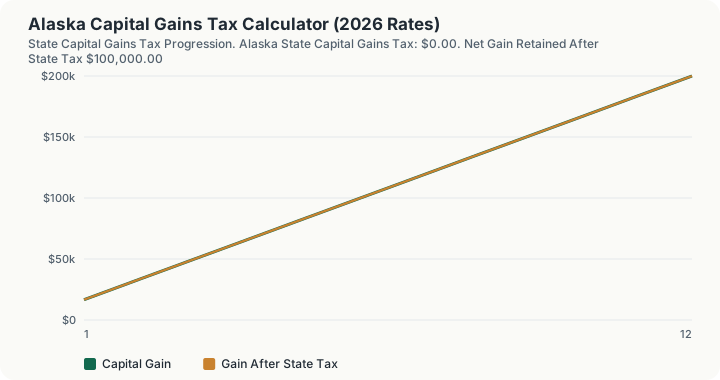
The table on this page steps the gain across twelve tiers, from $16,666.67 in the first row to $200,000.00 in the twelfth. On most state pages in this corpus that walk is where the bracket edges show up. Here the State Tax Due column reads $0.00 in all twelve rows, and the Gain After State Tax column reproduces the Capital Gain column exactly: $16,666.67 against $16,666.67, $50,000.00 against $50,000.00, $100,000.00 against $100,000.00, $200,000.00 against $200,000.00. The table carries no information the input box did not already contain, and it is worth saying so rather than presenting a flat line as if it were a finding.
There is no threshold anywhere in the range. A bracket edge is a gain at which the next dollar costs more than the last. Running the calculator at the values where other states break -- $500 and $501, $3,000 and $3,001, $10,000,000 and $10,001,000 -- returns $0.00 on both sides of each pair. Alaska tax is $0.00 at a $9,999,999 gain and $0.00 at a $10,000,000 gain. The reported marginal rate reads 0.00% at every point in the sweep, including at $12,000,000, the largest gain tested.
The Marginal Cost of the Next $1,000, and the Reverse Question
Each additional $1,000 of realized gain costs $0.00 in Alaska tax. The pair that proves it: a $99,000 gain returns $0.00 and a $100,000 gain returns $0.00. Same at the top of the range, where a $10,000,000 gain and a $10,001,000 gain both return $0.00.
The reverse question -- how much can be realised before crossing into a higher band -- has no finite answer on this page. The calculator accepts a gain up to $100,000,000, and every gain tested inside that range, up to and including $12,000,000, returns $0.00. There is no ceiling to plan against because there is no schedule.
The other-income field behaves the same way, and this is the one comparison the engine genuinely supports. Holding the gain at $100,000 and moving other taxable income across $0, $3,000, $5,600, $11,200, $16,000, $26,400 and $75,000 returns $0.00 at every one of the seven settings, with net proceeds of $100,000.00 throughout. On a graduated state the same field decides how much of the gain lands in the top band; here it is inert, retained only so the input set matches the other state pages.
That has one practical use. If you enter your figures on this page and see anything other than $0.00, you have used the wrong state page, because $0.00 is the only value this configuration can produce.
Federal Rules That Still Apply
The state answer is zero at every gain size, so the whole bill on an Alaskan's sale is a federal bill. - Holding period. An asset held for more than one year before disposal produces a long-term gain. One year or less makes it short-term, taxed at ordinary rates. - Long-term rates. Long-term gains fall in the 0%, 15%, or 20% band according to taxable income, with separate 25% and 28% treatment for unrecaptured section 1250 gain and collectibles. - Net Investment Income Tax. A separate federal 3.8% tax under IRC § 1411 applies to net investment income once modified adjusted gross income passes $200,000 for a single filer or $250,000 for a joint return. Living in Alaska does not reduce it. - Federal estimated payments. The IRS generally expects estimated tax from anyone who will owe $1,000 or more after withholding and credits, paid across four periods rather than in one lump at filing. The penalty is generally avoided by paying at least 90% of the current year's tax or 100% of the prior year's, whichever is smaller, with separate rules for higher-income taxpayers in Publication 505. So a large Alaskan sale can create a federal payment due in the quarter it closes even though no state payment exists at all. - Loss offsets. Capital losses net against capital gains, and up to $3,000 of excess net loss ($1,500 if married filing separately) comes off ordinary income, with the rest carried forward. That is federal law under IRC § 1211 and § 1212. Alaska has no parallel rule because Alaska taxes neither side of the netting.
What Alaska Charges Instead
Alaska is unusual twice over. It has no individual income tax and no statewide general sales tax either. The state's Tax Division collects oil and gas production tax, oil and gas property tax, and fuel surcharges, and nothing on a resident's wages or portfolio. Local government fills the gap: boroughs and cities levy their own sales taxes, so what an Alaskan pays at the register depends on the municipality rather than the state, and two people a few miles apart can face different rates.
The Permanent Fund Dividend runs the other way, as a payment out to residents rather than a tax collected from them, and it still matters on this page. The Permanent Fund Dividend Division states that dividends for adults are taxable for federal income tax purposes and reports them on Form 1099-MISC. The dividend is ordinary income, not a capital gain, but it lands in the same federal adjusted gross income as your sale. In a year with a large gain it can be the amount that carries a household past a NIIT threshold or out of the 0% long-term band.
Residency and Source Rules
An Alaska address is not a retroactive shield. Capital gain is generally taxed by the state where you were a resident when the sale was recognized, and by any state that sources the gain to itself, most commonly where real property sits. Selling a rental in Oregon or California from Anchorage means a nonresident return in that state whatever Alaska does. A part-year move splits the year, and the state you left will look at where you actually lived, where your family and belongings went, and how many days you spent in each place. Alaska's own residency test for the Permanent Fund Dividend is separate from all of that and proves nothing to another state's revenue agency.
What This Does Not Account For
This page is exact about the state answer, which is zero. Everything below sits outside the calculator and still has to be worked out separately: - Federal capital gains tax: long-term rates of 0%, 15%, or 20%, and short-term gains taxed at ordinary rates reaching 37%. - Net Investment Income Tax: the 3.8% federal tax under IRC § 1411 on net investment income above $200,000 of modified AGI for single filers and $250,000 for married filing jointly. - Alternative Minimum Tax: federal AMT under IRC § 55, which reaches the bargain element on an incentive stock option exercise. - Section 1031 like-kind exchanges: federal deferral for real property held for productive use in a trade or business or for investment. - Qualified Small Business Stock: the federal gain exclusion under IRC § 1202, which has its own holding period and issuer tests. - Tax owed to another state: a gain sourced to a state that does tax it, which this calculator does not model. - Loss netting inside the tool: there is no capital loss input. The engine takes the gain figure on trust and cannot apply the federal $3,000 excess-loss allowance for you.
Common Pitfalls
- Reading the state zero as a total zero. Alaska charges nothing on the gain. The federal bill on a large long-term gain still commonly runs 15% or 20% plus 3.8%.
- Waiting until April to pay the federal tax. A gain closed in the spring can require a federal estimated payment in that quarter, and the state's silence does not postpone it.
- Forgetting the dividend. The Permanent Fund Dividend is federally taxable income and stacks on top of the sale in the same year.
- Selling property in another state. Property located outside Alaska is generally taxed where it sits, no matter where you live.
- Weak basis records. Reinvested dividends, splits, and return-of-capital distributions all move basis, and missing records inflate the gain the IRS sees.
Frequently Asked Questions
Does Alaska have a state capital gains tax?
How are short-term and long-term gains treated for an Alaska resident?
Can capital losses offset capital gains in Alaska?
Do I have to make quarterly estimated payments after a big sale?
Are retirement account distributions taxed in Alaska?
Is the Permanent Fund Dividend taxable?
If I move to Alaska and then sell, is the gain exempt?
Sources
- Alaska Department of Revenue, Tax Division (tax.alaska.gov): the taxes the state administers, including oil and gas production tax, oil and gas property tax, and refined fuel surcharge. No individual income tax appears among them. tax.alaska.gov
- IRS, Topic no. 409, Capital Gains and Losses: holding period rule, the 0%, 15%, and 20% long-term rates, and the $3,000 capital loss limit with carryforward. irs.gov
- IRS, Publication 550, Investment Income and Expenses (Including Capital Gains and Losses).. irs.gov/publications/p550
Also consulted: Alaska Permanent Fund Dividend Division, Tax Information (pfd.alaska.gov/payments/tax-information): dividends for adults are taxable for federal income tax purposes and are reported on Form 1099-MISC; IRS, Estimated Taxes: the $1,000 threshold and the 90% current-year or 100% prior-year safe harbor.