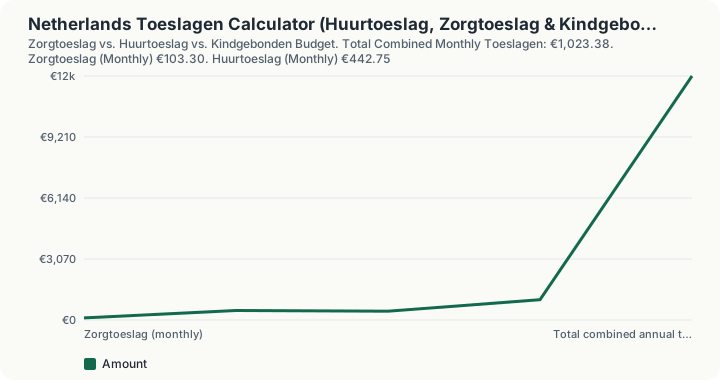
Quick Answer: A single parent in the Netherlands with one child under 12, €32,000.00 in annual household income, €750.00 in monthly rent, and €10,000.00 in assets qualifies for an estimated €105.30 a month in zorgtoeslag, €477.33 a month in kindgebonden budget, and €442.75 a month in huurtoeslag in 2026 -- a combined €1,025.38 a month (€12,304.56 a year) across all three benefits.
Overview
The Netherlands runs several income-tested benefits (toeslagen) through Dienst Toeslagen, part of the Belastingdienst, to offset the cost of healthcare, housing, and raising children for low- and middle-income households. This calculator combines the three most widely claimed toeslagen into a single estimate: zorgtoeslag (healthcare allowance, offsetting part of your mandatory health insurance premium), huurtoeslag (rent allowance, for tenants renting below a certain rent ceiling), and kindgebonden budget (child budget, a means-tested supplement on top of the universal kinderbijslag child benefit).
Each of these three benefits has its own separate eligibility rules, income thresholds, and phase-out formula, and 2026 brought a genuinely significant change to one of them: huurtoeslag was fundamentally reformed. The old system calculated a household-specific "normhuur" (standard contribution) using an opaque set of income-dependent a- and b-factors that few tenants could reconstruct by hand. As of 1 January 2026, that formula was replaced with a much simpler mechanism: every household pays a fixed basishuur (a flat base contribution -- €202.52 for a one-person household, €200.71 for a multi-person household in 2026) regardless of income, and the rest of the rent above that base is subsidized in three tiers (100%, then 65%, then 40%, up to rent ceilings that rise each year), with an additional straightforward linear reduction for income above a reference point. Since 2026, only the bare rent (kale huur) counts -- service costs such as cleaning or building maintenance charges no longer factor into the calculation at all.
Zorgtoeslag and kindgebonden budget both use the same basic shape: a maximum amount available up to a "drempelinkomen" (income threshold), phasing out linearly above it at a fixed percentage per euro of extra income, until it reaches zero at a defined maximum income. For zorgtoeslag, that phase-out rate is 13.73% for 2026. For kindgebonden budget, the phase-out rate (the "afbouwpercentage") is itself being increased gradually as a matter of policy -- from 6.75% in 2024, it rises to 7.60% in 2026, and is scheduled to keep climbing to 8.50% by 2028, meaning the same income now costs you more kindgebonden budget than it did just two years ago.
How This Is Calculated
Zorgtoeslag (2026: standaardpremie €2,119, drempelinkomen €29,736, 13.73% afbouw):
Kindgebonden budget (2026: per-child maximums, single-parent supplement, 7.60% afbouw):
Huurtoeslag (2026 reform: fixed basishuur, three-tier subsidy, linear income correction):
where the three tiers are the portions of your rent (after subtracting the fixed basishuur) falling below the kwaliteitskortingsgrens (€498.20), between it and the aftoppingsgrens (€713.02 for 1-2 person households, €764.14 for 3+), and between the aftoppingsgrens and the maximum rekenhuur (€932.93).
Worked Example
Using the calculator's default inputs: a single parent, one child under 12, €32,000.00 annual household income, €750.00 monthly rent, €10,000.00 in assets.
- Zorgtoeslag: normpremie = (€29,736 × 1.912%) + (€32,000.00 − €29,736) × 13.73% = €568.55 + €310.86 = €879.41; zorgtoeslag = €2,119.00 − €879.41 = €1,239.60/year = €103.30/month.
- Kindgebonden budget: max budget = €2,580.00 (one child under 12) + €3,320.00 (alleenstaande ouderkop) = €5,900.00; reduction = (€32,000.00 − €29,736) × 7.60% = €172.06; KGB = €5,900.00 − €172.06 = €5,727.94/year = €477.33/month.
- Huurtoeslag: rekenhuur = €750.00; single-person basishuur = €202.52; tier 1 (up to €498.20) = €295.68 at 100%; tier 2 (€498.20 to €713.02) = €214.82 at 65%; tier 3 (€713.02 to €750.00) = €36.98 at 40%; gross subsidy = €295.68 + €139.63 + €14.79 = €450.10; income (€32,000) is above the single-household ijkpunt (€23,425), so a small reduction applies, giving a final €442.75/month.
- Total: €103.30 + €477.33 + €442.75 = €1,023.38/month, or €12,280.56/year.
What This Does Not Account For
- Huurtoeslag's exact 2026-indexed inkomensijkpunt. This calculator uses figures (€23,425 single / €31,500 multi-person) drawn from converging secondary sources describing the reformed 2026 formula; the primary legal text confirms the formula's structure (a linear correction above a minimum-inkomensijkpunt) but the exact indexed 2026 amount could not be independently confirmed against a primary Dienst Toeslagen publication during this build. Treat the huurtoeslag figure as the least certain of the three benefits shown here, and confirm against the live Dienst Toeslagen "Proefberekening" before relying on it for a real application.
- Zorgtoeslag's drempelinkomen. The standaardpremie (€2,119) now comes from article 1 of the enacted Regeling vaststelling standaardpremie 2026, and the three percentages from the Wet op de zorgtoeslag itself. The remaining input, the €29,736 drempelinkomen, is expressed in the statute by reference to the wettelijk minimumloon rather than as a number; the figure used here matches the Belastingdienst's official 2026 Cijferbijlage but is corroborated rather than primary-confirmed.
- Kinderopvangtoeslag (childcare allowance) and other toeslagen (such as the AOW-partnertoeslag or specific municipal supplements) are not modeled here at all -- this calculator covers only zorgtoeslag, huurtoeslag, and kindgebonden budget.
- Household composition edge cases. Adult children living at home, kostgangers (lodgers), or a "toeslagpartner" definition that differs from a marriage or registered partnership (e.g., unmarried cohabitants meeting specific joint-household tests) can all change eligibility and amounts in ways this simplified model does not capture.
- Mid-year changes. Toeslagen are paid monthly as advances based on your estimated annual income and are reconciled after the fact; if your actual income differs from your estimate, you may owe money back or receive a top-up. This calculator shows a steady-state annual estimate only.
- The huurtoeslag asset test's exact treatment of a partner's individually-held assets, and other partner-specific allocation rules for the vermogensgrens.
Common Pitfalls
- Estimating income too low and getting a large repayment demand later. Toeslagen are advances against an estimated income; if your actual toetsingsinkomen comes in higher, Dienst Toeslagen will claw back the difference the following year, sometimes long after you've spent the money.
- Forgetting that service costs no longer count in huurtoeslag. Since the 2026 reform, only your bare rent (kale huur) is used in the calculation -- if your rental contract bundles in service costs, make sure you're entering the correct, lower base rent figure.
- Missing the asset (vermogen) test for huurtoeslag. Unlike zorgtoeslag and kindgebonden budget, huurtoeslag has a hard savings/investment ceiling (the vermogensgrens); exceeding it eliminates huurtoeslag entirely regardless of income, even by a small margin.
- Not recognizing that the kindgebonden budget afbouwpercentage keeps rising. Because the phase-out rate is being increased annually by policy (6.75% in 2024 toward 8.50% by 2028), comparing your kindgebonden budget entitlement to a prior year's figure at the same income level will systematically overstate what you'll actually receive now.
- Applying separately for each benefit instead of through Mijn Toeslagen. All three (and more) are managed through the same online portal and reconciled together; treating them as unrelated applications can lead to inconsistent income estimates being submitted for each.
Frequently Asked Questions
Do I need to apply separately for each of these three benefits?
Why did huurtoeslag change so much in 2026?
What happens if my income estimate turns out to be wrong?
Can I get kindgebonden budget without also getting kinderbijslag?
Does having a toeslagpartner always help or hurt my entitlement?
Sources
- Belastingdienst/Dienst Toeslagen, "Toeslagenkaart 2026" -- the annual summary of all key 2026 toeslagen figures. belastingdienst.nl
Also consulted: Regeling vaststelling standaardpremie en bestuursrechtelijke premies 2026, article 1 (Staatscourant 2025, 40022) -- the standaardpremie of €2,119 for berekeningsjaar 2026. Wet op de zorgtoeslag, article 2 lid 3 (consolidated text in force 1 January 2026, wetten.overheid.nl) -- the 1.912% single and 4.289% partner normpercentages and the 13.730% afbouwpercentage. The drempelinkomen of €29,736 is corroborated against the Belastingdienst Cijferbijlage 2026 rather than confirmed from a primary statement of the zorgtoeslag drempel itself; Tweede Kamer wetsvoorstel 36923, "Wijziging van de Wet op het kindgebonden budget... in verband met het verhogen van het afbouwpercentage" -- confirms the 2026 kindgebonden budget afbouwpercentage step to 7.60%; "Wijziging van de Wet verlaging eigen bijdrage huurtoeslag, de Wet op de huurtoeslag en enkele andere wetten ter verbetering van de koopkracht en vereenvoudiging van de regeling" -- the enacted 2026 huurtoeslag reform (primary legal text).