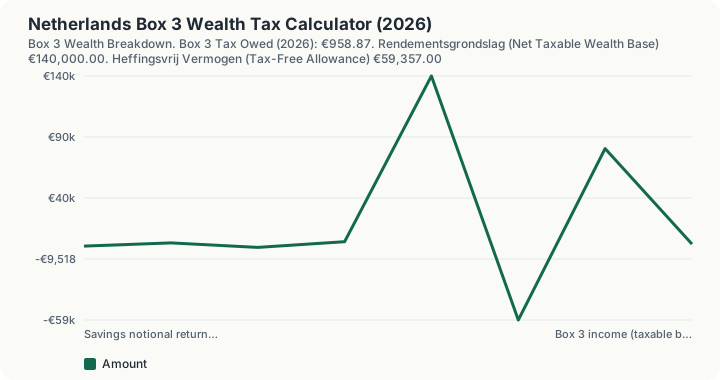
Quick Answer: A Dutch taxpayer with €80,000.00 in savings and €60,000.00 in investments, no debt, and no fiscal partner has a €140,000.00 rendementsgrondslag, a €59,357.00 tax-free allowance, an €80,643.00 taxable base, and owes €958.87 in Box 3 wealth tax for 2026 on €2,663.52 of notional Box 3 income.
Overview
Box 3 is the Dutch income tax box for savings and investments (vermogensrendementsheffing). Unlike most countries, the Netherlands does not simply tax your actual interest, dividends, or capital gains each year. Instead, it taxes a notional (forfaitair) return calculated from the value of your assets on 1 January (the peildatum, or reference date) of the tax year, regardless of what you actually earned.
This calculator is built for the Netherlands' current 2026 Box 3 rules, which are themselves the product of a multi-year legal saga. The old flat-rate system was declared unconstitutional by the Hoge Raad (Dutch Supreme Court) in December 2021 (the "Kerstarrest") because it taxed people on a fictitious return far higher than what many savers actually earned, especially during the low-interest years after 2017. The government responded first with a "rechtsherstel" (legal redress) formula for past years, then with a full "Overbruggingswet box 3" (bridging law) from 2023 onward, which is what remains in force for 2026: three separate notional return rates for savings, investments, and debts, rather than one blended assumption. A further Supreme Court ruling on 6 June 2024 forced the government to also allow taxpayers to be taxed on their actual return instead, if it is lower than the forfaitair outcome (the tegenbewijsregeling, or counter-evidence rule) -- and to apply that right retroactively to 2017. A genuinely new system based purely on actual return is planned but has been delayed repeatedly and is not expected before 2028 at the earliest.
For 2026, the Belastingdienst applies three notional return rates: 1.28% on savings and bank balances (provisional, finalized only in early 2027 once the actual average savings rate for the year is known), 6.00% on investments and other assets (fixed for the year), and 2.70% on debts above a threshold (also provisional). The Box 3 tax rate itself is 36%. Every taxpayer gets a tax-free allowance (heffingsvrij vermogen) of €59,357, doubled to €118,714 for fiscal partners who file together for the full year.
This calculator reproduces the Belastingdienst's own "nieuwe berekening" (new calculation) methodology used since the 2023 bridging law: it computes the notional return separately for each asset category, blends those into a single effective return rate, and applies that rate only to the portion of your wealth that survives the tax-free allowance.
How This Is Calculated
- Assets and deductible debt. Total assets (bezittingen) are your savings plus investments. Debts only count against Box 3 above a threshold -- €3,800 for an individual filer, €7,600 for fiscal partners filing together -- so only the excess is deductible.
- Rendementsgrondslag (net taxable wealth base). Total assets minus deductible debt.
- Notional return per category. Each category is multiplied by its own 2026 rate, and the notional debt return is subtracted:
- Effective blended rate. The total notional return divided by the rendementsgrondslag gives a single effective percentage that reflects your particular mix of savings, investments, and debt.
- Taxable base after the allowance. The heffingsvrij vermogen (€59,357 single / €118,714 partners) is subtracted from the rendementsgrondslag, not from each category separately.
- Box 3 income and tax. The taxable base is multiplied by the effective blended rate from step 4, then taxed at the flat 36% Box 3 rate.
Worked Example
Using the calculator's default inputs: €80,000.00 in savings, €60,000.00 in investments, no debt, filing as an individual.
- Assets total €80,000.00 + €60,000.00 = €140,000.00. No debt, so the rendementsgrondslag is also €140,000.00.
- Notional return: €80,000.00 × 1.28% = €1,024.00 (savings) plus €60,000.00 × 6.00% = €3,600.00 (investments) = €4,624.00 total notional return.
- Effective rate: €4,624.00 ÷ €140,000.00 = 3.30%.
- Taxable base: €140,000.00 − €59,357.00 (single allowance) = €80,643.00.
- Box 3 income: €80,643.00 × 3.30% = €2,663.52.
- Box 3 tax: €2,663.52 × 36% = €958.87.
Because the investment slice (taxed notionally at 6.00%) is a smaller share of this person's total wealth than the savings slice (taxed at only 1.28%), their blended effective rate of 3.30% sits well below the pure 6.00% investment rate -- illustrating why the asset mix, not just the total amount, drives the final bill.
What This Does Not Account For
- The tegenbewijsregeling (actual-return counter-evidence). Since the Hoge Raad's 6 June 2024 rulings, you may elect to be taxed on your actual return for the year instead of the forfaitair outcome, if your actual return was lower -- and this right applies retroactively to 2017. This calculator only computes the standard forfaitair (notional) outcome; if your true investment or savings return was clearly below the notional rates used here, filing on actual return could materially reduce your bill, and a tax adviser or the Belastingdienst's own opgaaf werkelijk rendement tool should be used to compare.
- Provisional 2026 rates. The savings (1.28%) and debt (2.70%) rates are provisional for the whole of 2026 and are only fixed in early 2027 once that year's actual average rates are known; your final assessment may differ slightly from a preliminary assessment (voorlopige aanslag) computed with these figures.
- Asset-category detail. Real Box 3 filings distinguish many sub-categories (a second home, crypto-assets, business-related receivables, life insurance with surrender value, and more), each with specific valuation and reporting quirks. This calculator uses only three buckets: savings, investments/other, and debt.
- A future move to a real actual-return system. The government has repeatedly stated its intention to replace this notional-return bridging law with a system taxing only real income and gains, but that system has slipped repeatedly and is not expected before 2028 at the earliest -- this calculator applies only to the rules currently in force.
- Partner allocation choices. Fiscal partners can freely allocate Box 3 assets and the shared allowance between their two individual returns in whatever split minimizes total tax; this calculator computes the combined household outcome only and does not optimize the allocation between partners.
Common Pitfalls
- Assuming Box 3 taxes what you actually earned. It doesn't -- it taxes a notional return based on your asset mix and the 1 January balance, which can exceed (or, more rarely, fall short of) your real investment performance for the year.
- Forgetting the tegenbewijsregeling exists. Many taxpayers still pay the forfaitair amount by default without realizing they can request an assessment on actual return if it was lower; this is not automatic and must be actively claimed via the "Opgaaf Werkelijk Rendement" form.
- Confusing your own-home mortgage with a Box 3 debt. A mortgage on your primary residence lives in Box 1 (see the companion Mortgage Interest Deduction Calculator on this platform), not Box 3. Only genuinely separate debts -- a personal loan, a second-home mortgage, or a student loan converted to a personal debt -- count here.
- Ignoring the 1 January reference date. Because Box 3 wealth is assessed on a single snapshot date, moving money between accounts or realizing gains just before or after 1 January can materially change your liability -- a detail many people only discover after the fact.
- Not doubling the allowance correctly for partners. Fiscal partners get a combined €118,714 allowance (not €59,357 twice applied to each partner's individual return separately in an uncoordinated way) -- and the assets, debts, and allowance should be allocated together across both partners' returns.
Frequently Asked Questions
Why does the Netherlands tax a "notional" return instead of my actual return?
What if my actual return was lower than the notional rates used here?
Are the 2026 rates final?
Does my own home count in Box 3?
How is the tax-free allowance applied if I have both savings and investments?
Sources
- Belastingdienst, "Hoe is het box 3-inkomen op mijn voorlopige aanslag 2026 berekend?" -- 2026 forfaitaire rendementen (1.28% savings, 6.00% investments, 2.70% debt) and the 36% tax rate. belastingdienst.nl
Also consulted: Belastingdienst, "Heffingsvrij vermogen" -- 2026 tax-free allowance of €59,357 (individual) / €118,714 (fiscal partners); Hoge Raad rulings of 24 December 2021 (Kerstarrest) and 6 June 2024, establishing the constitutional basis for the current bridging-law system and the tegenbewijsregeling; Rijksoverheid.nl, Overbruggingswet box 3 and related legislative summaries on the delayed transition to an actual-return system (targeted no earlier than 2028).