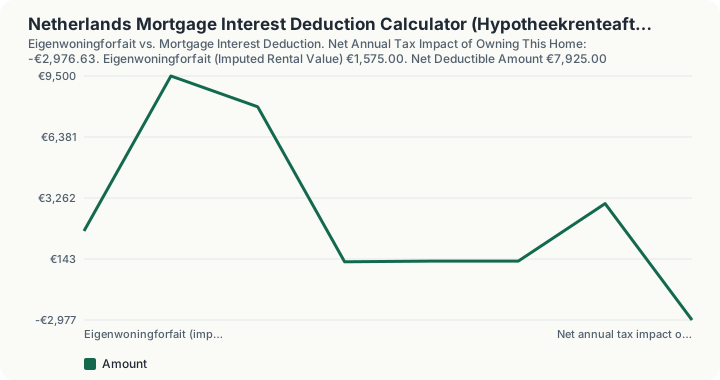
Quick Answer: A Dutch homeowner with a €450,000.00 WOZ-value home, €9,500.00 in annual mortgage interest, and €65,000.00 in other Box 1 income has a €1,575.00 eigenwoningforfait, a €7,925.00 net deductible amount, and saves €2,976.63 a year in tax (about €248.05 a month) from the mortgage interest deduction in 2026.
Overview
The Dutch hypotheekrenteaftrek (mortgage interest deduction) is one of the most consequential tax breaks for Dutch homeowners, but it is not a simple "deduct your interest" rule. It is a net calculation between two opposing entries in Box 1 of your income tax return: the interest you pay on a qualifying eigenwoningschuld (owner-occupied home loan) works against you as taxable income first, in the form of the eigenwoningforfait, an imputed rental value the tax authority adds back to your income simply for living in a home you own.
The eigenwoningforfait exists because homeownership provides a real economic benefit (free housing) that would otherwise go untaxed compared to renting. For 2026, it is set at 0.35% of your home's WOZ-waarde (the municipal property valuation used for local tax purposes) for homes valued between €75,000 and €1,350,000. Above that threshold, a special "villataks" applies: a fixed €4,725 plus 2.35% of the value exceeding €1,350,000, reflecting a long-running policy to tax expensive homes more heavily.
Your actual mortgage interest is then deducted against this imputed income. If your interest exceeds the forfait (the normal situation for anyone still paying down a substantial mortgage), the net difference is a genuine tax deduction, reducing your taxable Box 1 income. If your mortgage is mostly or fully paid off, the forfait can exceed your interest, creating a small net addition to your taxable income instead (a quirk the now-largely-phased-out Wet Hillen used to fully offset, and only partially offsets today).
The size of the tax benefit from a net deduction depends on your marginal Box 1 tax bracket -- but critically, it is capped. Since a series of gradual restrictions enacted from 2014 onward, the maximum rate at which mortgage interest and other owner-occupied-home deductions can be relieved has been ratcheted down year by year, and for 2026 that cap sits at 37.56%. Box 1 income tax for 2026 has three brackets: roughly 35.75% up to €38,883, 37.56% from there to €78,426, and 49.50% above that. Because the cap (37.56%) exactly equals the second bracket's own rate, the restriction only actually bites for taxpayers whose relevant income falls in the 49.50% top bracket -- for everyone else, the cap is already at or above their ordinary marginal rate, so it changes nothing in practice.
How This Is Calculated
- Eigenwoningforfait. Computed from your home's WOZ-value. The 0.35% figure below is the band that covers WOZ values from €75,000 to €1,350,000, which is where almost every Dutch owner-occupied home sits. This calculator applies 0.35% to any WOZ value up to €1,350,000, so results for a home below €75,000 will be slightly overstated (see "What This Does Not Account For").
- Net deductible amount or net addition. Mortgage interest is compared against the forfait.
- Marginal rate and the deduction cap. The rate applied to a net deduction is the lower of your marginal Box 1 rate (on your other income) and 37.56%; a net addition is taxed at your uncapped marginal rate.
- Tax impact.
A negative result is a net tax saving; a positive result is a net tax cost.
Worked Example
Using the calculator's default inputs: a €450,000.00 WOZ-value home, €9,500.00 in annual mortgage interest, and €65,000.00 in other Box 1 income.
- Eigenwoningforfait: €450,000.00 × 0.35% = €1,575.00.
- Net deductible amount: €9,500.00 − €1,575.00 = €7,925.00.
- €65,000.00 in other income falls entirely within the 37.56% bracket (€38,883-€78,426), so the marginal rate here is already 37.56% -- the cap changes nothing.
- Annual tax benefit: €7,925.00 × 37.56% = €2,976.63.
- That works out to roughly €248.05 a month in reduced tax withholding or a larger refund at filing.
For comparison, a homeowner with €150,000.00 in other income (squarely in the 49.50% top bracket) and €20,000.00 in interest against an €800,000.00 home would see their €17,200.00 net deductible amount relieved at only 37.56% (€6,460.32), not the full 49.50% their other income is taxed at (which would have been €8,514.00) -- a direct illustration of the cap actually restricting the benefit for higher earners.
What This Does Not Account For
- The reduced eigenwoningforfait bands for low WOZ values. For 2026 the Belastingdienst applies 0% up to €12,500, 0.10% from €12,500 to €25,000, 0.20% from €25,000 to €50,000, and 0.25% from €50,000 to €75,000, before the 0.35% band begins. This calculator uses 0.35% across the whole range up to €1,350,000, so it overstates the forfait for a home worth less than €75,000. For any normally valued Dutch home the figure shown is correct.
- The 30-year eigenwoningschuld rule. Mortgage interest is only deductible for a maximum of 30 years from when the loan was taken out, and only on debt that qualifies as an eigenwoningschuld (broadly, debt actually used to buy, improve, or maintain your primary residence, on an annuity or linear repayment schedule taken out since 2013). This calculator assumes your interest is fully qualifying.
- Wet Hillen phase-out. Homeowners with little or no remaining mortgage used to receive a full offsetting credit (aftrek wegens geen of geringe eigenwoningschuld) when the forfait exceeded their interest. That credit has been phased down by a fixed percentage each year and is being eliminated entirely by 2049; this calculator applies the plain net-addition rule without modeling the remaining transitional credit.
- Bijleenregeling (the "carry-along" scheme). If you sell a home with positive equity (overwaarde) and buy a new one, you generally must carry that equity forward, reducing the amount of new debt that qualifies for interest deduction. This is not modeled here.
- Financing costs and one-off deductible items. Notarial fees, valuation costs, and mortgage advice fees related to obtaining the loan can sometimes be deducted in the year paid; this calculator only handles ongoing annual interest.
- The rare below-€75,000 WOZ band. Homes with a WOZ-value under €75,000 use a different, lower legacy forfait table not modeled here; this is uncommon in the current Dutch housing market.
Common Pitfalls
- Thinking the deduction is simply "interest times your tax rate." The eigenwoningforfait offsets part of the benefit before your marginal rate is even applied -- only the net figure after that offset is actually deductible.
- Assuming the 37.56% cap always reduces your benefit. It only bites if your relevant marginal rate would otherwise be the 49.50% top bracket; for the two lower brackets, the cap equals or exceeds your ordinary rate and has no additional effect.
- Overlooking the near-paid-off-mortgage flip. As your mortgage balance shrinks, your interest falls while your eigenwoningforfait (based on your home's value, not your debt) typically doesn't -- eventually the forfait can exceed the interest entirely, turning your former deduction into a small net addition to taxable income.
- Forgetting the 30-year clock. Interest on a mortgage taken out before 2013 or held past its 30-year deductibility window may no longer qualify at all, even though it still appears on your annual mortgage statement.
- Not updating the WOZ-value each year. Municipalities reassess WOZ-values annually, and a rising valuation increases your eigenwoningforfait even if your mortgage terms haven't changed.
Frequently Asked Questions
Why does the Netherlands add income back for owning your own home?
Is the 37.56% cap the same every year?
What happens once my mortgage is fully paid off?
Does this apply to a second home or rental property?
Can married couples or fiscal partners both claim the deduction?
Sources
- Belastingdienst, "Hoe werkt eigenwoningforfait?" -- 2026 eigenwoningforfait rate (0.35%) and the villataks formula for WOZ-values above €1,350,000. belastingdienst.nl
Also consulted: Belastingdienst, "Minder aftrek voor uw eigen woning als u een hoog inkomen hebt" (tariefsaanpassing eigen woning) -- confirms the 37.56% maximum 2026 deduction rate; 2026 Belastingplan Box 1 bracket schedule (three tiers: ~35.75% / 37.56% / 49.50%), as reported across multiple converging Dutch tax-advisory summaries.